Gear Decisions12 October 2026
Cat Puzzle Toys: Start With an Easy First Win
Cat puzzle toys can add foraging enrichment without turning meals into a test. Start easy, preserve choice, and watch the whole feeding pattern.
TextPetzette Editorial
Read6 Min
Evidence status
Source-backed editorial
- Evidence record
- 5 claim cards linked to 4 documented sources.
- Independent expert review
- Not commissioned. Petzette Editorial is responsible for the published wording.
- Source record checked
- 14 July 2026
- Scope
- General guidance. Individual animals and circumstances can differ.
Cat puzzle toys can turn part of a cat’s familiar food into a small foraging opportunity. They are not a difficulty contest, a universal boredom cure, or a reason to remove the food bowl on day one. For a new cat, the useful decision is narrower: can this puzzle release food quickly, leave the cat free to walk away, and fit the feeding plan you already have?
This guide is product-neutral. It does not rank puzzle toys or name a winner. It gives you a first-session plan for choosing an appropriate level of challenge, watching the cat in front of you, and knowing when the puzzle should pause. For the wider question of treats and food extras, see our everyday cat-treat guide.
Treat the Puzzle as Optional Enrichment
A 2016 clinical review in the Journal of Feline Medicine and Surgery describes food puzzles as a biologically relevant enrichment option: a cat can work for some food rather than receiving every bite from a bowl. The review also makes the important limits clear. Evidence was still developing, cats differed in preference and skill, and the starting difficulty mattered.
The American Association of Feline Practitioners’ feeding-program consensus likewise describes small meals and gradual puzzle or forage feeding as possible ways to support natural feeding behavior. “Possible” is doing real work here. A food puzzle can be useful without being necessary, and a cat declining one has not failed a test.
Start with the cat’s current routine as the baseline. If your new cat is still settling into the home, keep the first puzzle quiet, optional, and separate from other changes. The new-kitten first-week setup covers the larger room, rest, litter, and routine decisions that make any enrichment easier to read.
Make the First Win Almost Too Easy
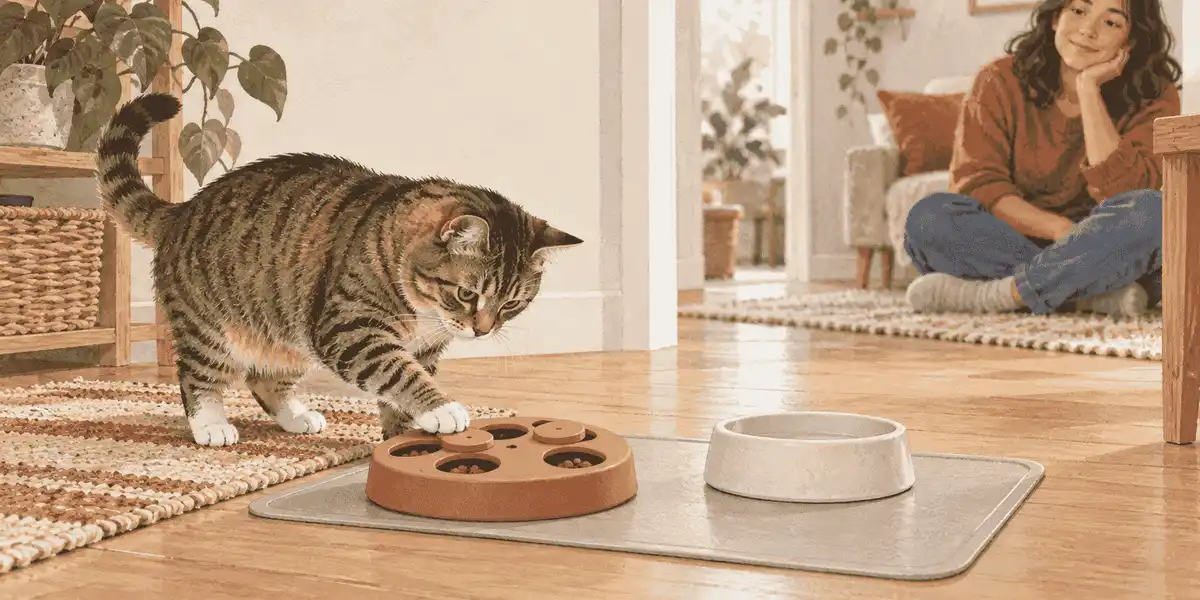
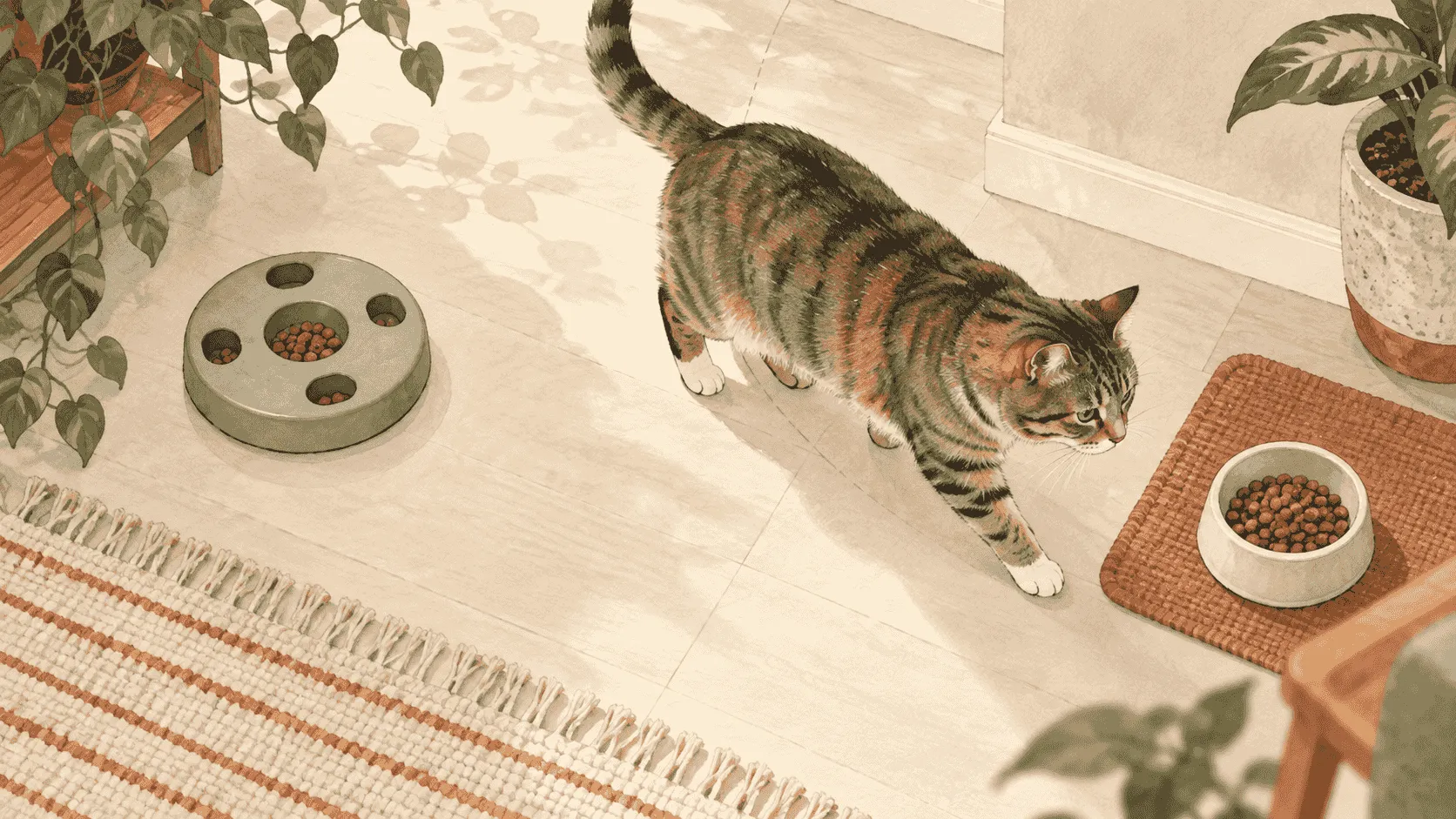
The first puzzle should behave more like an easy food station than a brain teaser. Choose a design with a large, visible opening or an uncomplicated route so the cat can reach the food promptly. Put a small amount of the cat’s usual food in it, then watch without coaxing, tapping, or moving the cat’s paws.
The goal of the first session is not to prove that the puzzle is clever. It is to let the cat learn: approach, nudge or reach, food appears, and leaving remains available. If the cat solves it quickly, that is useful information. You can change one feature later, but only after the current version is familiar and the cat is eating comfortably.
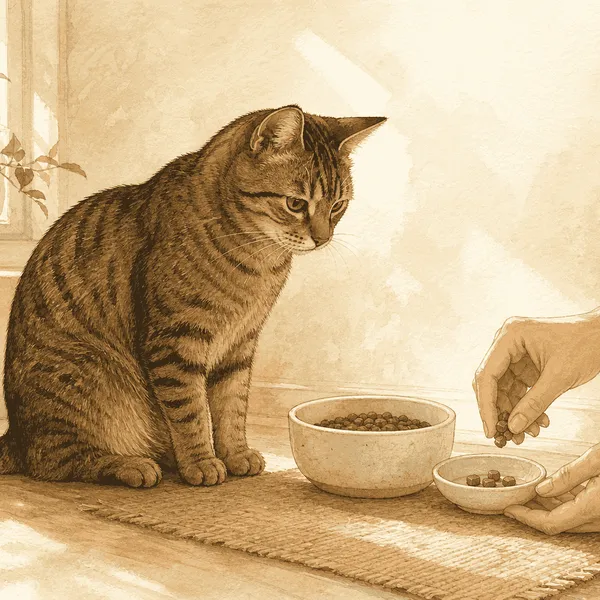
For a cat that seems unsettled by a feeding change, the same clinical review recommends offering the easy puzzle beside the familiar food container with the usual food. Preserve the known route while the new route becomes an option. Do not remove every bowl to force participation, and do not make the opening so difficult that the cat has to paw, bite, or knock the object around in frustration.
Keep the Daily Food Plan Intact
A puzzle changes how some food is offered; it does not automatically change how much food the cat needs. If you use part of a measured daily allowance in the puzzle, keep the rest of the feeding plan visible. Do not add puzzle food on top of the usual meals simply because the activity looks small.
AAHA’s 2021 nutrition and weight-management guidelines place complete and balanced food at the nutritional foundation for generally healthy cats, with treats and other extras kept to a small part of total intake. The exact plan can differ for a growing kitten, a cat on a therapeutic diet, or a cat whose appetite or weight is changing. A printed feeding direction is a starting point, not a prescription for every individual.
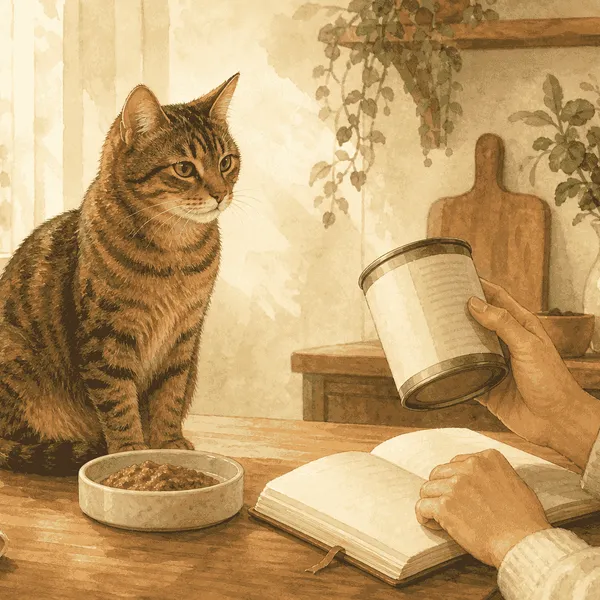
That makes ordinary bookkeeping more useful than a product claim. Note what food went into the puzzle, whether the cat finished the familiar meal, and whether anyone else offered extras. If you are unsure how a puzzle fits a growth diet, medical diet, body condition, or veterinary feeding plan, ask your veterinarian before changing the routine.
Watch Fluency, Not Difficulty
There is no prize for making the puzzle harder. In a good first session, the cat can approach or decline, find food without a prolonged struggle, pause, and return later if they choose. The cat’s body and the whole feeding pattern matter more than whether the toy has multiple compartments or a complicated mechanism.
Pause and simplify if the cat repeatedly bats the puzzle away without eating, becomes increasingly agitated, competes with another cat, or stops using the familiar feeding route. A single puzzled look is not a problem to solve. Repeated frustration or reduced intake is information that the setup is currently asking too much.
Change one thing at a time: the opening, the amount of food, the location, or the timing. Keep a familiar alternative available while you learn what this cat prefers. If the puzzle is noisy, slippery, hard to clean, or difficult to inspect, those practical details can outweigh its advertised level of challenge.
Give Cats Room to Feed Separately
In a multi-cat home, the puzzle is also a resource-and-distance decision. The AAFP consensus notes that feeding stations may need separation and visual privacy; cats eating in the same room are not automatically comfortable with one another. Offer each cat enough space to approach, pause, and leave without being watched or blocked.
Do not turn one puzzle into a shared competition. If one cat guards the object, steals food, or prevents another cat from returning, stop the group experiment and restore separate routes. A quiet puzzle in a private place may be more useful than a more elaborate puzzle in a busy corridor.
Know When the Puzzle Plan Should Pause
A food puzzle is an enrichment tool, not a way to interpret or treat a health change. Pause the experiment and contact your veterinarian if appetite drops, food intake changes meaningfully, weight changes, or eating becomes associated with repeated vomiting, diarrhea, pain, or marked withdrawal. A cat on a prescribed diet should stay within the plan set by the veterinary team.
Possible ingestion is a separate safety question. If a piece of the puzzle is missing, the cat has chewed material, or you cannot account for what may have been swallowed, keep the object and record what happened before calling. Do not rely on the puzzle’s label to decide whether an individual cat is safe.
Your First-Session Checklist
For the next session, keep the decision small:
- Use the cat’s usual food rather than adding an unplanned extra.
- Choose the easiest visible route and place the familiar bowl nearby.
- Watch from a distance; do not force contact or demonstrate with the cat’s paws.
- Stop if the cat walks away, becomes frustrated, competes, or eats less.
- Inspect the puzzle afterward and record what the cat actually did.
If the first attempt is uneventful, repeat the same setup before increasing difficulty. The useful outcome is not a cat that conquers a complicated toy. It is a feeding option the cat can choose, understand, and leave—while the complete diet, normal appetite, and veterinary boundaries stay in view.
Sources
Petzette's claim cards for this article point to the following scientific, veterinary, or animal-welfare sources.
- Cat Food Puzzles JFMS 2016: Peer-reviewed clinical review
- AAFP Consensus Statement On Feline Feeding Programs: Veterinary consensus statement
- AAHA Nutrition And Weight Management Guidelines 2021: Peer-reviewed veterinary clinical guideline
Cline MG, Burns KM, Coe JB, et al. 2021 AAHA Nutrition and Weight Management Guidelines for Dogs and Cats. Journal of the American Animal Hospital Association. 2021;57:153-178.
- AAFCO Pet Food Labels And Nutritional Adequacy: US feed-control association consumer and regulatory guidance