Behavior12 October 2026
Why Do Cats Chase Their Tails? Use a Context Check
Why do cats chase their tails? Learn how to separate occasional play from a repeated or self-biting pattern and when to call your veterinarian.
TextPetzette Editorial
Read5 Min
Evidence status
Source-backed editorial
- Evidence record
- 6 claim cards linked to 5 documented sources.
- Independent expert review
- Not commissioned. Petzette Editorial is responsible for the published wording.
- Source record checked
- 12 October 2026
- Scope
- General guidance. Individual animals and circumstances can differ.
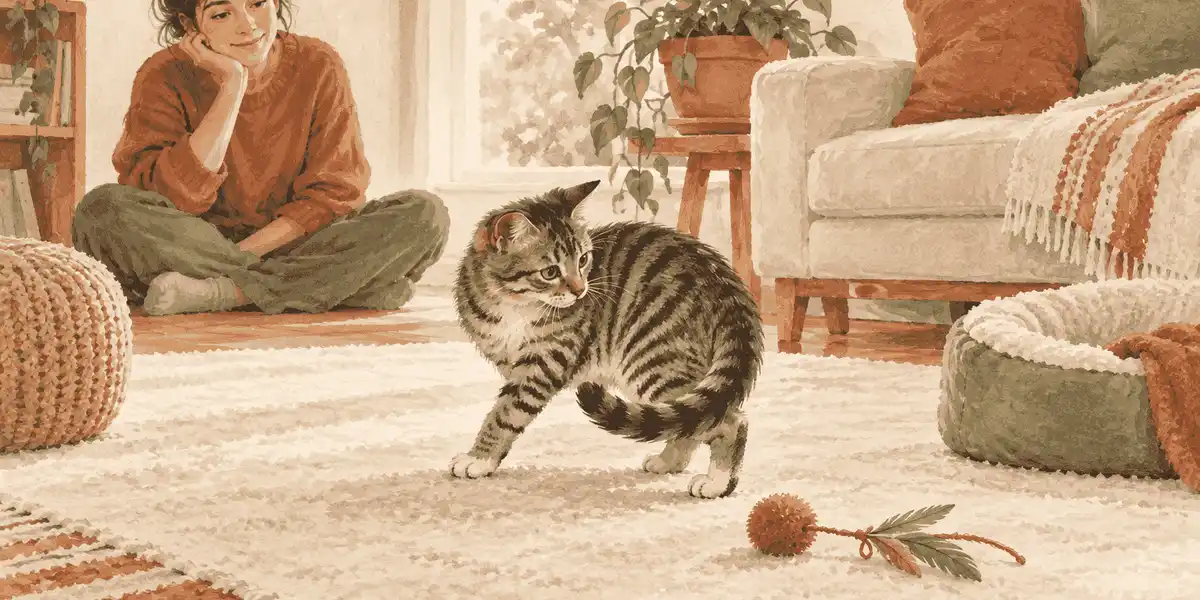
Why do cats chase their tails? Sometimes the movement can fit play, especially in a kitten learning to hunt and play. An adult cat may also chase its tail occasionally. But the spin is a description, not a complete explanation. The useful first-year decision is whether the episode is brief and self-limited or whether the pattern is becoming repeated, intense, self-biting, damaging, or newly different.
This is a narrower question than general cat zoomies or cat body language. The calm first-year zoomies guide covers sudden running and pouncing more broadly. Here, keep your attention on the tail: what happened before it moved, whether the cat could disengage, and what the tail and coat looked like afterward.
Start With the Pattern, Not the Motive
Cats Protection describes some tail chasing as a form of play. Its guidance says the behavior is more common in kittens learning to hunt and play, while adult cats may still do it occasionally. That makes an occasional, short chase compatible with ordinary predatory play—but it does not create a rule for every cat or every episode.
Veterinary behavior guidance adds an important limit. Tail chasing can occur in more than one context, including play and high arousal, and catching and biting the tail can lead to injury. Cornell’s Feline Health Center also notes that some cats with a concerning sensitivity pattern may chase their tails, while emphasizing that other possible causes need evaluation. Those points are reasons to observe carefully, not reasons to diagnose a condition from a video.
Compare the episode with the cat you know:
- Brief and self-limited: The cat chases for a short time, stops without biting, and returns to a familiar activity.
- Repeated or changing: The cat returns to the behavior often, stays engaged for longer, or seems unable to leave the pattern alone.
- Self-injuring or visibly different: The cat catches or bites the tail, or you notice a coat or skin change, other unusual behavior, or a sudden shift from the usual pattern.
These are observation categories, not diagnoses. A cat can look playful and still need help when the behavior is recurring or damaging. A single chase can also be difficult to interpret without the moments around it.
Write Down What Happened Before and After
If you are unsure which pattern you are seeing, make a short record rather than trying to translate the spin. Note:
- Onset: When did you first notice the tail chasing?
- Frequency: How often is it happening compared with the cat’s usual behavior?
- Duration: Does each episode end quickly, or does it keep restarting?
- Before: What was happening just before the chase—play, handling, a household change, another animal, or something else you can describe?
- After: Did the cat settle, walk away, continue chasing, or catch and bite the tail?
- Visible change: Is there a new coat or skin change, or another unusual detail worth reporting?
Use factual wording. “Three short episodes after dinner” is more useful than “my cat is anxious.” “The cat caught the tail and bit it” is more useful than “the cat has a compulsive disorder.” If a safe, brief video happens naturally, it may help your veterinarian see the movement. Do not corner the cat, touch the tail, or provoke another chase to complete your record.
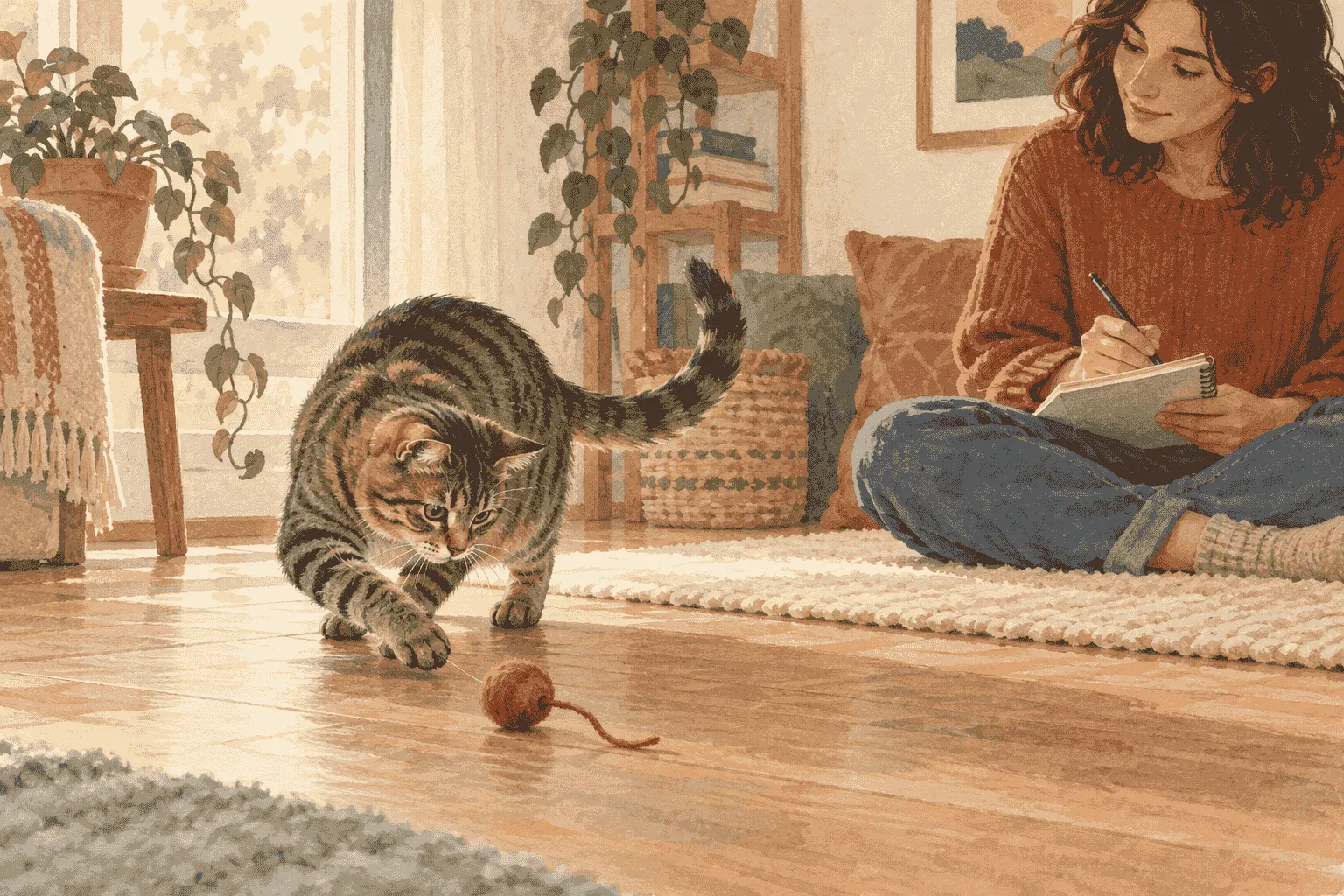
The whole-cat body-language check can help you restore the wider scene: posture, movement, distance, route away, and what changed around the behavior. Keep the tail chase as one observation inside that scene, not as a shortcut to the cat’s emotional or medical state.
If It Looks Playful, Offer a Safer Chase
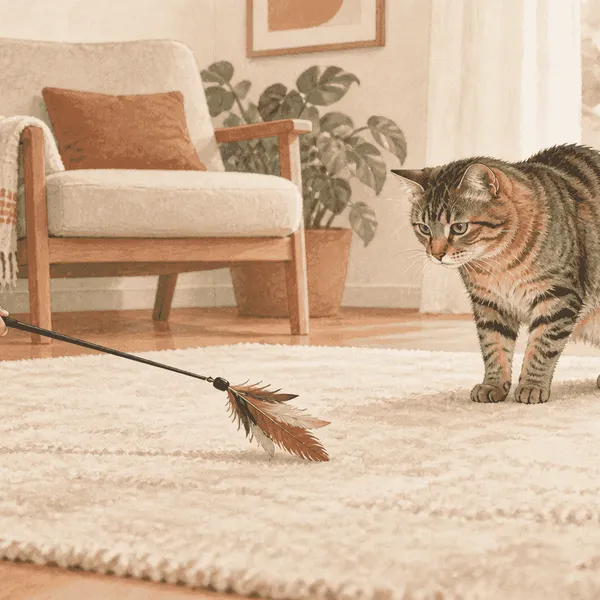
Cats need opportunities for play and predatory behavior, including a chance to chase and catch an appropriate target. If the cat is settled and interested in play, offer an intact toy that can move away from the body and can eventually be caught. A wand-style toy, a small chase toy, or another safe option can keep the target away from hands and feet.
Do not grab the tail, hold the cat in place, or use punishment to stop the movement. Those responses can add pressure and still do not tell you why the behavior occurred. Keep your hands out of the predatory target; Cornell’s play guidance supports using toys at a distance rather than teaching a cat that fingers or feet are part of the game.
Let the cat choose the length of the interaction. If the cat walks away, the play session is over. Lower the toy, stop pursuing, and leave room for the cat to reinitiate later. A calmer routine and more varied, cat-led play can be supportive, but enrichment is not a treatment and it does not clear a repeated or self-injuring pattern.
If the cat is already biting the tail or looks distressed, skip the home experiment and move to the professional-help boundary. The cat grooming guide explains why a coat or skin change is an observation to report rather than a diagnosis to solve from the body area.
When Tail Chasing Becomes a Veterinarian Question
Contact your veterinarian when tail chasing is regular, intense, self-biting, visibly damaging, newly changed, or paired with other unusual signs. A veterinary assessment matters because the same outward movement can sit beside different physical, behavioral, or environmental contributors. An article cannot sort those possibilities from a short description.
Ask for prompt direction if the cat is actively injuring the tail, if you can see a wound or marked coat or skin change, or if the behavior is sudden and severe. Keep the record, any naturally captured short video, and a note about what happened before and after. Do not apply a product, give medication, restrain the cat to inspect a painful-looking area, or wait for the behavior to become more dramatic before asking for help.
The practical decision is therefore simple but conditional:
- Occasional and self-limited: observe the whole scene and offer a safe chase-and-catch option if the cat wants to play.
- Repeated or newly changed: keep a neutral log and contact your veterinarian for an individual assessment.
- Self-biting, damaging, or severe: protect distance, avoid handling the tail, and seek prompt professional guidance.
The tail may be the moving object that caught your cat’s eye. It is not a reliable label for boredom, anxiety, pain, or a compulsive disorder. Describe the pattern, keep play low-pressure, and let the next action follow the cat in front of you.
Sources
Petzette's claim cards for this article point to the following scientific, veterinary, or animal-welfare sources.
- Cat Tail Chasing: Play, Pattern, And Veterinary Boundary: Veterinary behavior and welfare guidance synthesis. Supports a narrow owner decision about how to read occasional versus recurring or self-biting tail chasing in cats. It is not a diagnosis, a behavior-treatment plan, a boredom test, or a medication guide.
- AAFP/ISFM Feline Environmental Needs Guidelines 2013: Peer-reviewed veterinary guidelines plus client-facing practice resource
- Cornell Cat Destructive Behavior, Play, And Scratching: Veterinary school feline behavior guidance
- Cornell Cat Play Aggression: Veterinary school feline behavior guidance
- Cat Friendly Homes: Play Ends With The Cat's Choice: Veterinary-association caregiver guidance