Behavior23 October 2026
Dog Daycare for Socialization: A Safer First-Year Check
Dog daycare socialization is not automatic. Check your dog's fit, provider supervision and rest plan, and when your veterinarian should guide the choice.
TextPetzette Editorial
Read6 Min

Evidence status
Source-backed editorial
- Evidence record
- 6 claim cards linked to 5 documented sources.
- Independent expert review
- Not commissioned. Petzette Editorial is responsible for the published wording.
- Source record checked
- 23 October 2026
- Scope
- General guidance. Individual animals and circumstances can differ.
Dog daycare socialization is not a matter of finding the busiest room and hoping your dog learns to love it. Daycare can be one carefully chosen care setting, but the useful decision is whether this dog can stay comfortable there and whether the provider can manage contact, rest, and a safe exit.
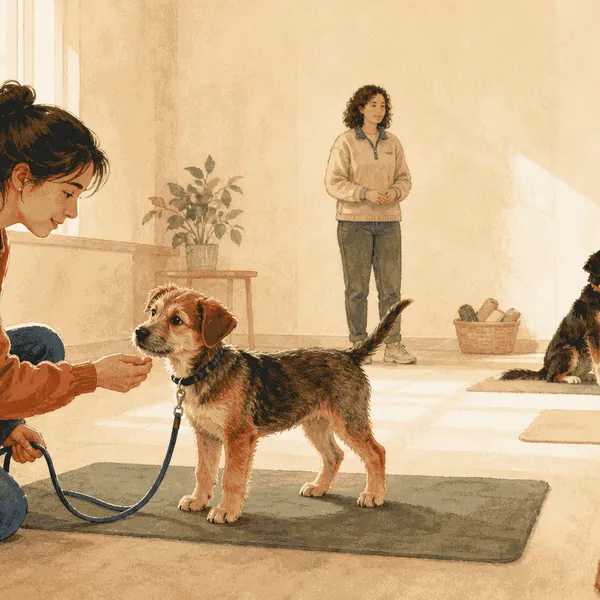
This is different from choosing a small, structured socialization class. A class usually teaches a planned skill with a handler present. Daycare is a longer care environment with group movement, transitions, rest periods, staff decisions, and other dogs arriving and leaving. If you are deciding between them, compare the actual job each setting needs to do.
Daycare is a care setting, not a socialization shortcut
Socialization means helping a dog become more comfortable with people, animals, places, sounds, handling, and ordinary changes through experiences that stay manageable. The American Veterinary Society of Animal Behavior describes graded exposure and attention to the individual puppy’s responses, not a rule that more contact is always better.
Blue Cross makes the same distinction in its doggy daycare guidance: daycare may suit some dogs, but not every dog will enjoy it, and daycare should not replace socializing a puppy with its owner. A new dog still needs calm experiences with you—watching a quiet street, meeting a suitable person, practicing handling, settling at home, and learning how to leave an uncomfortable situation.
The first question is therefore not “Will daycare socialize my dog?” It is “What would my dog need from this setting today?” A young, shy, easily overwhelmed, older, or health-compromised dog may need a quieter arrangement, shorter care, or a different kind of support. A confident dog may still need breaks, careful introductions, and a group that is not too intense.
Check the dog’s fit before judging the facility
Start with information about the individual dog rather than a label such as “friendly.” Note what happens around unfamiliar dogs, busy rooms, handling, food, toys, gates, transport, and rest. A dog that plays in one familiar garden may respond differently in a new building with unfamiliar dogs and people.
Blue Cross recommends considering age, personality, behavior, and health before using daycare. That does not mean diagnosing your dog from a single moment. It means telling the provider what you have observed and asking whether the environment can be adjusted around it.
RSPCA guidance for choosing daycare in England gives a useful welfare boundary: a dog should be assessed before attendance, and the provider should monitor behavior, social interactions, and the environment. It also describes access to a toilet area and a safe space where a dog can avoid people or other dogs if needed. Those are practical questions anywhere, even though licensing rules vary by country and local authority.
Ask whether the provider can answer these questions clearly:
- How do you assess a dog before the first day, and what would make you decline or delay enrollment?
- How are dogs grouped, introduced, and separated when the play becomes one-sided or too intense?
- Can a dog choose a quiet area or take a break without being pulled back into the group?
- How many trained staff supervise each group, and who has authority to intervene?
- How do you manage food, toys, gates, arrivals, departures, toileting, and rest?
- What is the emergency plan, which veterinarian would be contacted, and how would you tell me what happened?
- What local licensing, health, vaccination, or disease-prevention requirements apply, and what should I confirm with my veterinarian?
The answers matter more than a promise that the dogs “all love to play.” A welfare-minded provider should be able to describe what happens when a dog does not want to play.
Look for managed contact and real rest
A responsible daycare is not just a room where dogs are released together. Blue Cross advises owners to ask about staff training, supervision, breaks, intervention, licensing, and emergencies. Its guidance also says that shy dogs should be protected from more boisterous dogs and that play between young dogs should be managed so it does not become overwhelming.
That gives you a simple observation plan. Look for staff who watch the whole group rather than chatting while dogs make all the decisions. Look for clear routes away from the action, a quiet place to unwind, and a willingness to interrupt play before a dog has to defend itself. Check whether rest is part of the schedule rather than something offered only after a dog is exhausted.
Read your dog’s whole body and the situation. Turning away, freezing, repeatedly hiding, scanning, trying to leave, or becoming unable to respond may tell you that the current setup is too difficult, but no single signal diagnoses fear, pain, or aggression. Offer space and record what changed. A dog that can reorient, rest, and choose whether to return gives you different information from a dog that remains trapped in the group.

Treat the first visit as information, not a test
Do not use a trial visit to prove that your dog can tolerate anything. Ask what the provider observes, how long the first stay lasts, and what would make them stop or call you. Keep the veterinary plan and local disease-risk advice in view, especially for a puppy whose protection is still developing.
If the provider says your dog must keep playing, cannot access a quiet space, or should ignore repeated attempts to leave, pause the decision. Do not force greetings, add a bigger group to “build confidence,” or assume that tired means socially comfortable. A calmer home routine, a one-to-one caregiver, a quiet walker, or a structured class may be a better next step.
For the separate question of a planned learning environment, use the safe first-year dog socialization class checklist. For the wider new-dog routine, the first 30 days with a new puppy guide keeps socialization alongside sleep, gentle training, alone-time practice, and veterinary care.
Keep owner-led socialization in the plan
Daycare cannot teach your dog how to handle every setting. Continue small, positive experiences that you can observe and adjust: a calm person at home, a new surface, a short car ride, quiet handling, watching another dog from a distance, or settling while ordinary household sounds happen.
Change one variable at a time. If a puppy can rest near two calm dogs, that does not automatically mean a busy group, a dog park, or a full day of daycare is the next safe step. The dog body-language pause map can help you record the whole scene without turning one posture or wag into a fixed story.
If your dog repeatedly panics, cannot recover after contact, guards food or toys, shows escalating fear or aggression, has a bite incident, or seems suddenly different, ask your veterinarian about the change and seek qualified behavior support. A veterinarian can help consider health context; a qualified behavior professional can help design an individualized plan. This article cannot decide that a particular dog is safe for group care.
Your next step is practical: visit or interview the provider before enrolling, ask how they assess dogs and protect rest, and describe your dog’s actual responses rather than a personality label. Daycare may be a useful fit for some dogs. It is a good decision only when the setting can make room for this dog to pause, opt out, and learn at a manageable pace.
Sources
Petzette's claim cards for this article point to the following scientific, veterinary, or animal-welfare sources.
- Blue Cross Doggy Daycare Choice: Established animal-welfare charity guidance on doggy daycare fit and provider questions
- RSPCA Dog Daycare Welfare And Selection: Established animal-welfare guidance on dog daycare welfare and provider selection
- AVSAB Puppy Socialization Position Statement: Veterinary behavior society position statement
- Blue Cross Puppy Exercise And Socialisation: Animal welfare charity guidance / puppy exercise and socialisation advice
- Dogs Trust Body Language Context Guidance: Welfare organization dog body-language guidance