Nutrition02 September 2026
Homemade Cat Treats: A Simple Safety Check
Homemade cat treats can stay simple: choose plain ingredients, protect the complete diet, and know when a veterinarian should guide the plan.
TextPetzette Editorial
Read4 Min
Evidence status
Source-backed editorial
- Evidence record
- 6 claim cards linked to 4 documented sources.
- Independent expert review
- Not commissioned. Petzette Editorial is responsible for the published wording.
- Source record checked
- 06 August 2026
- Scope
- General information, not an individual diagnosis or treatment plan.
Homemade cat treats can stay simple, but “homemade” is not a safety verdict. If your cat can have extras, start with one plain, thoroughly cooked, boneless ingredient or a small plain piece from a veterinary-named fruit list. Keep complete cat food as the foundation. The decision is whether one small extra fits this cat’s feeding plan—not whether a kitchen ingredient sounds wholesome.
Start With the Whole Feeding Plan
Cats Protection guidance separates a cat’s balanced everyday diet from occasional human-food extras. A small amount of plain, thoroughly cooked, boneless chicken or fish may fit an individual cat’s daily allowance, but it is not a complete long-term diet. Treat the homemade bite as an extra, not a second dinner.
A 2021 American Animal Hospital Association nutrition guideline gives the same useful frame: for generally healthy pets, complete and balanced food should provide at least 90 percent of calories, leaving treats and other extras at 10 percent or less. That is a ceiling for a general situation, not a universal target. A kitten, a cat on a therapeutic diet, or a cat with food reactions, digestive signs, appetite change, or weight concerns needs an individual plan from a veterinarian.
If the cat is still growing, keep the life-stage decision separate from the treat decision. Our kitten-food label checklist explains why a complete growth diet matters; this page is only about an occasional extra.
Choose a Bounded Homemade Option
For a cat who can have food extras, there are two evidence-bounded starting points:
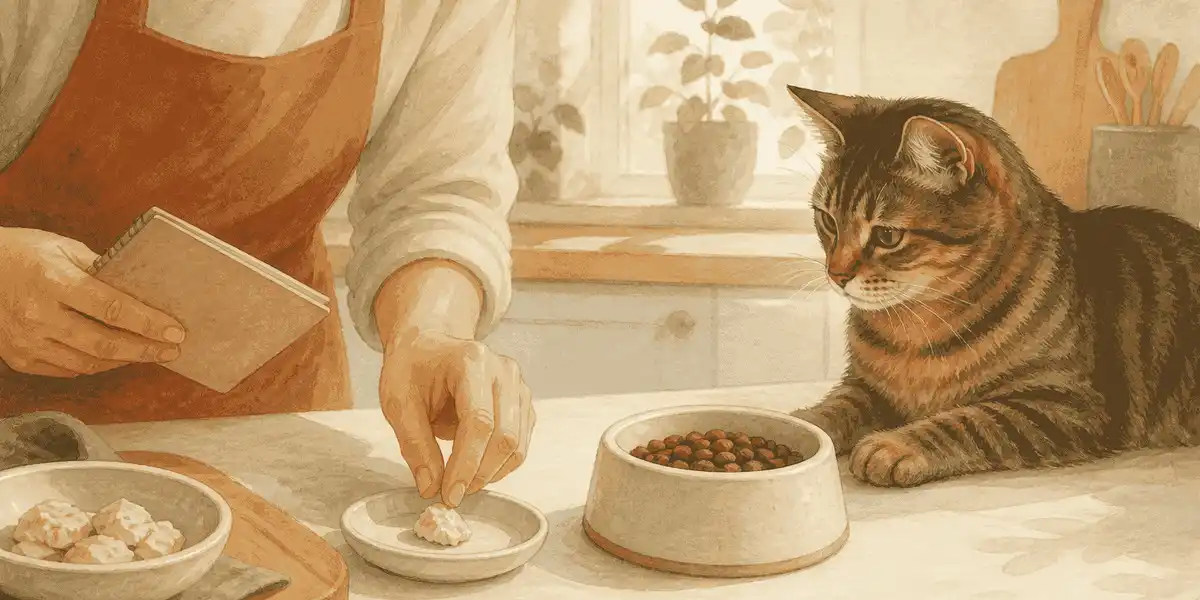
- Plain cooked meat or fish: use a small amount that is thoroughly cooked and boneless. Leave out seasoning, sauce, skin, and fat trimmings. Cats Protection presents this as an occasional extra, not a daily food or a complete diet.
- A source-named fruit piece: VCA’s cat-specific guidance names apple, blueberry, strawberry, raspberry, and seedless watermelon as examples that may work as occasional treats for some cats. Keep the piece plain and unseasoned.
The VCA list is a bounded example set, not a fruit whitelist. It does not tell you that an unlisted fruit, a smoothie, dried fruit, or a fruit-flavored product fits your cat. A cat’s lack of interest also does not need fixing; leave an unfamiliar option off the menu when the preparation or individual fit is unclear.
This is where a homemade treat differs from a general treat-aisle decision. The everyday cat-treat guide covers labels, extras, and enrichment. Here, the useful check is the ingredient and how it was prepared.
Keep the Preparation Plain
Use this short kitchen check before offering anything:
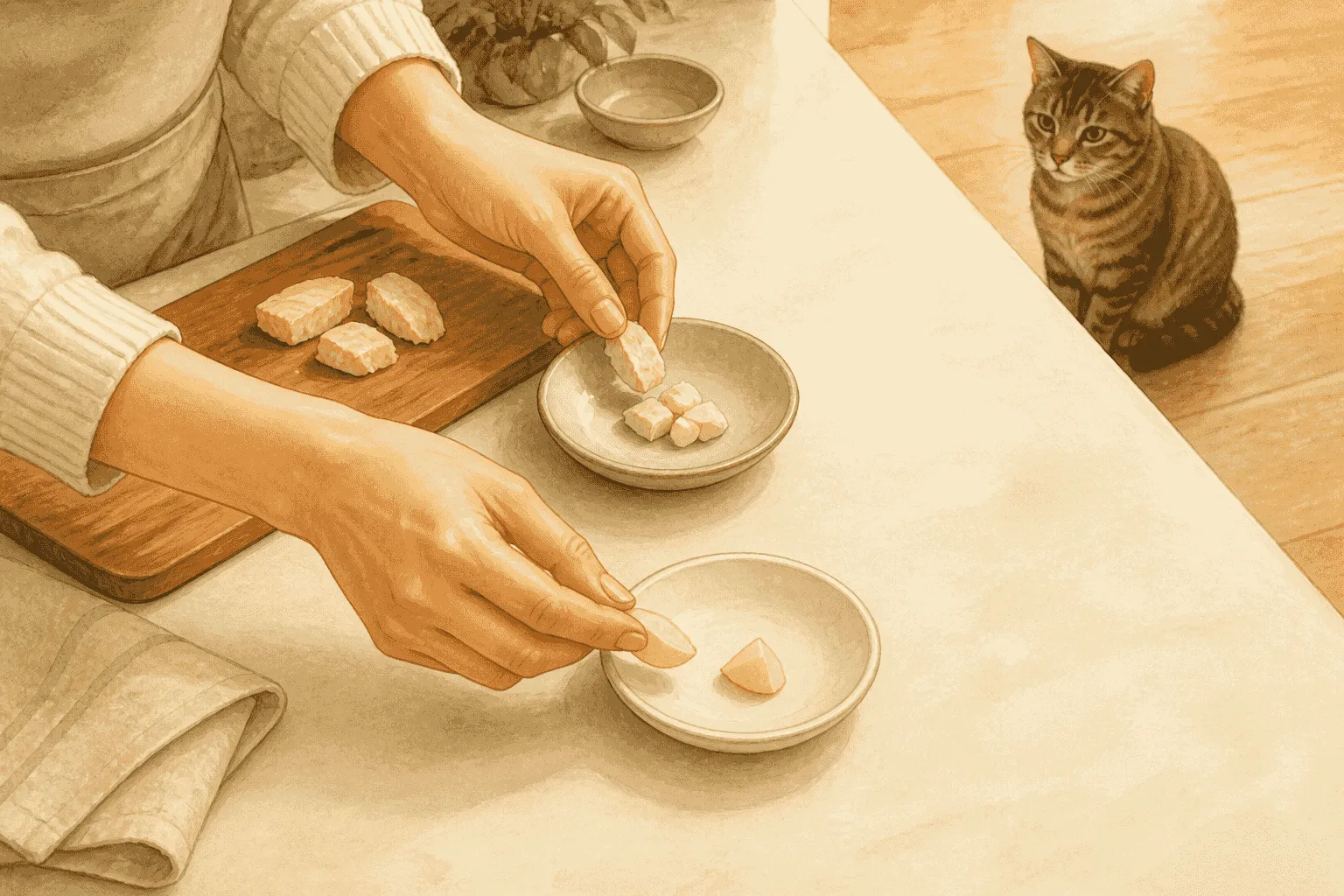
- For meat or fish: cook it thoroughly, remove every bone, and keep it plain. Raw supermarket meat, fish, eggs, and raw bones are not routine cat treats; Cats Protection notes contamination, choking, and obstruction concerns.
- For fruit: wash it and remove thick peel, skin, rind, stem, seeds, pits, and core material as applicable. Preparation lowers some avoidable hazards, but it does not make every fruit or every remaining piece suitable.
- For all extras: check the whole ingredient list. Do not add onion, garlic, chocolate, coffee, or other caffeine-containing ingredients. Do not assume a tiny piece of a mixed dish has the same boundaries as a plain ingredient.
If you cannot identify the ingredient or prepare it with confidence, skip the treat. “Natural,” “fresh,” and “homemade” describe a process or impression; they do not establish nutritional completeness or individual suitability.
Do Not Turn a Treat Into a Homemade Diet
The 2021 AAHA guideline warns that many published home-prepared recipes are not complete and balanced. A snack can remain occasional without carrying the nutritional work of the cat’s everyday food. If you are considering a home-prepared diet rather than a small extra, ask your veterinarian about a recipe formulated by a board-certified veterinary nutritionist and follow that plan exactly.
That boundary matters especially for a kitten or a cat whose food is already doing a specific medical job. Repeatedly swapping ingredients, adding supplements, or replacing meals because a homemade option feels more transparent can make the feeding plan harder to assess.
When the Treat Question Becomes a Veterinary Call
Pause the kitchen experiment and ask your veterinarian before introducing an extra when the cat has a therapeutic diet, known food reaction, ongoing digestive changes, reduced appetite, or another health concern. If a cat may have eaten an unsafe or uncertain ingredient, keep the package, recipe, possible amount, and time available and contact a veterinarian or animal poison-control service promptly. Do not induce vomiting or give medication unless a professional directs it.
The practical decision is small: choose one plain, source-bounded option only when extras fit the cat’s plan, count it with the day’s other food, and stop when the preparation or individual context is uncertain. If this is sudden or severe, ask your veterinarian promptly. Homemade cat treats work best as a modest extra—not a promise that the kitchen can answer every feeding question.
Sources
Petzette's claim cards for this article point to the following scientific, veterinary, or animal-welfare sources.
- Cats Protection Cats And Human Foods Guidance: Current cat-welfare feeding and household-food safety guidance
- VCA Cat Fruit and Training-Treat Guidance: Current veterinary nutrition and training guidance from a veterinary hospital network, including a cat-specific article authored by credentialed nutrition professionals
- Hunt R, RVT, VTS (Nutrition), and Wilson S, BScH, DVM, DACVIM (Nutrition). “Using Food and Treats for Training Cats.” VCA Animal Hospitals / LifeLearn Animal Health, last updated 2026-05-22.
- AVMA Pet First Aid: Poison Response Boundary: Veterinary-association first-aid brochure
- AAHA Nutrition And Weight Management Guidelines 2021: Peer-reviewed veterinary clinical guideline
Cline MG, Burns KM, Coe JB, et al. 2021 AAHA Nutrition and Weight Management Guidelines for Dogs and Cats. Journal of the American Animal Hospital Association. 2021;57:153-178.