Nutrition07 October 2026
Is THC Toxic to Dogs? What to Do After Possible Exposure
Is THC toxic to dogs? Learn why possible cannabis exposure needs prompt veterinary help, which signs to record, and why a home urine test cannot clear it.
TextPetzette Editorial
Read4 Min

Evidence status
Source-backed editorial
- Evidence record
- 5 claim cards linked to 4 documented sources.
- Independent expert review
- Not commissioned. Petzette Editorial is responsible for the published wording.
- Source record checked
- 04 August 2026
- Scope
- General information, not an individual diagnosis or treatment plan.
Is THC toxic to dogs? A possible cannabis or THC exposure is a professional-call situation, not a home diagnosis. If your dog may have eaten cannabis or a cannabis-containing product, contact your veterinarian, an emergency animal hospital, or an animal poison-control service right away. Keep the product packaging available if you can do so safely.
That advice does not depend on waiting for a symptom. It also does not mean that every unsteady or sleepy dog has THC exposure. The useful decision is to report the possible access and the dog’s actual pattern, then let a veterinary professional assess the product, route, amount, timing, and animal together.
First, separate the exposure questions
“THC” may refer to plant material, an edible, a concentrate, a discarded product, or packaging that still carries another ingredient. Those are not interchangeable exposure records. A label can help identify what the dog may have reached, but it does not give you a safe amount or a home-treatment plan.
The U.S. Food and Drug Administration lists marijuana among potentially dangerous household items for pets and advises prompt veterinary or poison-control contact after possible ingestion. The FDA also says it has not approved cannabis for any use in animals and cannot ensure the safety or effectiveness of products marketed as animal-health products. A pet-facing label is therefore not a reason to start a product, change a veterinary plan, or treat an exposure as harmless.
For prevention, store cannabis plant material, edibles, concentrates, and related packaging in a closed place your dog cannot access. Include guest belongings and discarded products in that check. Storage lowers opportunity; it does not clear an exposure that may already have happened.
Which signs should you record?
A 2024 paper in the Journal of the American Veterinary Medical Association reviewed 223 selected canine cases from January 2017 through July 2021. In that clinical cohort, reported signs included ataxia (unsteady movement), unusual sensitivity to touch, lethargy, urinary incontinence, and vomiting. Cornell University College of Veterinary Medicine also describes a varied pattern in dogs with possible THC exposure.
That list is not a THC test. Unsteadiness, sleepiness, disorientation, vomiting, drooling, urinary leakage, or unusual sensitivity can have several causes. The study was a retrospective clinical cohort of dogs selected because ingestion was known or a human urine test was positive; it was not a population sample or a diagnostic-accuracy study. Its percentages cannot predict what will happen to your dog.
Record what you can observe without trying to provoke another sign:
- what the dog may have reached, including the product name or packaging;
- whether the route was eating, licking, chewing, or uncertain;
- the possible time and amount, using “unknown” rather than a confident guess;
- changes in movement, alertness, sensitivity, urination, vomiting, drooling, or coordination; and
- the dog’s age, approximate weight, existing conditions, medicines, and current behavior.
If a short, naturally occurring video is safe to make, it may help the veterinary team understand movement or alertness. Do not delay the call while trying to make a perfect record, and do not use a sign list to decide that another emergency is impossible.
Why the next call matters
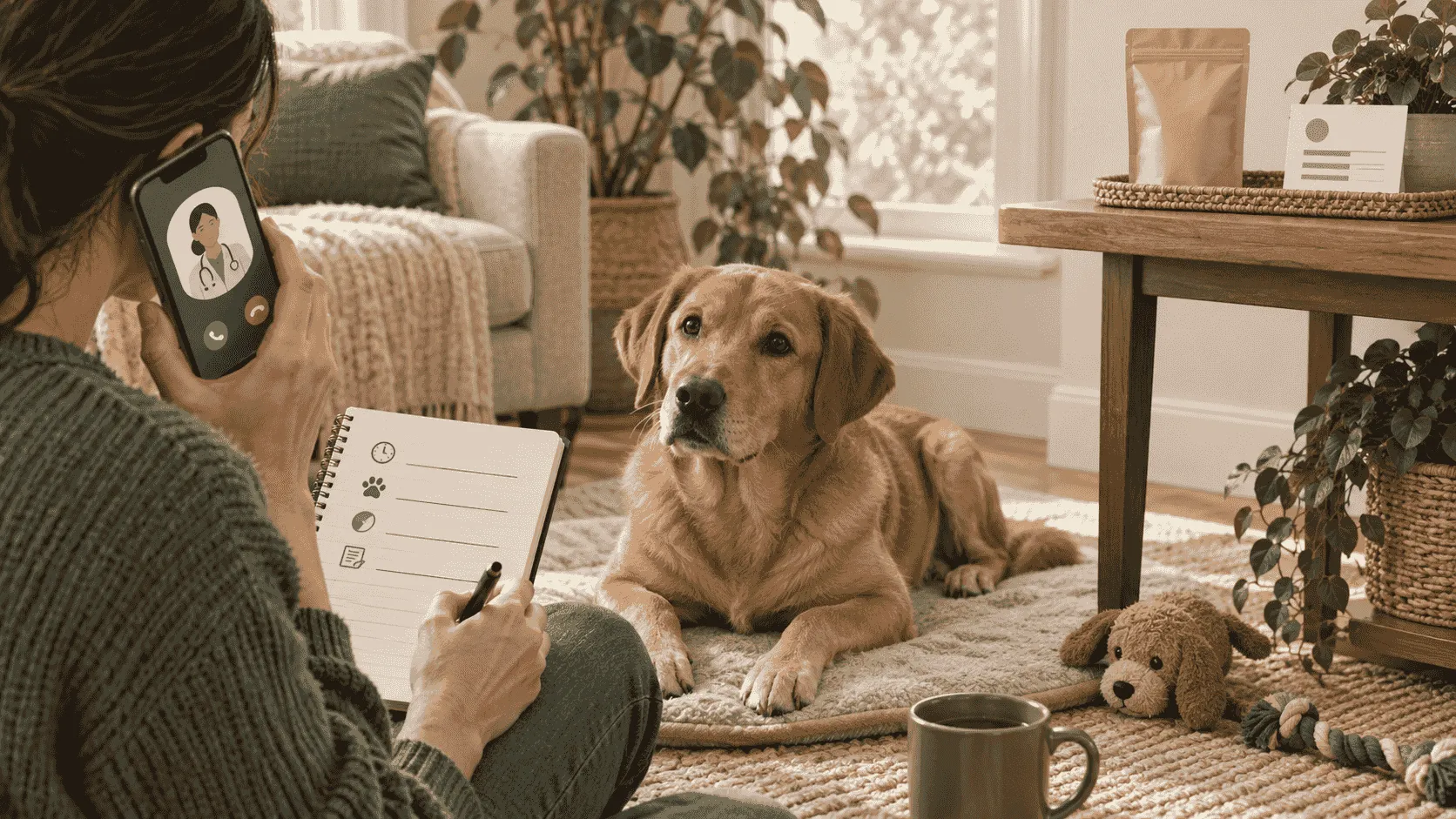
Cornell’s canine health guidance directs caregivers to contact a veterinarian, emergency hospital, or animal poison-control service after suspected dog exposure. The FDA gives the same prompt-contact boundary for a pet that may have ingested cannabis or a cannabis-containing substance.
The professional needs the exposure history even when the cause is uncertain. Say what is known—“a package may be open,” “a piece may be missing,” or “the timing is unknown”—and keep the packaging or a clear label photo available. Product type, possible amount, timing, and other ingredients can change the assessment. A dog that looks comfortable at one moment has not thereby been cleared.
Do not make the dog vomit, give charcoal, give a household remedy, or calculate a waiting period from an online amount. The approved evidence does not provide a home dose or decontamination protocol. It supports prompt professional direction.
A negative human urine test does not clear a dog
One tempting shortcut is to use a human at-home urine drug screen. A 2009 comparative canine study evaluated a human on-site urine multidrug test alongside the study’s laboratory gas-chromatography/mass-spectrometry work. For marijuana exposure in the dogs studied, those approaches were not effective identifiers.
That finding has a narrow meaning. It does not say that every current veterinary assay is unreliable, and it does not make veterinary testing pointless. It means a caregiver should not use a human screen to clear a dog, confirm the cause, choose home treatment, or delay a call. Share the possible exposure, product information, and observed pattern with the professional who can decide what assessment is appropriate.
Keep the prevention plan practical
The simplest household check is a closed-storage walk-through before a new dog arrives and whenever cannabis products enter the home. Include handbags, coat pockets, visitors’ belongings, bins, and low surfaces where a discarded item could be found. Keep the original package rather than transferring an edible or concentrate into an unlabeled container.
For a broader product-label boundary, the dog calming-treat guide explains why a CBD or “calming” label cannot establish an individual dog’s safety or solve a behavior question. For other household food hazards, use the dog-food hazard checklist instead of trying to build a universal list from memory.
The practical answer to “is THC toxic to dogs?” is not a dose or a symptom test. A possible exposure needs prompt professional contact; sudden changes need assessment rather than a home label; and a human urine screen cannot clear the dog. Secure the products, keep the packaging, record the facts you can observe, and call.
Sources
Petzette's claim cards for this article point to the following scientific, veterinary, or animal-welfare sources.
- Dog THC Toxicosis: 223-Case Retrospective Clinical Findings: Peer-reviewed retrospective veterinary clinical study
- Binagia, E. M., Gregory, E. A., and Yankin, I. Clinical examination findings and electrolyte abnormalities of dogs with marijuana/tetrahydrocannabinol toxicity: 223 cases (January 2017-July 2021). Journal of the American Veterinary Medical Association. 2024;262(8):1047-1054. doi:10.2460/javma.24.02.0092. PubMed PMID:38608656. Directly reviewed 2026-08-04.
- Cornell Canine THC Exposure: Prevention, Information, and Test Limits: Veterinary-school canine health education
- Cohen, A. Cannabis (THC) intoxication in dogs. Cornell University College of Veterinary Medicine, Riney Canine Health Center. Updated 2025-12-22; directly reviewed 2026-08-04.
- FDA Cannabis Products for Pets: Approval Boundary and Prompt Referral: U.S. government animal-health and consumer-safety guidance
- U.S. Food and Drug Administration. FDA Regulation of Cannabis and Cannabis-Derived Products, Including Cannabidiol (CBD), pets and other animals section. Directly reviewed 2026-08-04.
- Human On-Site Urine Screens: Canine Marijuana Test Limitation: Peer-reviewed comparative veterinary diagnostic-screening study
- Teitler, J. B. Evaluation of a human on-site urine multidrug test for emergency use with dogs. Journal of the American Animal Hospital Association. 2009;45(2):59-66. doi:10.5326/0450059. PubMed PMID:19258416. Directly reviewed 2026-08-04.