Nutrition06 October 2026
What Foods Are Toxic to Cats? A Label-and-Call Checklist
What foods are toxic to cats? Keep four household hazards out of reach, save the label after possible exposure, and call a veterinarian.
TextPetzette Editorial
Read5 Min
Evidence status
Source-backed editorial
- Evidence record
- 5 claim cards linked to 5 documented sources.
- Independent expert review
- Not commissioned. Petzette Editorial is responsible for the published wording.
- Source record checked
- 17 August 2026
- Scope
- General information, not an individual diagnosis or treatment plan.
What foods are toxic to cats? Start with a short household rule, not a giant online list. Keep chocolate and caffeine-containing foods, onion-family ingredients, grapes and raisins, and raw yeast dough away from cats. If exposure may have happened, save the label or recipe, record what you know, and call a veterinarian or animal poison-control service promptly.
The useful distinction is between a food you are considering offering and a possible exposure that has already happened. A routine treat question can use a careful preparation check. A possible hazard needs information gathering and professional direction, not a home-safe calculation.
Start With the Exact Food and Situation
Move the food out of reach and keep other pets away from it. Then preserve the details a professional may need:
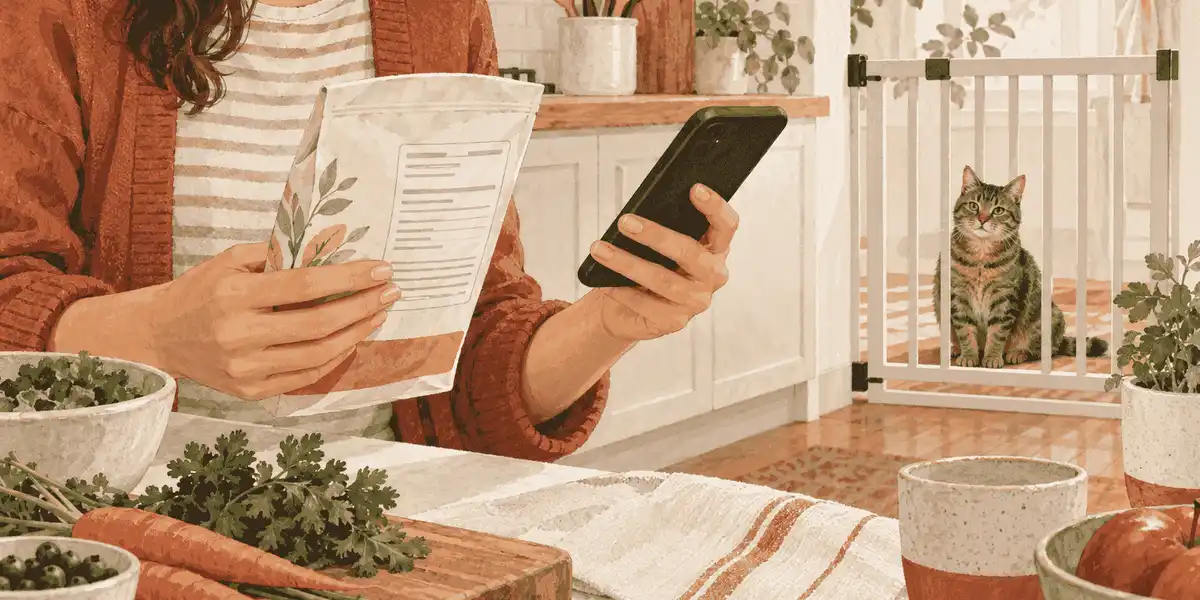
- the package, ingredient panel, recipe, or a clear photograph;
- the possible amount and time of contact, even when both are uncertain;
- your cat’s age, weight, and any changes you can see; and
- whether another pet could also have reached the food.
The American Veterinary Medical Association’s pet first-aid guidance says to keep the product information available and contact a veterinarian or poison-control service before inducing vomiting or giving medication. “Unknown” is useful information. Guessing a safe threshold from a food’s appearance is not.
If you are deciding whether to offer a normal human-food extra and no exposure has occurred, use the human-food safety check for cats instead. That page covers plain preparation, complete food as the foundation, and the difference between an occasional extra and a possible hazard. This page starts when the food itself may be unsafe or the ingredients are uncertain.
Four Food Hazards to Keep Out of Reach
Chocolate, coffee, and caffeine
Cats Protection lists chocolate, coffee, and other caffeine-containing foods as hazards for cats and directs suspected exposure toward prompt veterinary advice. Keep bars, baking chocolate, coffee grounds, drinks, desserts, and mixed foods containing them behind a closed door or otherwise out of reach.
Do not turn a product name into a home-safe amount. A bar, drink, baking ingredient, or dessert can have different ingredients and concentrations, and the evidence does not provide a universal threshold for an individual cat. Our chocolate exposure guide for cats explains what to keep beside the phone.
Onion, garlic, chives, and leeks
Allium ingredients can hide in cooked dishes, sauces, seasoning powders, leftovers, and mixed foods. A peer-reviewed veterinary toxicology review and MSD Veterinary Manual guidance describe exposure in dogs and cats across raw, cooked, dried, and powdered forms. The important effects may be delayed, so a cat’s normal early appearance is not a reliable clearance test.
Keep onion, garlic, chives, and leeks out of food offered to cats. Do not publish or rely on a public “safe amount,” and do not try to decide from body weight alone. If a possible exposure occurred, keep the ingredient details and contact a veterinarian or poison-control service promptly.
Grapes, raisins, and currants
These are not routine cat treats. Cats Protection and veterinary guidance identify grapes, raisins, and currants as food hazards and direct suspected exposure toward veterinary advice. The evidence does not establish a home-safe count, symptom timetable, or way to predict an individual cat’s outcome.
Fresh and dried forms can appear in snack bowls, baking ingredients, cereal, trail mixes, or mixed dishes. Keep the whole package or recipe rather than reporting only the most visible piece. If one may have been eaten, the cat grape and raisin exposure guide explains the information to collect before you call.
Raw yeast dough
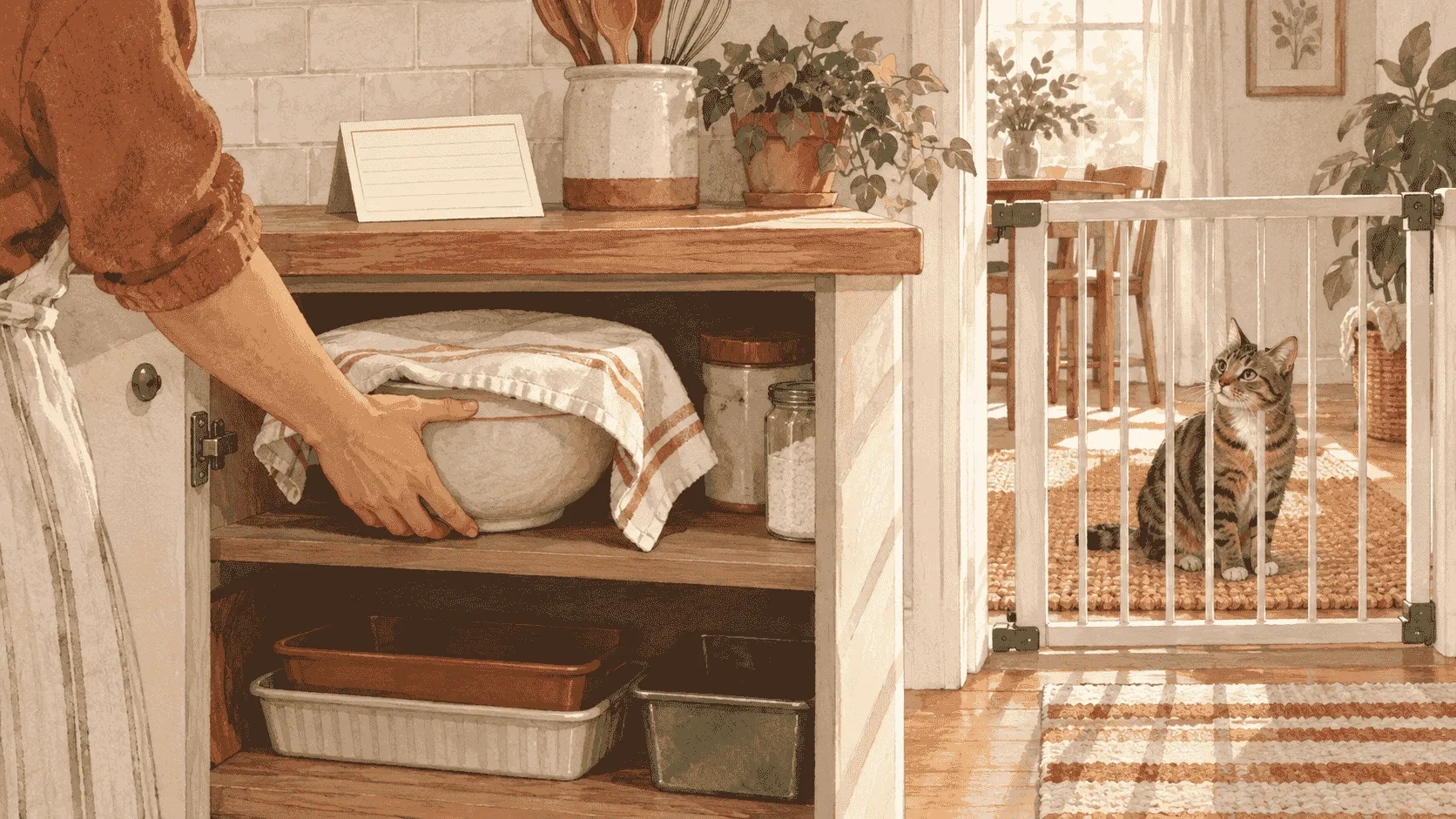
Raw, unbaked dough that contains yeast is a distinct kitchen hazard. Current MSD Veterinary Manual material, ASPCA Animal Poison Control guidance, and University of Illinois veterinary education support keeping it away from dogs and cats while it is being mixed, resting, rising, transported, or discarded.
That does not label every dough, bread, batter, or sourdough starter the same way. It also does not make a counter, drawer, oven, or container automatically pet-proof. Treat raw yeast dough as a possible exposure if a cat may have eaten it, keep the recipe and timing details, and contact a veterinarian or poison-control service rather than choosing a home response.
Read the Whole Label, Not Just the Visible Bite
The risky part of a food may be a powdered seasoning, a drink ingredient, a dried fruit, a mixed filling, or a dough that looks like an ordinary kitchen spill. If you cannot identify the ingredients and preparation, do not offer the food as a treat. If the cat may already have reached it, keep the full package or recipe and report the uncertainty rather than trying to reconstruct it from memory.
Do not use a routine feeding list to clear a possible exposure. Complete and balanced cat food should remain the nutritional foundation, but that does not make a harmful extra safe. A cat’s size, a small-looking missing piece, or the absence of an immediate change cannot replace case-specific advice.
The Call Comes Before Home Treatment
After possible access to one of these hazards:
- Block further access. Move the food and keep other animals away.
- Keep the evidence. Save the container, label, recipe, or a clear photo.
- Write down the timeline. Note the possible amount, time, cat details, and any changes you can see.
- Call promptly. Contact your veterinarian, an emergency veterinary service, or an appropriate animal poison-control service.
- Wait for direction before acting. Do not induce vomiting, give medication, charcoal, food, fluid, or another home remedy unless the professional handling the case tells you to.
This is an information-and-referral plan, not a diagnosis or treatment guide. If your cat is already showing a concerning change, describe it plainly during the call and follow the level of care the veterinary team recommends.
The safest answer to “what foods are toxic to cats?” is therefore specific but limited: keep these evidence-backed hazards out of reach, check the whole label, and call with the details when exposure may have happened. A short list cannot predict every food or every cat, but it can help you avoid guessing when the next step matters.
Sources
Petzette's claim cards for this article point to the following scientific, veterinary, or animal-welfare sources.
- Cats Protection Cats And Human Foods Guidance: Current cat-welfare feeding and household-food safety guidance
- Allium Food Exposure In Dogs And Cats — Review And Guidance: Peer-reviewed veterinary toxicology review, peer-reviewed veterinary manual, and established animal poison-control guidance
Hayes C. Garlic and Onion (Allium spp) Toxicosis in Animals. MSD Veterinary Manual, full review September 2024; Cortinovis C, Caloni F. Household Food Items Toxic to Dogs and Cats. Front Vet Sci. 2016;3:26. doi:10.3389/fvets.2016.00026; ASPCA Animal Poison Control. People Foods to Avoid Feeding Your Pets.
- AVMA Pet First Aid: Poison Response Boundary: Veterinary-association first-aid brochure
- VCA Cat Fruit and Training-Treat Guidance: Current veterinary nutrition and training guidance from a veterinary hospital network, including a cat-specific article authored by credentialed nutrition professionals
- Hunt R, RVT, VTS (Nutrition), and Wilson S, BScH, DVM, DACVIM (Nutrition). “Using Food and Treats for Training Cats.” VCA Animal Hospitals / LifeLearn Animal Health, last updated 2026-05-22.
- Raw Yeast Dough: Pet-Access Prevention and Professional-Referral Boundary: Cross-source veterinary-toxicology, poison-control, veterinary-school, and peer-reviewed evidence note. It supports prevention and prompt professional referral after possible access to raw, yeast-containing dough only. It is not a food recommendation, an individual risk calculation, a symptom checklist, a diagnosis, or a home-treatment protocol.
- Hayes C. *Bread Dough Toxicosis in Animals.* MSD Veterinary Manual, Veterinary Professionals. Full review September 2024; last updated August 2025; authored by a DVM at ASPCA Animal Poison Control Center and peer reviewed by a DVM, DABT, DABVT at the University of Minnesota. The original page was directly rendered and HTTP-200 verified on 2026-08-17.