Behavior25 August 2026
Cat Anxiety: What to Notice Before You Try to Help
Cat anxiety can overlap with health, environment, and behavior changes. Learn what to record, what to adjust, and when your veterinarian should lead.
TextPetzette Editorial
Read4 Min
Evidence status
Source-backed editorial
- Evidence record
- 7 claim cards linked to 5 documented sources.
- Independent expert review
- Not commissioned. Petzette Editorial is responsible for the published wording.
- Source record checked
- 25 August 2026
- Scope
- General guidance. Individual animals and circumstances can differ.
Cat anxiety is a useful search phrase, but it is not a home diagnosis. A cat who hides, hisses, vocalizes, grooms differently, changes appetite, scratches, or toilets outside the box may be reacting to a stressful scene. The same change can also have a medical, environmental, or other behavior explanation. The first-year decision is therefore practical: what can you record and adjust without turning the cat into a test, and when should your veterinarian lead? Use the pattern before you reach for the label.
Cat Anxiety Is a Pattern Question, Not a Label
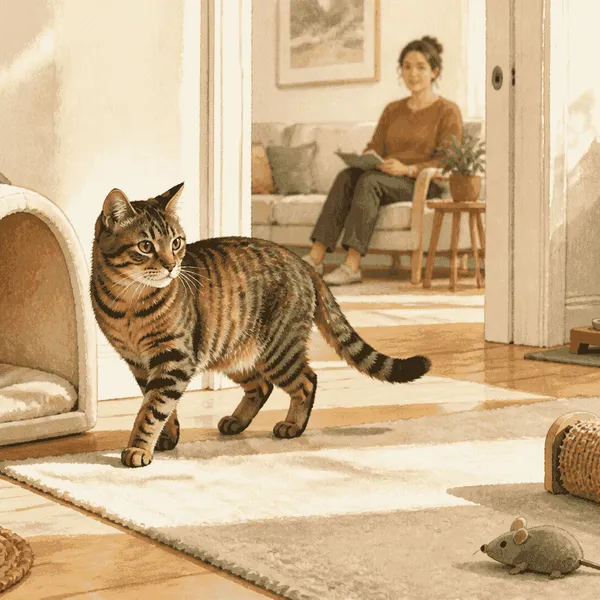
Start with the situation, not the word anxiety. Note what happened just before the change: a move, visitor, noise, handling, another animal, a blocked route, or a caregiver leaving. Then compare the moment with this cat’s ordinary eating, toileting, grooming, resting, and activity. One sign or one episode cannot identify the cause.
The evidence around absence-linked behavior shows why caution matters. A 2020 PLOS ONE questionnaire study collected responses about 223 cats; 30 met at least one behavior criterion used by that study. That is a study-defined finding, not a prevalence estimate for all cats. A 2002 clinical-record study described selected cases brought for behavior problems, not a prediction for a cat at home. Current veterinary guidance also notes that feline diagnostic criteria are limited and medical, environmental, and behavior explanations can overlap.
If the change appears mainly after you leave, use the narrower cat separation-anxiety record. It covers the absence-linked timeline. This guide stays with the broader question of what to notice when the context is still unclear.
Make a Five-Part Cat Anxiety Record
Keep the record short enough to repeat for several ordinary moments. Write down:
- The trigger: what changed immediately before the behavior, and whether the cat had a clear way to move away.
- The whole scene: posture, face, movement, distance, hiding, vocalizing, hissing, grooming, scratching, or toileting changes—not just the loudest sign.
- Key routines: what was offered and eaten, water access, litter-box use, rest, play, and contact with people or animals.
- The timeline: when the change began, how long it lasted, what happened after, and whether it is familiar for this individual cat.
- A safe record: a brief video can show sequence and recovery if it can be taken without staging the behavior or delaying urgent care.
This is observation, not a scoring system. A normal-looking reunion, one quiet interval, or a later meal does not clear a new concern. The whole-cat body-language check can help you describe face, body, distance, and movement without assigning one meaning to one cue.
Make the Home Easier Without Forcing Contact
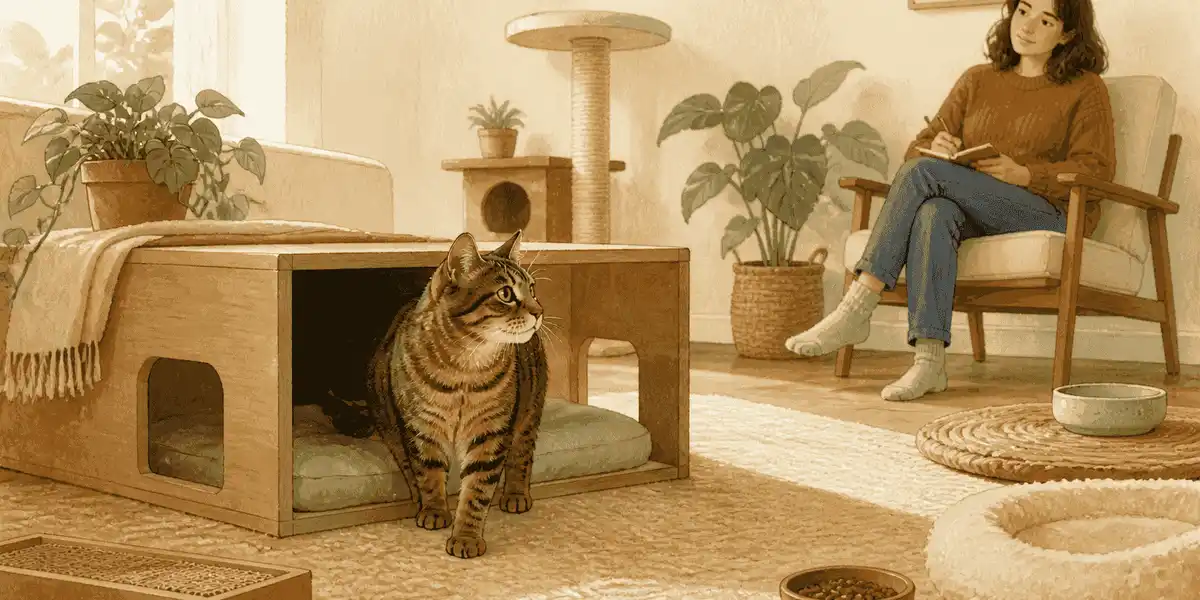
The AAFP/ISFM feline environmental-needs guidelines organize a workable home around safe places, separated key resources, play and predatory opportunities, predictable positive interaction, and respect for scent. In practice, separate food, water, toileting, scratching, play, and resting areas so the cat has choices rather than one crowded corner.
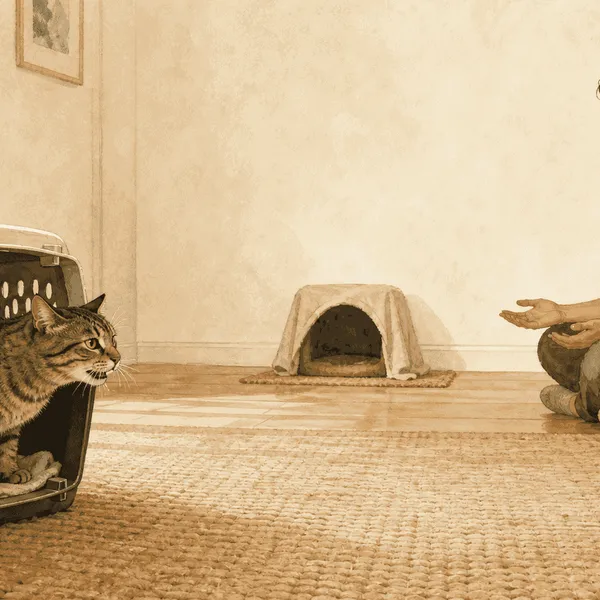
Offer a stable retreat where the cat can enter, leave, and avoid being cornered. Current FelineVMA guidance describes an exit option from more than one side as useful when a cat feels threatened, while also making clear that individual preferences differ. A 2014 Applied Animal Behaviour Science study found faster stress reduction for shelter cats given hiding boxes in that specific setting. That supports offering a voluntary refuge; it does not show that a box treats every anxiety-like change.
If the cat hisses, stop reaching and add distance. Keep the route to a retreat open, and do not pet, restrain, correct, or punish the cat to make the sound stop. A hiss is a distance request, not a character verdict. The three-path cat-hissing check covers person, introduction, and touch-specific situations in more detail.
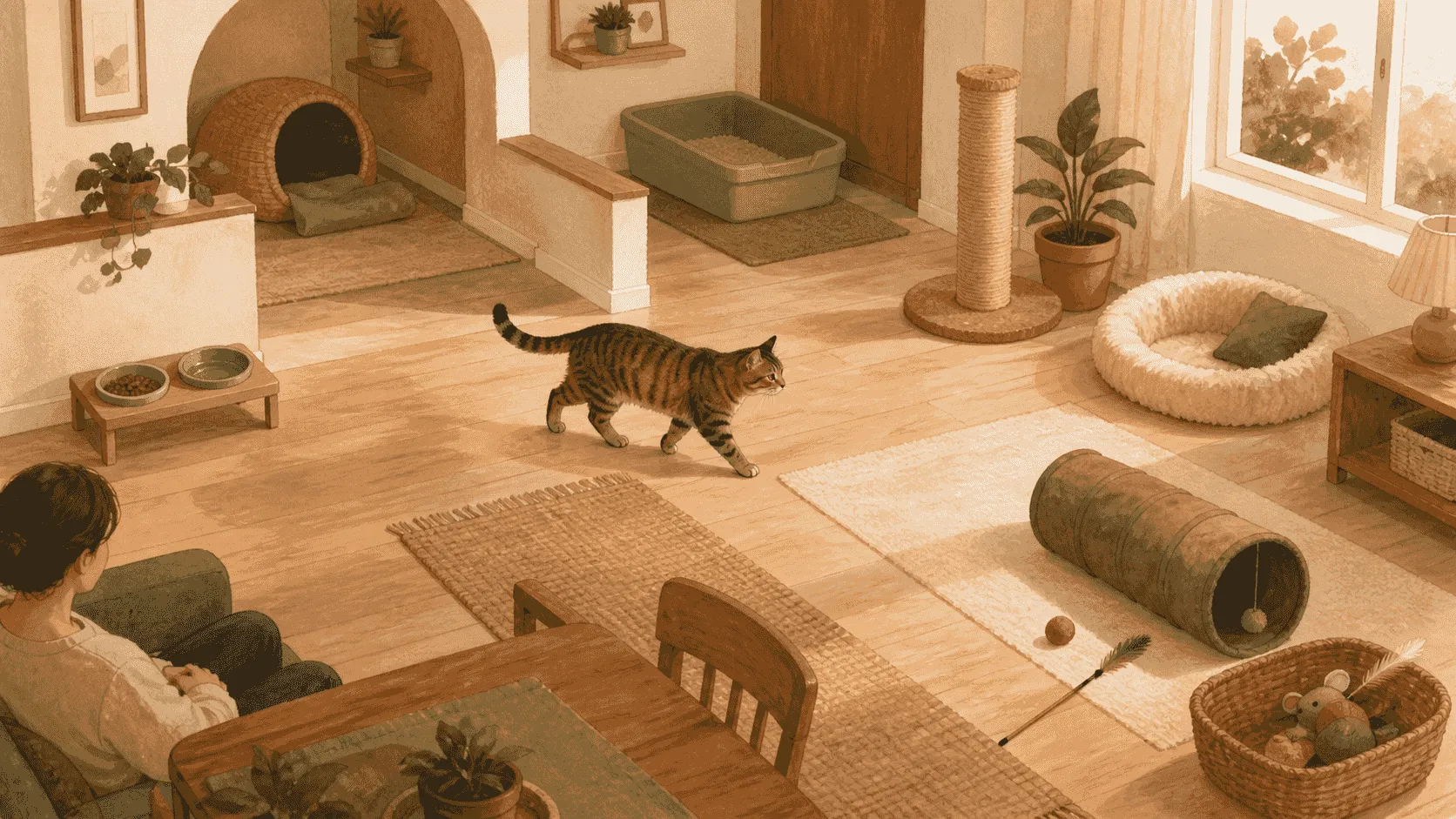
Do not pull a cat from hiding, reach into a refuge, or use a new room layout as a forced test. Small environmental changes are easier to read when the cat can opt out and ordinary resources stay available.
When Your Veterinarian Should Lead
Contact your veterinarian when the change is new, repeated, severe, or linked with appetite, elimination, vomiting, pain, injury, or reduced wellbeing. Also ask for veterinary direction when hissing is unusual for this cat or repeats when one area is touched. Those patterns can have a health context; the sound or behavior alone cannot tell you which one.
Bring the short timeline and a safely captured video if available, but do not delay urgent care to make a recording. The useful handoff is concrete: what happened before, what the whole body did, what routines changed, how long it lasted, and what happened afterward. A veterinarian can decide whether further health or behavior assessment is needed.
Choose the Narrowest Next Step
Use this decision aid after the first record:
- If there is a clear pressure point, ordinary eating and toileting, and a quick return to the usual pattern, remove that pressure and preserve choice while you keep watching.
- If the pattern is tied to departures, follow the absence-specific record rather than guessing at a diagnosis.
- If the immediate signal is hissing, back away and keep an escape route open before considering any interaction.
- If the change is new, repeated, severe, touch-specific, or connected to wellbeing, call your veterinarian.
Cat anxiety becomes a safer question when it leads to a smaller response: record the scene, offer choices, and escalate a meaningful change instead of trying to prove a label at home.
Sources
Petzette's claim cards for this article point to the following scientific, veterinary, or animal-welfare sources.
- Cat Separation-Related Problems: Pattern, Limits, And Veterinary Boundary: Evidence synthesis of two peer-reviewed feline studies and current veterinary guidance. It supports only a cat-specific observation, environmental-support, and professional-assessment boundary for possible separation-related problems. It is not a diagnostic checklist, treatment plan, medication guide, dose guide, or promise that a cat can be made comfortable alone on a fixed schedule.
- Machado DS, Felsmann MZ, et al. Identification of separation-related problems in domestic cats: A questionnaire survey. *PLOS ONE*. 2020;15(4):e0230999. doi:10.1371/journal.pone.0230999; PMID:32294083. Direct PubMed and publisher DOI records reviewed on 2026-08-25.
- AAFP/ISFM Feline Environmental Needs Guidelines 2013: Peer-reviewed veterinary guidelines plus client-facing practice resource
- FelineVMA Environmental Needs: Safe Places And Choice: Current feline-veterinary caregiver guidance
- Hiding Boxes And Shelter Cat Stress: Peer-reviewed paper
- Cats Protection Hissing Guidance: Current cat-welfare behavior guidance