Behavior25 August 2026
Cat Separation Anxiety: What to Record Before You Call
Cat separation anxiety can overlap with health and home-setting changes; use a calm absence record to decide when your veterinarian should lead.
TextPetzette Editorial
Read4 Min
Evidence status
Source-backed editorial
- Evidence record
- 4 claim cards linked to 3 documented sources.
- Independent expert review
- Not commissioned. Petzette Editorial is responsible for the published wording.
- Source record checked
- 25 August 2026
- Scope
- General guidance. Individual animals and circumstances can differ.
Cat separation anxiety is a pattern question before it is a label. If your cat vocalizes, scratches, grooms, eliminates outside the box, or changes appetite when you leave, the useful first decision is whether to record the pattern and make the home easier—or contact a veterinarian before trying to change it. One behavior does not settle the cause.
For the wider first month with a new cat, use the calm first-30-days guide. This article stays with the narrower absence question: what to notice, what not to test, and when professional help should lead.
Cat Separation Anxiety Is a Pattern Question
Research supports taking the concern seriously while keeping the evidence in proportion. A 2020 questionnaire survey in PLOS ONE collected owner reports about 223 cats; 30 cats met at least one study-defined behavioral criterion for a possible separation-related problem. The figure is not a prevalence estimate for all cats, and the study authors described their criteria as a starting point in an area that remains under-studied.
A 2002 retrospective study reviewed 136 cats already evaluated for behavior problems and included cases in which signs appeared only when the cat was separated from an apparent attachment figure. In that selected clinical record, inappropriate urination was common; other cases involved inappropriate defecation, vocalization, destructiveness, or excessive grooming. A referral sample can show what clinicians encountered, but it cannot tell you what one cat’s behavior means at home.
The practical takeaway is careful rather than dismissive: a possible absence-linked pattern exists, but the same signs can arise from medical, environmental, or other behavior concerns. Read the whole sequence.
Record What Happens When You Leave
Make one ordinary absence more legible without staging a stressful test. If a safely placed camera is already available, a short recording can show timing and context; it is evidence for a veterinary conversation, not a home diagnosis. Write down:
- what changed in the household routine, caregiver schedule, room access, or other animals;
- what happened before departure, including eating, play, grooming, toileting, and settling;
- how soon the vocalizing, scratching, elimination, grooming, hiding, or other change began;
- whether your cat could reach food, water, litter, rest, and a retreat without being blocked; and
- what you saw after returning, including appetite, movement, greeting, and recovery into ordinary activity.
Use concrete descriptions rather than conclusions. “Urinated on the bed 15 minutes after the door closed” is more useful than “was anxious.” If the pattern changes with a different caregiver, room, or absence length, record that too, but do not deliberately lengthen the absence to see what happens. The dog separation-anxiety plan uses a different species’ evidence; its shared lesson is to observe before naming, not to borrow a dog timetable for a cat.
Make the Home Easier Without Creating a Test
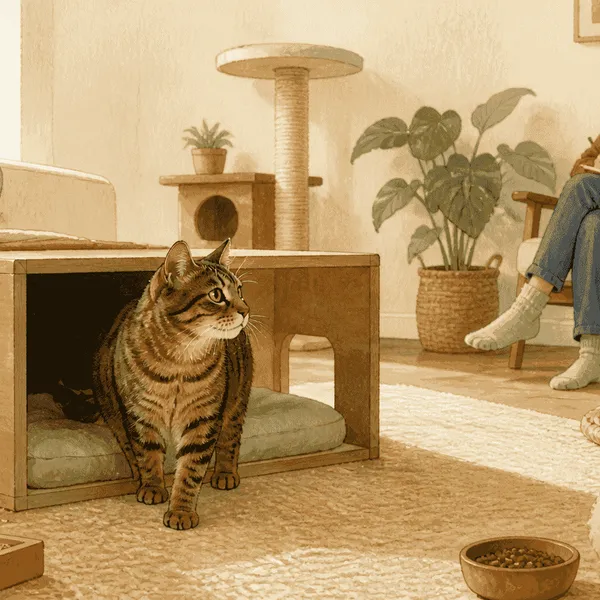
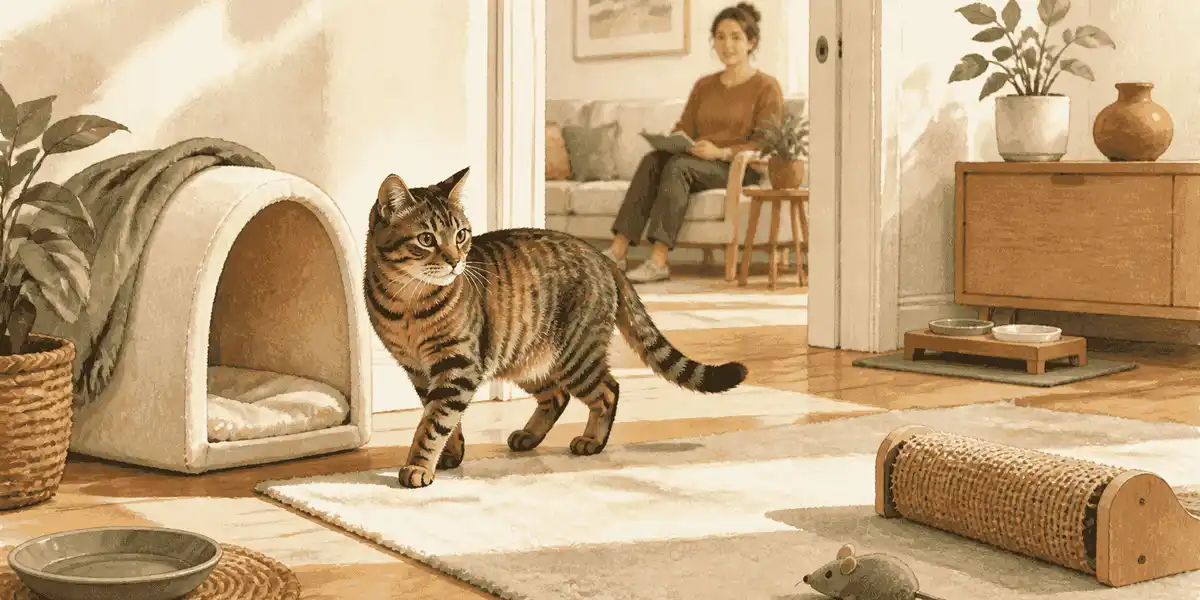
While you gather information, reduce pressure in the environment. Feline environmental guidance recommends safe retreat spaces, separated key resources, play opportunities, and contact the cat can control. That might mean keeping food, water, litter, scratching, resting, and play choices from competing in one crowded corner.
A retreat should preserve choice. Offer a stable place the cat can enter and leave without being cornered, and do not reach in to force contact. A box, carrier, or perch may be useful to one cat and uninteresting to another; the evidence supports access and control, not one required design. Keep essential resources reachable even if the cat spends more time in a quiet room.
Do not turn the room into a separation experiment. Avoid punishment after a mess, forced handling, or a sudden change to every resource at once. If the absence concern began after adoption or a household change, keep the routine predictable and change one practical feature at a time. The cat litter-box setup guide can help you examine access and cleanliness when elimination is part of the record, but a new box should not delay a health conversation.
When Your Veterinarian Should Lead
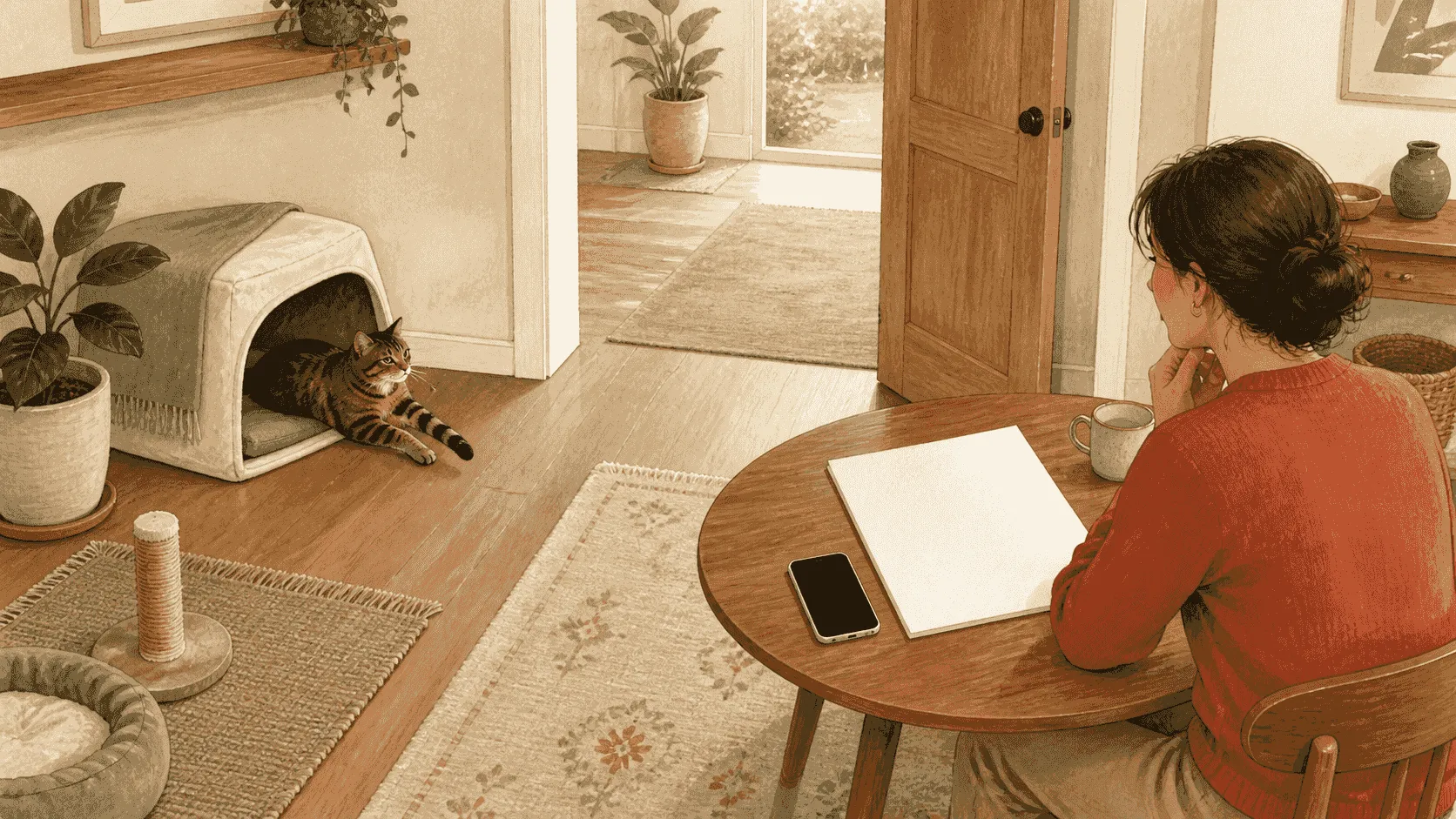
Contact your veterinarian when the change is new, repeated, severe, or paired with reduced appetite, vomiting, elimination changes, pain, injury risk, or a wider drop in wellbeing. Feline separation-related criteria are limited, and medical problems can look like a behavior problem. A timeline and short video may help the clinical team understand the sequence, but do not delay urgent care to make a recording.
Also call when the cat cannot settle, repeatedly damages itself or the home, or the pattern is getting worse despite a calmer setup. Bring the exact dates, the absence context, what the cat could access, and what happened after you returned. Do not punish the behavior while you wait; the event happened outside your supervision, and punishment cannot explain what caused it.
Keep the Decision Small and Honest
This guide can help you choose the next observation and recognize a professional boundary. It cannot tell you that your cat has separation anxiety, set a safe number of hours alone, prescribe medication, recommend a supplement or diffuser, or promise that a toy, room, or fixed schedule will solve the problem. Those decisions depend on the individual cat and may require veterinary or qualified behavior support.
Your five-line plan is enough for today: note what changed, record one ordinary absence if it is safe, preserve reachable choices, write down appetite and toileting, and call your veterinarian for a new, repeated, severe, or wellbeing-linked pattern. The goal is not certainty from a camera. It is a clearer handoff to the person who can assess the cat in front of you.
Sources
Petzette's claim cards for this article point to the following scientific, veterinary, or animal-welfare sources.
- Cat Separation-Related Problems: Pattern, Limits, And Veterinary Boundary: Evidence synthesis of two peer-reviewed feline studies and current veterinary guidance. It supports only a cat-specific observation, environmental-support, and professional-assessment boundary for possible separation-related problems. It is not a diagnostic checklist, treatment plan, medication guide, dose guide, or promise that a cat can be made comfortable alone on a fixed schedule.
- Machado DS, Felsmann MZ, et al. Identification of separation-related problems in domestic cats: A questionnaire survey. *PLOS ONE*. 2020;15(4):e0230999. doi:10.1371/journal.pone.0230999; PMID:32294083. Direct PubMed and publisher DOI records reviewed on 2026-08-25.
- AAFP/ISFM Feline Environmental Needs Guidelines 2013: Peer-reviewed veterinary guidelines plus client-facing practice resource
- FelineVMA Environmental Needs: Safe Places And Choice: Current feline-veterinary caregiver guidance