Behavior06 October 2026
Cat Butt Sniffing: Why Cats Sniff Each Other and When to Pause
Why do cats sniff each other’s butts? Read the approach, body tension, distance, and exit before deciding whether to pause a cat greeting.
TextPetzette Editorial
Read5 Min
Evidence status
Source-backed editorial
- Evidence record
- 4 claim cards linked to 5 documented sources.
- Independent expert review
- Not commissioned. Petzette Editorial is responsible for the published wording.
- Source record checked
- 06 October 2026
- Scope
- General guidance. Individual animals and circumstances can differ.
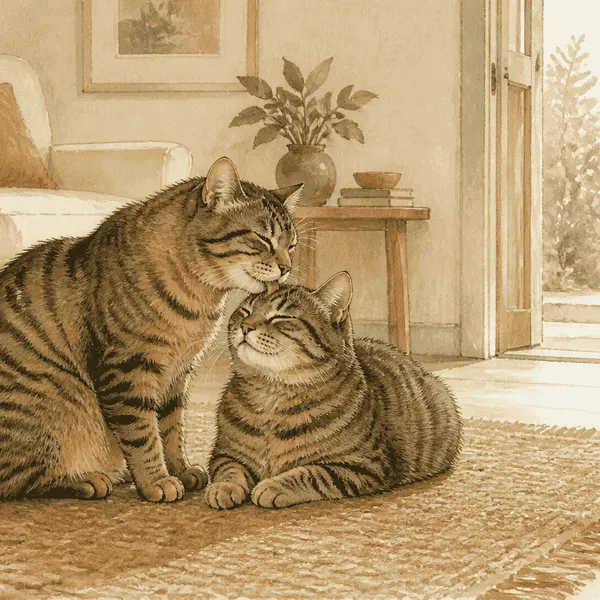
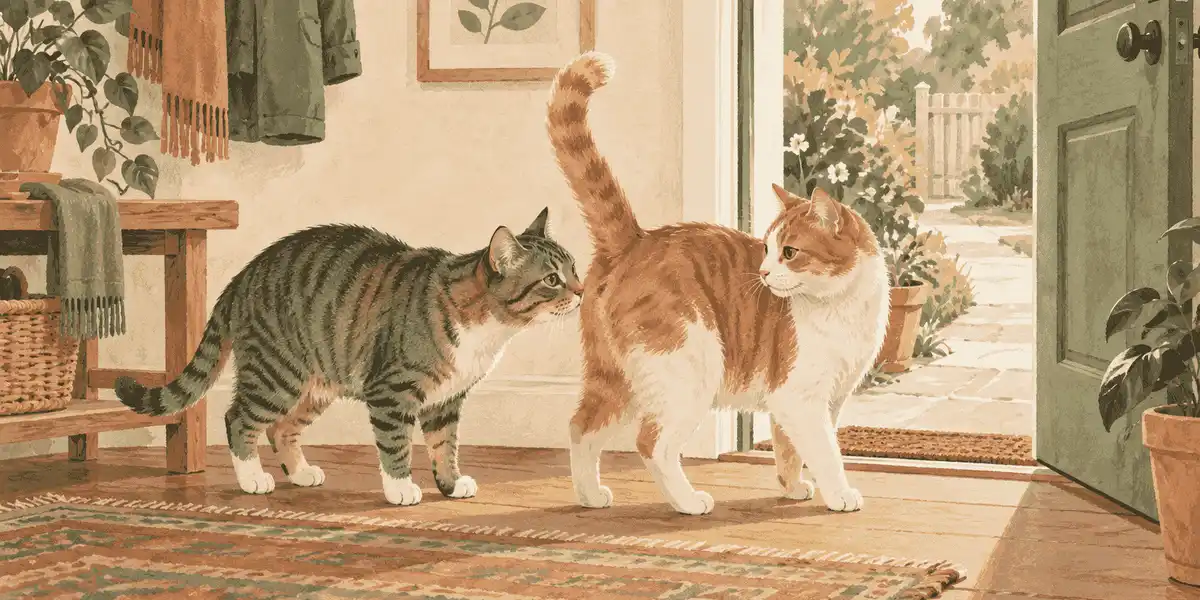
Why do cats sniff each other’s butts? A tail-area sniff can be part of a cat-to-cat greeting: the cats are investigating scent at close range. That is a useful description, not a complete translation. It does not prove that two cats are friends, that either cat feels safe, or that they are ready to spend more time together.
For a new cat owner, the practical decision is smaller: can both cats choose their distance, keep an exit route, and move on without pressure? Read the approach, the whole body, the room, and what happens after the sniff before you decide whether to pause the interaction.
What Cat Butt Sniffing Can Tell You
Cats Protection’s general body-language guidance describes cats greeting one another by investigating around the tail. Scent can therefore be part of a normal social exchange. The wording matters, though: “part of a greeting” is not the same as one fixed meaning for every cat, household, or meeting.
Treat the sniff as an opening question. One cat may approach, pause, and leave. Another may circle back. A third may be interested but unsure and need more space. The visible act is the same broad category of behavior, while the useful next step changes with the rest of the scene.
Do not turn the moment into a test. Avoid holding one cat in place, pushing a face or rear toward the other, or rewarding yourself with a confident label such as “dominant,” “submissive,” or “best friends.” Those labels are not established by a single sniff. Let the cats supply more information through their movement and choices.
Read the Greeting, Not Just the Sniff
Use a short scene snapshot:
- Approach: Did the cat walk over by choice, or was it cornered near food, a litter area, a doorway, or a resting place?
- Whole body: Are the shoulders and pace loose, or is the body stiff, crouched, leaning away, or suddenly still? Add ears, eyes, whiskers, mouth, tail, and breathing to the picture.
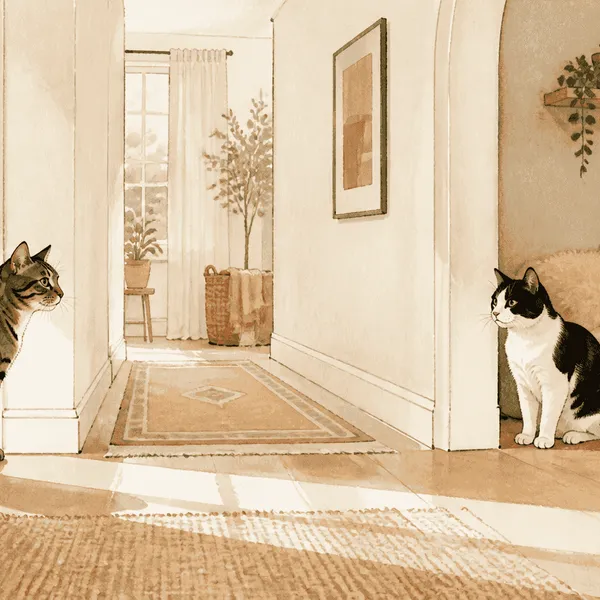
- Distance: Can either cat turn away or take a few steps back without being followed? A clear route matters more than getting a close-up greeting.
- Afterwards: Does each cat settle, continue exploring, move away, chase, block, hide, or return to the same spot?
The whole-cat body-language context check uses the same principle for cat-human moments: one feature can be a clue, but it cannot carry the whole message. A cat that pauses after a sniff may be calmly processing the encounter or asking for more room. Watch what it chooses next instead of trying to translate the pause with certainty.
Research on another close-contact behavior shows why this restraint helps. A 2026 video-based observational study of 53 domestic-cat dyads found allogrooming in more than one kind of sequence. Mutual contact, matching posture, escape routes, displacement, and what happened after grooming supplied more context than the licking act alone. That study was not about butt sniffing, and it cannot identify a cat’s private motive. It does support a safer habit: describe the sequence you can see before assigning a relationship label.
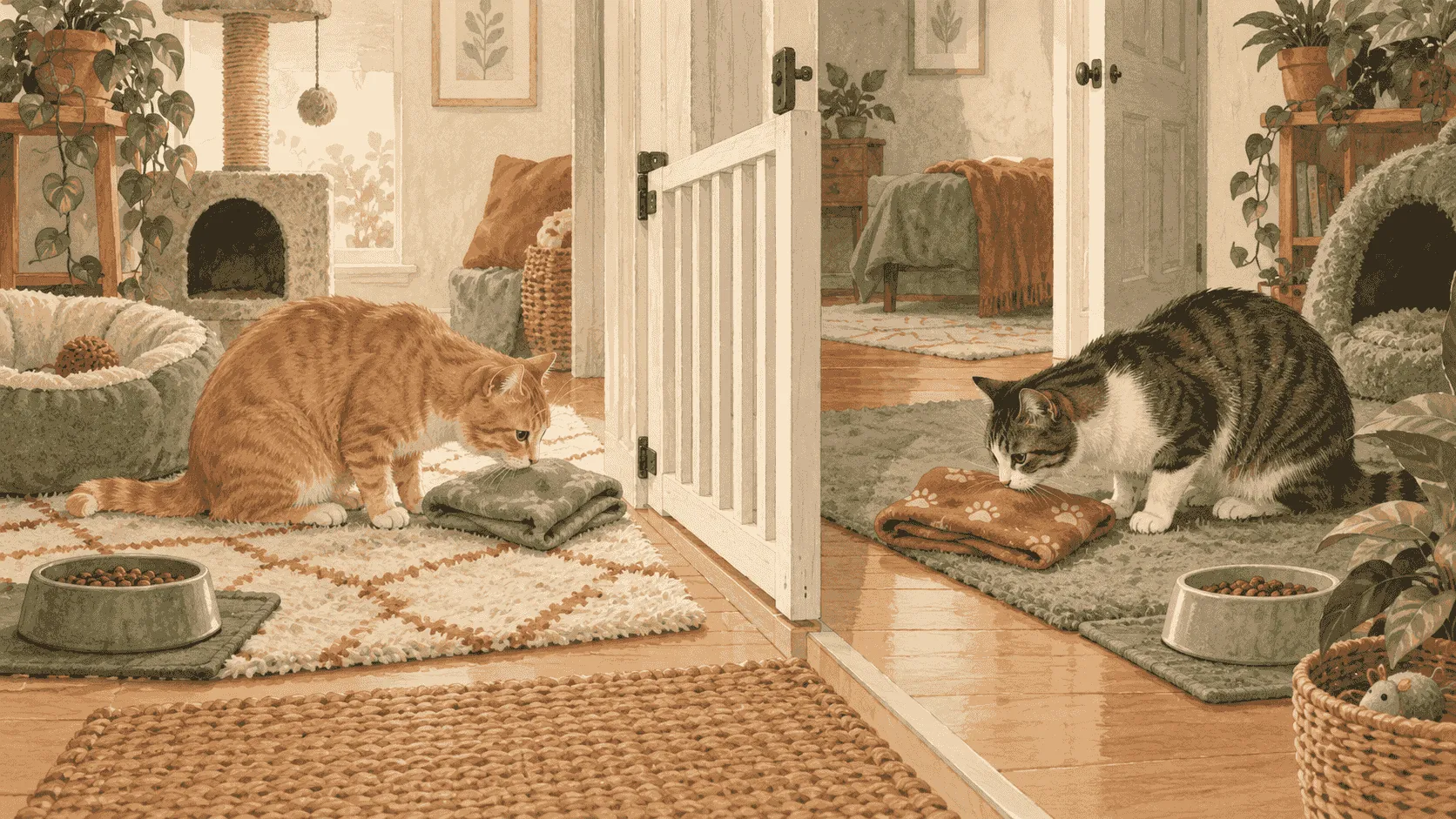
When Two Cats Are Meeting for the First Time
If this is a new-cat introduction, a butt sniff should not be the first goal. Cats Protection introduction guidance supports moving at the cats’ pace: begin with separate space and scent exchange, then use a visual barrier, and only later try brief supervised physical proximity when the cats can choose whether to approach or retreat.
There is no universal introduction timetable and no promise that every pair will become close. If tension appears, go back to an earlier stage. Do not hold the cats nose-to-tail to “help them bond,” and do not leave them to fight it out. A first meeting can be successful when it ends with both cats still able to move away; it does not need to become a long greeting.
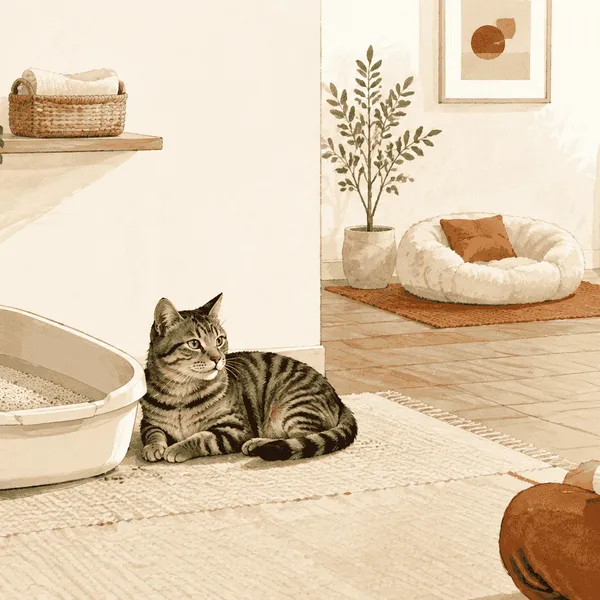
Set up the room so the sniff is not a trap. Provide separate resting options and separated key resources, including food, water, toileting, scratching, and play areas. A doorway, tall furniture, or another visual break can matter when one cat needs to stop looking at the other. The cat rear-facing greeting guide covers the different cat-to-human version of scent-led contact; this article keeps the focus on two cats sharing space.
When to Pause the Interaction
Pause when either cat cannot easily disengage. That can look like a stiff approach, repeated following, a blocked doorway, staring, fleeing, hiding, a sharp escalation, or a cat returning to a resource only to be displaced. A brief hiss or retreat is information to reduce pressure, not a cue to punish or force a second attempt.
If cats are already fighting, keep your hands out of the middle. Use a safe barrier or another distance-creating option you can manage without grabbing either animal, then allow recovery time. Veterinary or qualified behavior support is appropriate for repeated blocking, injury, escalating aggression, persistent tension, sudden hiding, pain signs, or a marked change in how either cat moves through the home.
A single sniff is not a health assessment. If the behavior is suddenly intense, uncomfortable, or part of a wider change in appetite, toileting, movement, touch tolerance, or activity, record the pattern and contact your veterinarian. Avoid trying to solve a possible medical issue by changing introductions alone.
A Four-Step Cat Greeting Check
When one cat approaches another’s rear, use this plan:
- Pause your own intervention. Do not push, hold, grab, or place either cat into position.
- Check the route. Make sure both cats can turn, retreat, and reach separate calm spaces.
- Read the next action. Look for loose movement and voluntary re-approach, or for stiffness, blocking, chasing, hiding, and displacement.
- Change the setup if needed. Shorten the meeting, return to scent or barrier work, separate resources, and write down what happened before and after.
The answer to “why do cats sniff each other’s butts?” is often that scent investigation can be part of a greeting. The safer answer to “what should I do?” is to keep the greeting choice-led and unfinished until both cats show, through their whole interaction, that they can leave comfortably.
Sources
Petzette's claim cards for this article point to the following scientific, veterinary, or animal-welfare sources.
- 2024 AAFP Intercat Tension Guideline Brief: Veterinary consensus-guideline brief
- Context Around Allogrooming In Domestic Cat Dyads: Peer-reviewed video-based observational study
Van Belle MJR, Moons CPH, Mills DS, Broeckx BJG, Tuyttens FAM, Gajdoš Kmecová N. Unravelling feline social dynamics - A video-based observational study on allogrooming in domestic cats. *Applied Animal Behaviour Science*. 2026;301:107038.
- Cats Protection Gradual Cat Introductions: Animal-welfare behavior guidance
- Cats Protection Cat Greeting Sniffing Guidance: Animal-welfare behavior guidance
- AAFP/ISFM Feline Environmental Needs Guidelines 2013: Peer-reviewed veterinary guidelines plus client-facing practice resource