Behavior29 August 2026
Why Do Cats Fight? Read the Route Before the Clash
Why do cats fight? Read staring, blocked routes, escape choices, and resource access before you intervene, and know when to call your veterinarian.
TextPetzette Editorial
Read4 Min
Evidence status
Source-backed editorial
- Evidence record
- 5 claim cards linked to 4 documented sources.
- Independent expert review
- Not commissioned. Petzette Editorial is responsible for the published wording.
- Source record checked
- 22 July 2026
- Scope
- General guidance. Individual animals and circumstances can differ.
Why do cats fight? For a new multi-cat owner, the useful question is less about assigning a personality and more about finding where the household has become hard to navigate. A fight may appear around a new introduction, a blocked route, competition for a resource, or a sudden change in one cat’s comfort. Create distance first, then read the pattern.
Why Do Cats Fight? Start With Access, Not Dominance
The 2024 intercat-tension guideline from the Feline Veterinary Medical Association and the American Association of Feline Practitioners, published in the Journal of Feline Medicine and Surgery, lists staring, blocking, stalking, fleeing, hiding, and reduced activity, appetite, or play among possible subtle signs. A visible fight may be the loudest part of a pattern that began earlier.
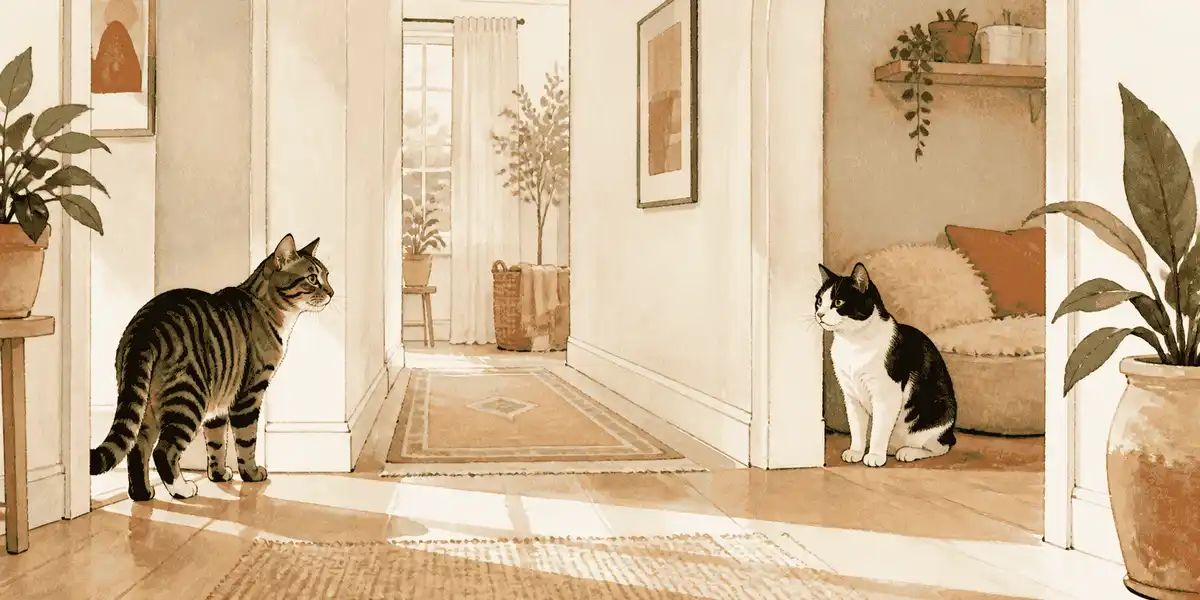
That gives you a better opening question than “Which cat is in charge?” One cat may quietly control a doorway, the route to a litter area, or the approach to food. The guideline describes feline social organization through individual relationships, familiarity, and affiliation rather than a simple dominance hierarchy. Treat a blocked route as information about access, not proof of a permanent rank.
Read the Quiet Fight Before the Loud One
Watch what each cat does before and after the obvious moment. A brief hiss or chase does not, by itself, establish chronic intercat tension. The pattern becomes more useful when one cat repeatedly:
- pauses or changes route when the other cat appears;
- fixes a stare near a doorway, bowl, litter area, bed, or perch;
- hides, plays less, or becomes less active after an encounter; or
- flees, is followed, or cannot disengage from the interaction.
Record the time, location, distance, trigger, and each cat’s next choice. Could both cats leave? Did either one have to pass through the other cat’s space to reach something essential? The cat hissing context check covers why one sound needs the whole scene; the same rule applies when the scene ends in a chase.
Do not turn a single stare into a label such as “bully” or “dominant.” Look for repetition and for changes in ordinary life. A cat that still eats, rests, grooms, plays, and moves through the home has given you different information from one that is quietly withdrawing, but neither pattern can be interpreted from one snapshot alone.
Map the Multi-Cat Bottleneck in One Pass
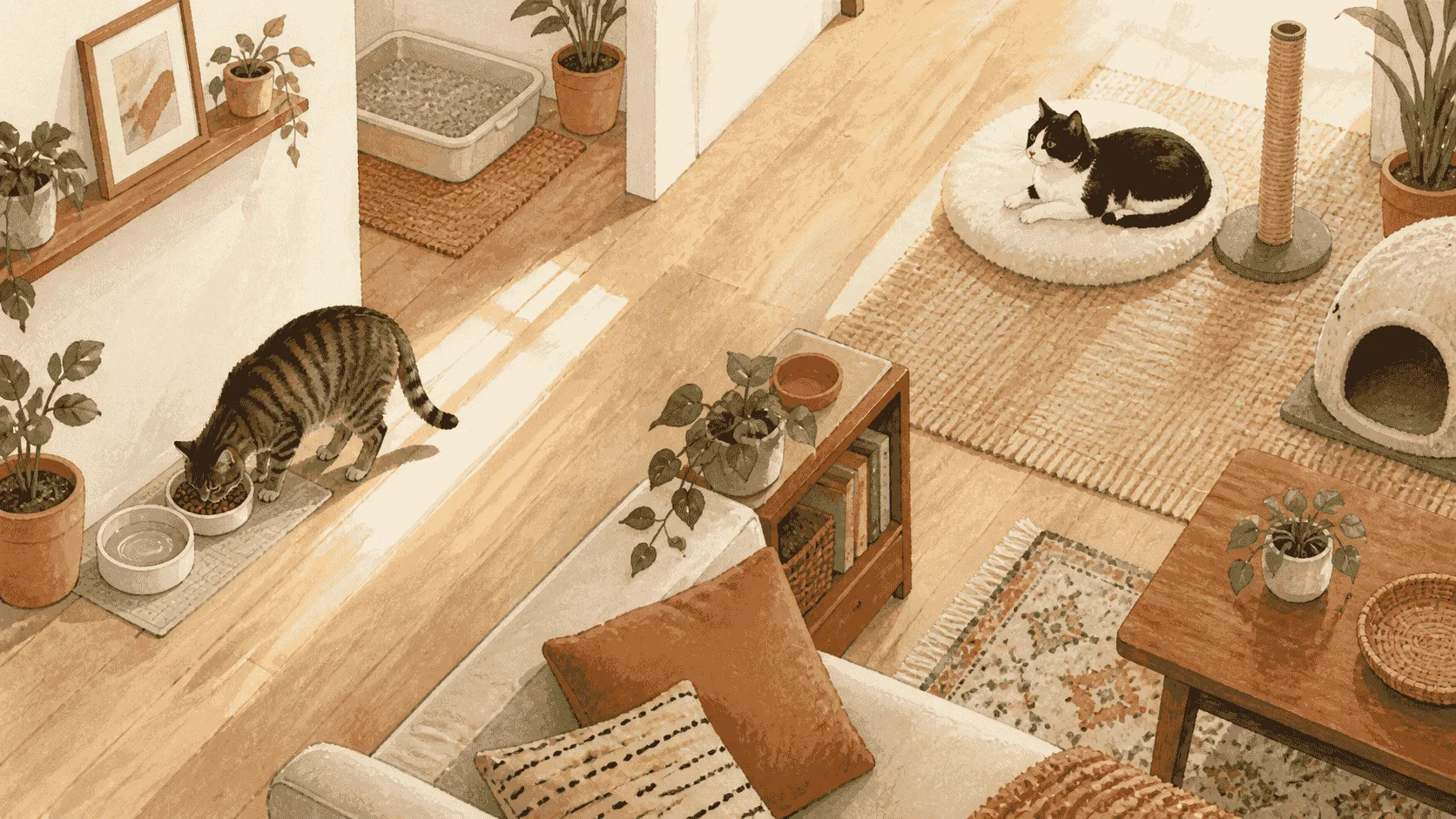
Use a quick floor-plan check before rearranging the entire home:
- Mark the essentials. Note every food and water station, litter area, resting place, scratching area, play space, and retreat.
- Draw the routes. Follow each cat from a rest area to food, water, and toileting. Mark any hallway, doorway, stair, or corner that both must use.
- Change the bottleneck. If one cat can watch or block the whole route, add distance and visual separation between useful options. Give each cat a retreat it can enter and leave without being cornered.
The 2013 AAFP/ISFM feline environmental-needs guidelines describe safe places and separated key resources as part of a workable home environment. The 2024 intercat-tension guideline makes the practical point sharper: three bowls side by side are still one feeding station if one cat can block the row. Count usable access, not just objects.
Do not expect a moved bowl or an extra box to cure every conflict. A safe place is an option, not a trap: current FelineVMA caregiver guidance recommends preserving the cat’s ability to enter, leave, and avoid being cornered. The cat litter-box setup guide shows how route, access, cleanliness, and other cats fit into that one resource decision.
If Cats Are Fighting After a New Arrival
If a new cat is involved, do not put bare hands between actively fighting cats. Prioritize distance and a barrier that does not corner either animal, then restore separate spaces. Do not force another face-to-face meeting to see whether the problem has passed.
Cats Protection guidance and the 2024 intercat-tension guideline support a staged sequence: separate space and scent exchange first, barrier-based visual contact next, and brief supervised physical proximity only later. If tension appears, return to the last stage where both cats could remain comfortable. There is no universal timeline and no guarantee that two cats will choose close friendship.
The new-kitten introduction progress guide owns the detailed arrival sequence. This page adds the route check for the wider multi-cat problem: even a familiar pair can have a household bottleneck that makes daily access difficult.
When Cats Fighting Needs a Veterinarian or Behavior Help
Ask your veterinarian about a sudden or persistent change, especially when fighting or avoidance arrives with reduced appetite, activity, grooming, movement, toileting, or general wellbeing. Pain or illness can contribute to behavior change, and a home layout cannot rule that out. Do not press, provoke, or repeat an encounter to test a theory.
Keep the cats separated and seek qualified cat behavior support when repeated fights continue, one cat keeps chasing or blocking the other, fear does not ease after distance, or you cannot keep both cats safe. Do not punish warning signals or let the cats “work it out.” An individual plan may need the home’s routes, resources, health history, and exact triggers.
Your next step is concrete: create safe distance, draw the routes, identify the first blocked resource, and record what changes. Why do cats fight? Sometimes the answer is visible only in the traffic pattern before the clash. Make that pattern easier to read before you ask the cats to share more space.
Sources
Petzette's claim cards for this article point to the following scientific, veterinary, or animal-welfare sources.
- 2024 AAFP Intercat Tension Guideline Brief: Veterinary consensus-guideline brief
- Cats Protection Gradual Cat Introductions: Animal-welfare behavior guidance
- AAFP/ISFM Feline Environmental Needs Guidelines 2013: Peer-reviewed veterinary guidelines plus client-facing practice resource
- FelineVMA Environmental Needs: Safe Places And Choice: Current feline-veterinary caregiver guidance