Behavior18 October 2026
Cat Hissing at Another Cat After a Vet Visit: Rebuild the Introduction
Cat hissing at another cat after a vet visit? Create safe distance, reset familiar scent, and rebuild contact gradually without forcing a reunion.
TextPetzette Editorial
Read5 Min
Evidence status
Source-backed editorial
- Evidence record
- 7 claim cards linked to 5 documented sources.
- Independent expert review
- Not commissioned. Petzette Editorial is responsible for the published wording.
- Source record checked
- 18 October 2026
- Scope
- General guidance. Individual animals and circumstances can differ.
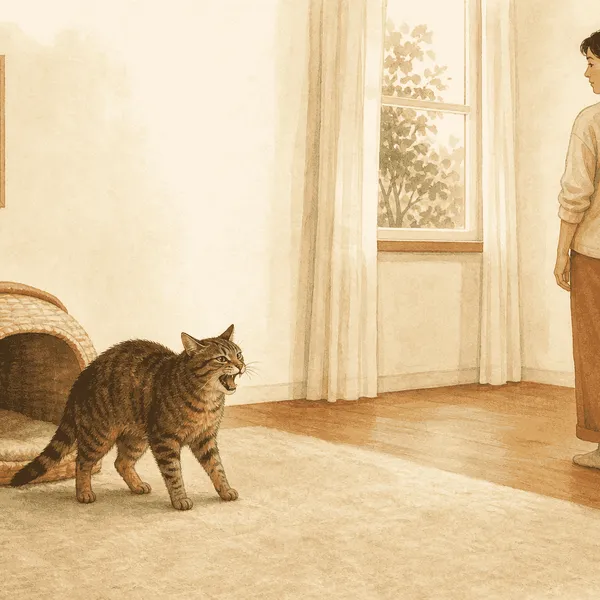
Cat hissing at another cat after a vet visit can make a familiar home feel suddenly unsafe. Start with a lower-pressure explanation: a cat returning from a veterinary stay may smell different, and the other cat may not immediately respond as if the social relationship is unchanged. That does not prove that either cat has become aggressive or that the relationship is permanently damaged.
The useful first decision is not whether to make the cats greet each other. It is whether to create enough distance for both cats to settle, then rebuild recognition and contact in stages. Cats Protection’s guidance on reintroducing cats after a separation specifically includes a stay at the vets: it recommends temporary separation, familiar-scent exchange, and a gradual return to contact.
Start With Separation, Not a Reunion
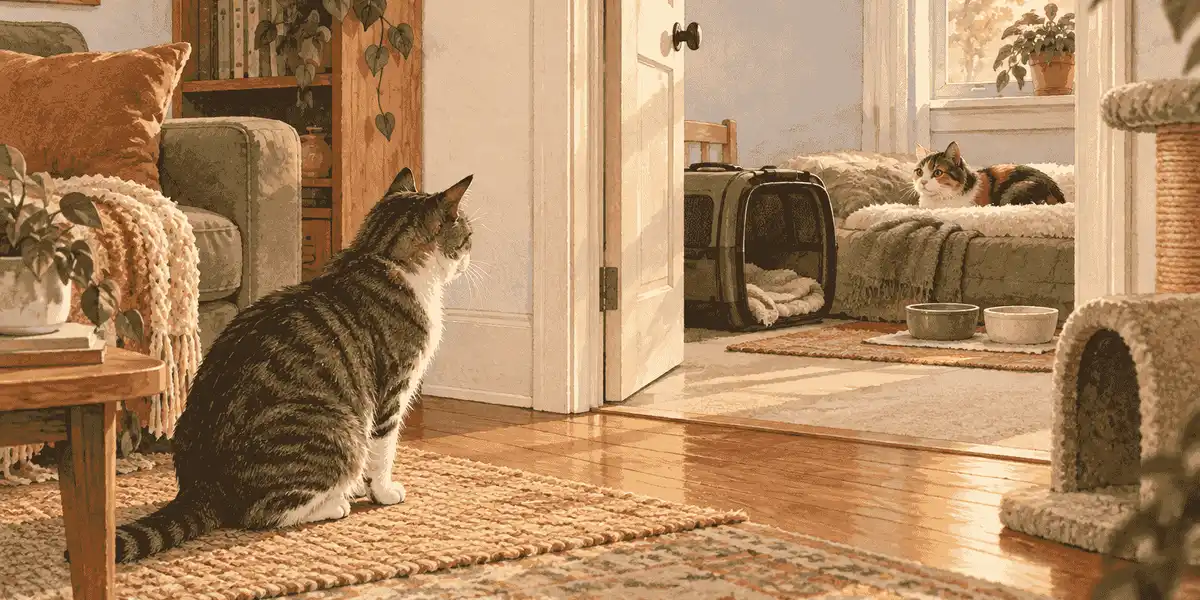
If the returning cat hisses, growls, stares, or tries to avoid the resident cat, pause the reunion. Move the returning cat to a quiet, secure room with water, toileting access, a resting place, and a route that does not force contact. Keep the resident cat’s ordinary resources available elsewhere. The goal is to make the next encounter optional, not to prove that the cats are still friends.
Do not carry one cat toward the other, hold them nose to nose, or put them together so they can “work it out.” If a fight has already started, do not put bare hands between the cats. Use distance and a barrier without cornering either animal, then let the scene settle.
The returning cat may also need to recover from the appointment, a procedure, medication, or travel. Follow the veterinary team’s discharge instructions. If the cat seems unwell, unusually painful, very distressed, or different beyond the reunion problem, contact the practice rather than assuming scent explains everything.
Reset Familiar Scent Without Making It a Test
Cats Protection describes scent as part of how cats recognize members of their social group. After a stay at the vets, the returning cat may carry unfamiliar smells. You cannot make recognition happen on a schedule, but you can lower the pressure while familiar smells return.
Try a quiet reset:
- Give the cats separate spaces where each can eat, rest, use the litter area, and retreat without passing the other cat.
- Keep familiar bedding or other safe household smells with the returning cat when the veterinary team has not given a reason to remove them.
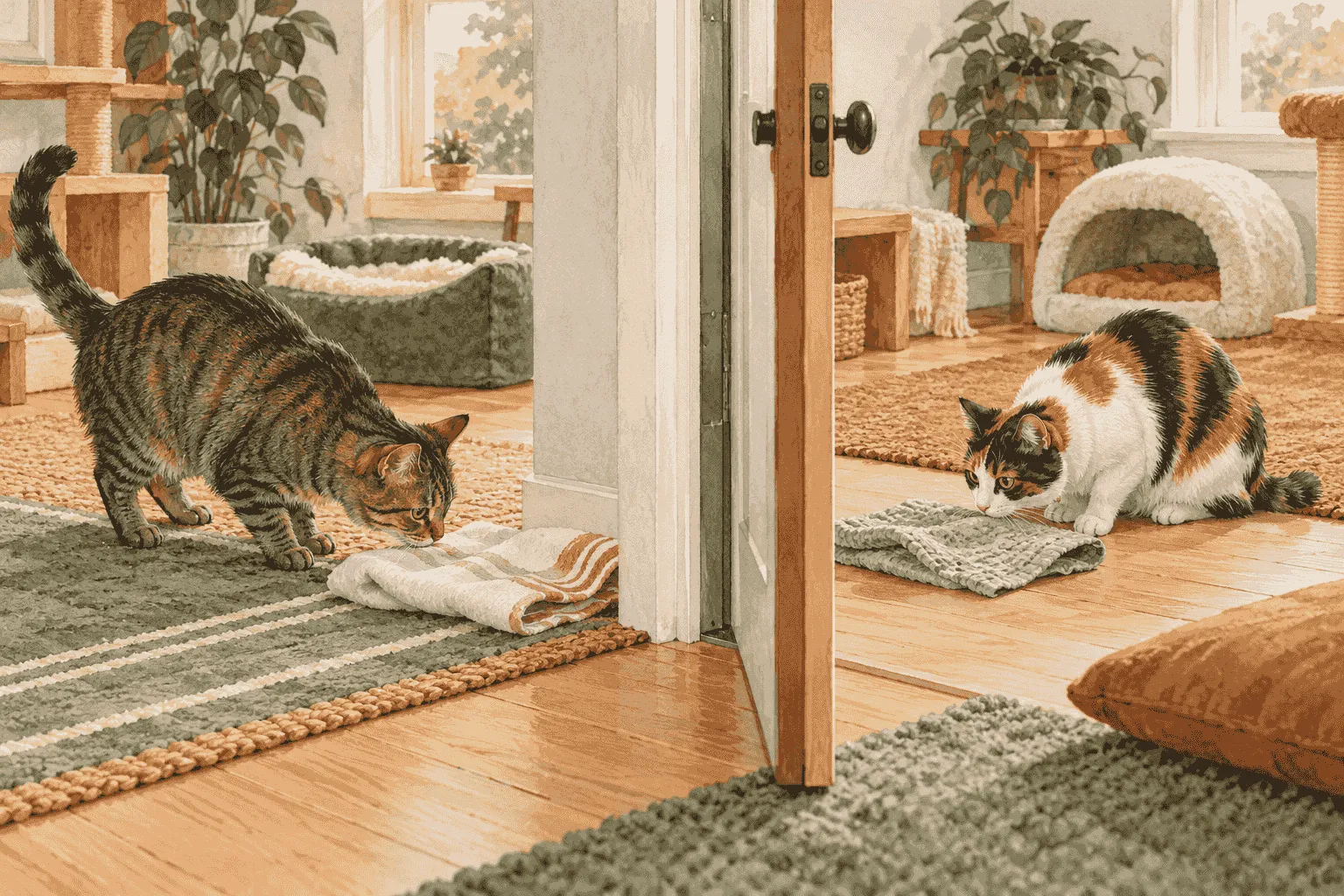
- Exchange scent gradually with a clean cloth or bedding item. Let each cat investigate at a distance and stop if either cat becomes more tense.
- Keep the route to each retreat open. A safe place should be somewhere a cat can enter, leave, and avoid being cornered.
Do not rub a scent onto a cat, force a nose-to-nose check, or treat one sniff as proof that the reset is complete. A hiss is a request for more distance, not a failed test. Back away calmly and give the cat another chance to choose.
Rebuild Contact in Three Stages
The 2024 intercat-tension guideline from the American Association of Feline Practitioners and Feline Veterinary Medical Association, alongside Cats Protection’s introduction guidance, supports a staged sequence. Use the cats’ behavior to decide whether to stay at a stage or go back one.
1. Scent before sight
Begin with separate rooms and scent exchange. Feed, play, or offer calm attention on each side of a closed door only when both cats can remain reasonably settled. If one cat stares at the door, blocks it, hides for longer, or stops ordinary activities, increase distance and simplify the setup.
2. Sight through a secure barrier
When the closed-door stage is calm, allow brief visual contact through a barrier that prevents chasing and lets both cats retreat. Keep the barrier interaction short enough that you can end while the cats are still coping. Hissing means pause and add distance; it is not an instruction to move the cats closer.
3. Brief supervised proximity
Only when both cats can look away, move normally, and disengage should you try a short physical interaction. Keep an exit route open and supervise without forcing play or touch. If tension rises, return to the last stage that was workable. There is no universal number of hours or days, and a slower reintroduction is not a failure.
Read More Than the Hiss
A hiss is one part of an interaction. The cat hissing context check explains why the sound needs the whole scene: watch posture, movement, distance, trigger, and what each cat does next. A brief hiss followed by retreat is different information from repeated staring, blocking, chasing, fleeing, hiding, or a loss of normal eating, grooming, play, or rest.
The guide to why cats fight adds a practical route check. Map food, water, litter, resting, and retreat areas rather than counting objects. Several bowls in one row can still be one contested station if one cat can block the route. Separated resources give each cat more usable choice while you assess the relationship; they do not guarantee that conflict will disappear.
Do not turn one encounter into a label such as “dominant,” “jealous,” or “aggressive.” The small study summarized in the approved evidence record found that isolated cat sounds produced less clear response differences than visual displays, with important limits. The safer lesson is simple: sound alone is not a household emotion dictionary.
When Professional Help Belongs in the Plan
Contact your veterinarian if the hissing is new for that cat, repeats when one body area is touched, or arrives with a wider change in appetite, drinking, toileting, movement, grooming, activity, or comfort. Do not press the area again to test a theory. Hissing can have a health context, but it cannot diagnose one at home.
Ask for veterinary or qualified behavior support when the cats cannot remain safely separated, repeated fights continue, one cat persistently blocks the other, or either cat cannot return to ordinary routines. Bring a short record of the veterinary visit, when the hissing started, what each cat did before and after it, and which stage of reintroduction was tolerable. A video can help only if it can be taken without provoking or delaying care.
Your next step is concrete: separate the cats, preserve familiar smells, record the whole pattern, and restart with scent before sight. A post-vet hiss may be a signal that the introduction needs rebuilding—not a verdict on the cats’ relationship.
Sources
Petzette's claim cards for this article point to the following scientific, veterinary, or animal-welfare sources.
- 2024 AAFP Intercat Tension Guideline Brief: Veterinary consensus-guideline brief
- Cats Protection Reintroducing Cats After A Veterinary Stay: Current cat-welfare guidance for reintroducing cats after separation
- Cats Protection Hissing Guidance: Current cat-welfare behavior guidance
- Cats Respond To Visual And Auditory Cues From Other Cats: Peer-reviewed home-based cat social-cognition experiment
Spoelstra KE, Vonk J, van Berlo E, Kok J, Kret ME. Purr-ceiving feelings: domestic cats respond to intraspecific cues of emotion. *PeerJ*. 2026;14:e21292.
- Cats Protection Gradual Cat Introductions: Animal-welfare behavior guidance