Behavior04 October 2026
Dog Growling but Wagging Its Tail: Read the Whole Moment
When a dog is growling but wagging its tail, pause the interaction, read the whole body, and choose space or help instead of guessing.
TextPetzette Editorial
Read5 Min
Evidence status
Source-backed editorial
- Evidence record
- 6 claim cards linked to 6 documented sources.
- Independent expert review
- Not commissioned. Petzette Editorial is responsible for the published wording.
- Source record checked
- 30 August 2026
- Scope
- General guidance. Individual animals and circumstances can differ.
When a dog is growling but wagging its tail, the two observations are not a code phrase you need to decode. A wagging tail is not permission to approach, and a growl does not translate the dog’s complete intention. The useful first decision is smaller: stop adding pressure, give the dog an exit, and watch what changes when the moment becomes easier.
A Growl and a Wag Do Not Cancel Each Other Out
It is tempting to call a growling, wagging dog “friendly,” “confused,” or “aggressive.” None of those labels follows from the two signals alone. Their coexistence tells you that you have heard one vocal cue and seen one movement. It does not identify the dog’s emotion, safety, or next action.
One controlled study gives the growl a narrower meaning. In a 2010 PLOS ONE experiment, 96 family dogs heard growls from 12 known-size dogs while viewing two projections of the same dog at different sizes. In the dog-picture and growl condition, 20 of 24 dogs looked first at the size-matched image, and the group looked longer at that match. The result supports access to a body-size cue in that food-guarding-growl task. It did not show that a growl reveals a live dog’s exact intent, identity, emotion, danger, or next move.
The study also does not support reducing a growl to pitch. The small and large growl sets differed in more than one acoustic feature, and the test used selected recordings and two-dimensional projections in a research room. Do not replay or imitate a growl to see what a dog will do. That would add pressure without answering the question safely.
Tail movement needs the same restraint. A 2007 Current Biology paper found that dogs showed different tail-wagging responses to different emotional stimuli. That supports reading tail movement in context, not treating a wag as a fixed translation. The safer interpretation of a wag is “look wider,” not “reach in.”
Make the First Move Less Crowded
If the growl happens while you are reaching, greeting, petting, harnessing, moving a bowl, or bringing the dog closer to another dog, pause that action. Stop the hand or forward movement; do not lean over the dog, hold the face still, or repeat the approach to get a clearer reaction. A growl is information. You do not need to prove what it means by making the same moment happen again.
Then create a little more choice. Step back, lower the pressure, open a route away, or use the setting’s existing separation arrangement. If the dog chooses distance, let that distance stand. If the body softens after the pressure changes, record that as part of the pattern rather than treating it as a permanent “all clear.” If the dog stays tense, continues vocalizing, or cannot move away safely, end the interaction and seek help rather than testing another cue.
For an unfamiliar dog, owner permission is only one part of a greeting. A wagging tail does not require the dog to come closer, and a growl is a reason to stop the approach. Keep your body and hands out of the dog’s route, do not hug or corner the dog, and let the owner manage their dog. The whole-body dog-language pause map gives a broader way to decide when to lower pressure before you attach a feeling to one signal.
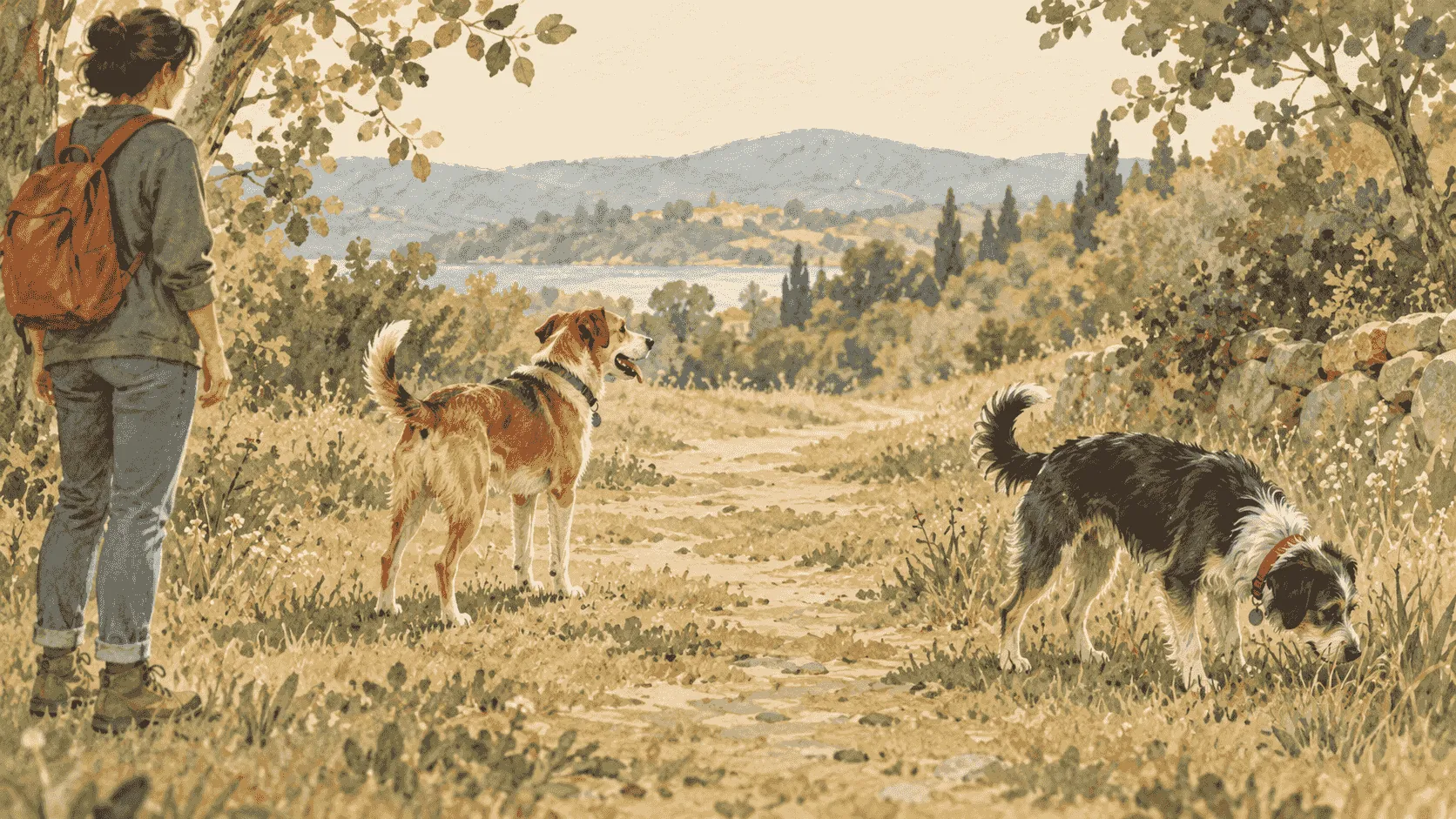
Read the Whole Dog and the Sequence
Dogs Trust and the RSPCA recommend reading the individual dog, the whole body, and the situation. Take a quick snapshot rather than a score:
- Before: What changed just before the growl? Note a hand moving closer, a resting place, food, a doorway, a visitor, a noise, a lead, or another dog.
- During: Does the body look loose or held tight? Notice weight, posture, face, ears, mouth, tail, movement, distance, and whether the dog has a route away.
- Choice: Is the dog approaching, freezing, turning away, moving behind a person, holding position, or trying to create more space?
- After: What happens when you stop, add distance, or remove the new pressure? Does the dog settle, leave, reorient, or remain tense?
This is observation, not an emotion test. A 2022 controlled study of 28 dogs found that no individual facial action consistently classified the study’s reward-context conditions, and a 2024 systematic review found limited validation across observational dog-welfare measures. That evidence does not make body language useless. It explains why one wag, growl, ear position, lip lick, or owner-made tally cannot diagnose fear, pain, aggression, happiness, or safety.
Look for combinations and changes from this dog’s ordinary pattern. A lowered body, turned head, ears back, tucked tail, lip lick, yawn, or lifted paw may matter more when they occur together with a matching situation and a wish for distance. They still do not tell you the complete cause. The practical response is to reduce pressure and preserve options while you learn what repeats.
If the Growl Happens Around Another Dog
A growl during play or a puppy introduction needs two-dog context. Do not use the wag as proof that both dogs are comfortable, and do not use the growl alone as a complete aggression label. Pause the interaction briefly and give both dogs room to show what they choose next.
If both dogs stay loose and voluntarily return, play may continue in a lower-key burst, while keeping the whole exchange under observation. If one dog uses the pause to walk away, hide, turn out, or avoid re-engaging, let the break become the ending or extend it. Leaving is useful information, not a problem to solve by luring the dog back. If one dog keeps applying pressure, the bodies become stiff, or a route out closes, end the interaction and add more distance. Do not grab between escalating dogs or ask them to sort it out.
For a puppy meeting a resident dog, use the new-puppy introduction plan with built-in space. The dog play guide explains why a short break is an observation tool rather than a guarantee that every pairing is safe.
Know When Observation Is Not Enough
Ask your veterinarian about a sudden, marked, persistent, or concerning change in growling or body language, especially when the pattern appears alongside a wider change in comfort or behavior. A home observation can describe timing; it cannot identify a medical influence or diagnose what the dog feels.
Seek qualified behavior support for repeated escalation, significant aggression, guarding, bite risk, injury, or a dog who cannot disengage safely. Do not punish the growl, replay it, provoke it, or keep moving closer to test whether the tail is still wagging. If it is safe to record a naturally occurring pattern, note what happened before and after; never follow, corner, restrain, or recreate the trigger for a better clip.
The bottom line is simple: a growl plus a wag is an ambiguous observation, not a friendly pass and not a complete danger verdict. Pause, give space, read the whole sequence, and let a veterinarian or qualified behavior professional handle what careful observation cannot settle.
Sources
Petzette's claim cards for this article point to the following scientific, veterinary, or animal-welfare sources.
- Dogs Matched Growl Cues To A Signaler's Body Size: Peer-reviewed canine cross-modal preferential-looking experiment
Faragó T, Pongrácz P, Miklósi Á, Huber L, Virányi Z, Range F. Dogs' expectation about signalers' body size by virtue of their growls. *PLOS ONE*. 2010;5(12):e15175.
- Dog Tail Wag Direction And Emotional Stimuli: Peer-reviewed paper
- Dog Body-Language Observation Limits And Raised-Hackles Context: Cross-source peer-reviewed canine-welfare evidence and established animal-welfare guidance. This note supports a narrow public boundary: visible cues can guide calmer observation and space, but neither one cue nor an owner-made tally is a validated at-home emotion, stress, welfare, aggression, pain, or bite-prediction test.
- Bremhorst A, Mills DS, Würbel H, Riemer S. *Evaluating the accuracy of facial expressions as emotion indicators across contexts in dogs.* Animal Cognition. 2022;25:121-136. doi:10.1007/s10071-021-01532-1; PMID:34338869; PMCID:PMC8904359. The directly rendered PMC full text reports a 28-dog laboratory study of positive anticipation and frustration across food and toy contexts. Although several facial actions differed between the study conditions, no individual action consistently classified the associated state. The authors state that diagnostic-accuracy measures are needed for candidate emotion indicators.
- Dogs Trust Body Language Context Guidance: Welfare organization dog body-language guidance
- RSPCA Dog Body Language: Animal-welfare behavior guidance
- Dogs Trust Play Breaks And Body-Language Check: Animal-welfare behavior guidance