Gear Decisions12 July 2026
Dog Harness Fit: Purpose, Comfort, and Movement Checks
A dog harness should fit the individual dog and the task. Learn how to check security, rubbing, movement, comfort, and training expectations.
TextPetzette Editorial
Read4 Min
Evidence status
Source-backed editorial
- Evidence record
- 3 claim cards linked to 3 documented sources.
- Independent expert review
- Not commissioned. Petzette Editorial is responsible for the published wording.
- Source record checked
- 11 July 2026
- Scope
- General guidance. Individual animals and circumstances can differ.
A dog harness is useful when it fits the individual dog and the job you expect it to do. Shape labels, dramatic promises, and breed-size categories cannot replace checking security, contact points, movement, and comfort on the dog in front of you.
That makes the most useful dog harness guide a practical fitting routine, not a shopping podium. Start with the intended activity, observe an ordinary walk, and keep reassessing as your dog grows or changes shape.
There Is No Universal Best Dog Harness Shape
A 2026 review in Frontiers in Veterinary Science examined the limited research on dog-worn equipment. Across published gait studies, every investigated harness type changed at least one measured aspect of movement. The size and direction of those changes varied among designs, dogs, tasks, and studies.
That finding does not establish that ordinary harness use causes pain, injury, arthritis, or future disease. A change in a joint angle or stride measurement is not the same as harm. It also means labels such as “restrictive” and “non-restrictive” do not create a dependable universal safety ranking.
The evidence supports a quieter conclusion: choose for the individual dog and purpose, then check what happens in real use. A design that sits comfortably and securely on one dog may contact a different place on another body shape.
How a Dog Harness Should Fit the Individual
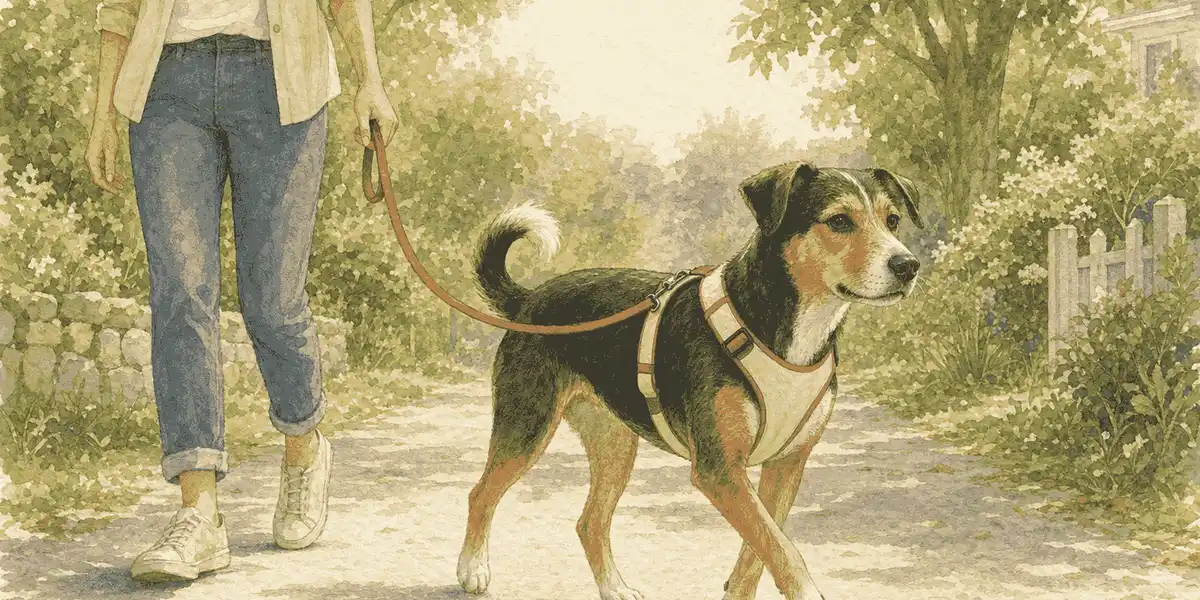
Begin with the activity. A routine neighborhood walk is not the same task as running, prolonged working use, vehicle restraint, or mobility support. Specialized jobs can bring different fit and safety requirements, so do not assume an everyday walking harness is interchangeable with equipment made for another purpose.
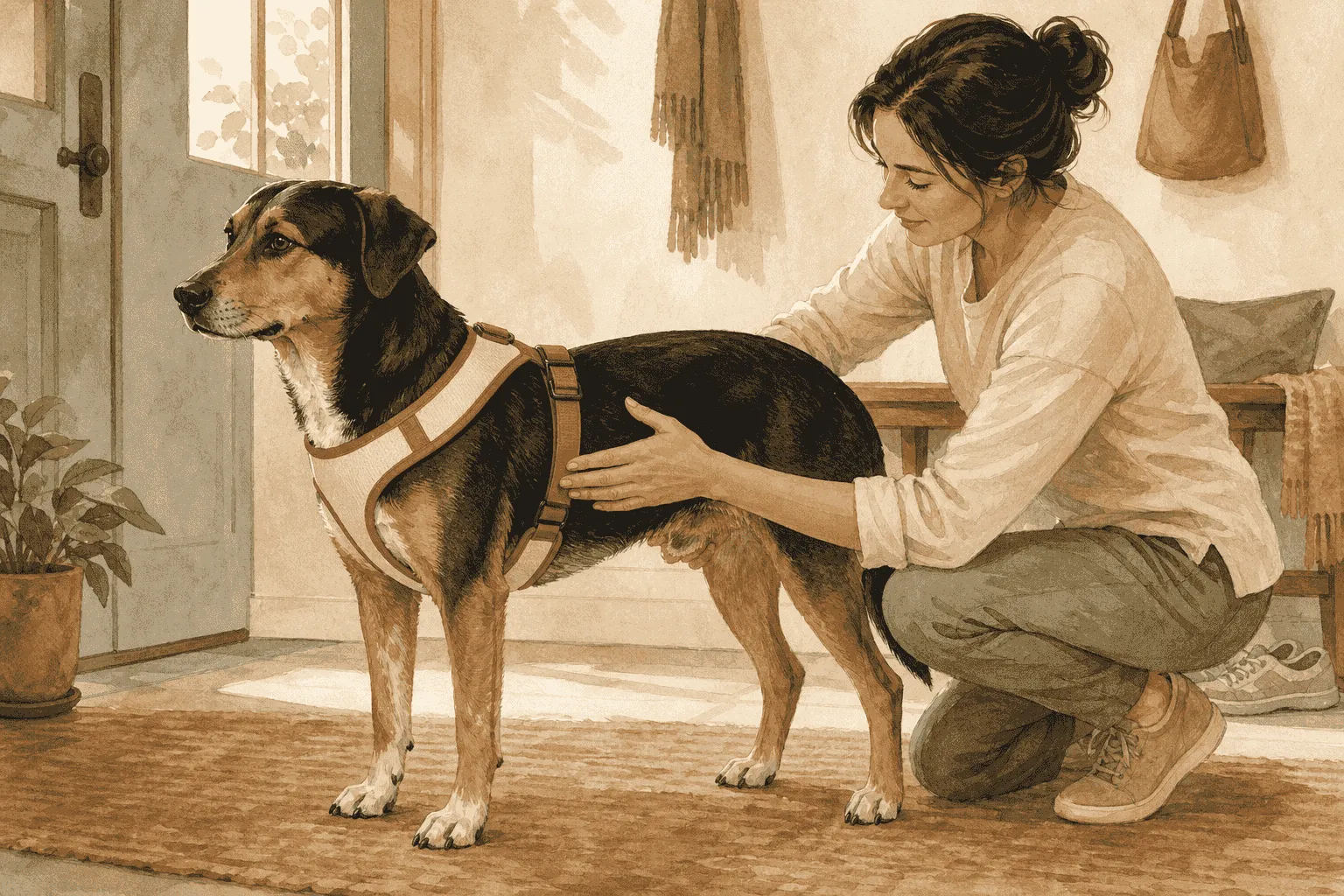
With the harness adjusted, look at the whole setup:
- It stays secure as the dog stands, turns, and walks.
- Straps lie flat rather than twisting or trapping folds of material.
- Contact points are not rubbing the skin or catching the coat.
- The dog can use a normal posture and natural movement for that individual.
- Fastenings and the leash attachment remain in their intended positions.
There is no universal finger-width rule that guarantees fit across every coat, body shape, design, escape risk, and task. Use the manufacturer’s basic fitting instructions as a starting point, then judge the result on your dog. Recheck a growing puppy and any dog whose coat, muscle, weight, or mobility changes.
Watch Movement and the Whole Dog
Let your dog take a few calm steps before deciding the fit is finished. Watch from the side and behind if you can do so safely. Compare the walk with your dog’s familiar baseline rather than expecting one ideal picture for every dog.
Comfort also needs context. Dogs Trust advises reading the individual dog, the whole body, and the situation because one signal can carry different meanings in different moments. A single glance, pause, or lip lick cannot diagnose discomfort. A cluster of changes during harness handling or walking is a reason to stop, simplify the setup, and look again. For more on that approach, see how to read your dog’s whole body in context.
Check the harness after the walk as well. Look for shifted straps, caught coat, or areas of rubbing. Persistent reluctance, an altered gait, lameness, pain, skin injury, breathing difficulty, or a sudden behavior change deserves veterinary guidance. Dogs with unusual anatomy, eye disease, or mobility-support needs may also benefit from individual advice from a veterinarian or qualified rehabilitation professional.
A No-Pull Dog Harness Is Not a Training Plan
Equipment can change how leash forces are applied, but the current evidence does not support promising that a harness prevents pulling. A “no-pull” label should not be treated as proof that the product will teach loose-leash walking or solve the reason a dog surges ahead.
Training is a separate job. The American Veterinary Society of Animal Behavior recommends reward-based methods that teach the behavior you want without relying on fear, pain, intimidation, or discomfort. On a walk, that can mean rewarding moments when the leash is loose and setting up short practice where the environment is manageable.
Reward-based training still includes structure and boundaries. It simply teaches the next useful action rather than asking equipment to do all the teaching. If pulling comes with serious fear, aggression, or another concerning behavior, seek veterinary and qualified behavior support instead of escalating equipment pressure.
Recheck Fit Instead of Trusting the Label
Before heading out, run one final review: Is this harness appropriate for today’s task? Does it remain secure without rubbing? Can your dog stand, turn, and walk in their familiar way? Does the whole dog look comfortable in this context? Has anything changed since the last fitting?
The best dog harness is not a universal shape or a named product. It is an appropriately used piece of equipment that fits this dog, for this task, today—and gets checked again tomorrow.
Sources
Petzette's claim cards for this article point to the following scientific, veterinary, or animal-welfare sources.
- Dog-Worn Equipment Health Review 2026: Peer-reviewed narrative review of physical risks and evidence gaps
Ridgway M. Health implications of dog-worn equipment: a review of known and alleged physical risks. Frontiers in Veterinary Science. 2026;13:1711781.
- Dogs Trust Body Language Context Guidance: Welfare organization dog body-language guidance
- AVSAB Humane Dog Training 2021: Veterinary behavior society position statement