Gear Decisions12 August 2026
Puppy Cleaning Supplies: A Label-Led Safety Plan
Puppy cleaning supplies should support label-led use, secure storage, and a clear plan if a cleaner may have reached your dog.
TextPetzette Editorial
Read4 Min

Evidence status
Source-backed editorial
- Evidence record
- 2 claim cards linked to 1 documented source.
- Independent expert review
- Not commissioned. Petzette Editorial is responsible for the published wording.
- Source record checked
- 12 August 2026
- Scope
- General guidance. Individual animals and circumstances can differ.
Puppy cleaning supplies can sound like a shopping list. The more useful decision is a household routine: use each product as its own label directs, keep your puppy away while it is in use, and keep the product information available if contact may have happened. A familiar, scented, natural, diluted, or dry product is not a universal safety answer.
This is not a product-ranking guide. The word cleaner covers products with different instructions and different risks. A small label-and-access plan is more useful than treating one front-of-bottle claim as a universal answer.
Start With the Job, Not a “Pet-Safe” Label
ASPCA Animal Poison Control guidance emphasizes following the directions for the individual cleaning product. That keeps the decision tied to what is actually in your hand rather than to a broad category, a smell, or a marketing term.
Before adding a cleaner to your puppy setup, ask one practical question: can everyone in the home use it exactly as its label directs? That includes its instructions for dilution, ventilation, rinsing, drying, and re-entry where those instructions apply. If the label does not fit the surface, room, or way you plan to use the product, pause rather than filling in the gaps with a generic rule.
The goal is not to make the home sterile or to collect a universal approved list. It is to make access and instructions easy to follow on an ordinary day.
Make a Three-Part Cleaning Setup
Set up the process before a spill or muddy-paw moment creates a rush:
- Keep the original container. Put each cleaner away where your puppy cannot reach it. The original label is more useful than a mystery bottle if a question comes up later.
- Give the puppy a different place to be. Keep your puppy out of the working area while you clean. Use the product’s own directions to decide what needs to happen before that area is used again.
- Treat the label as the return plan. Follow its directions for ventilation, rinsing, drying, and re-entry instead of making up one household waiting time.
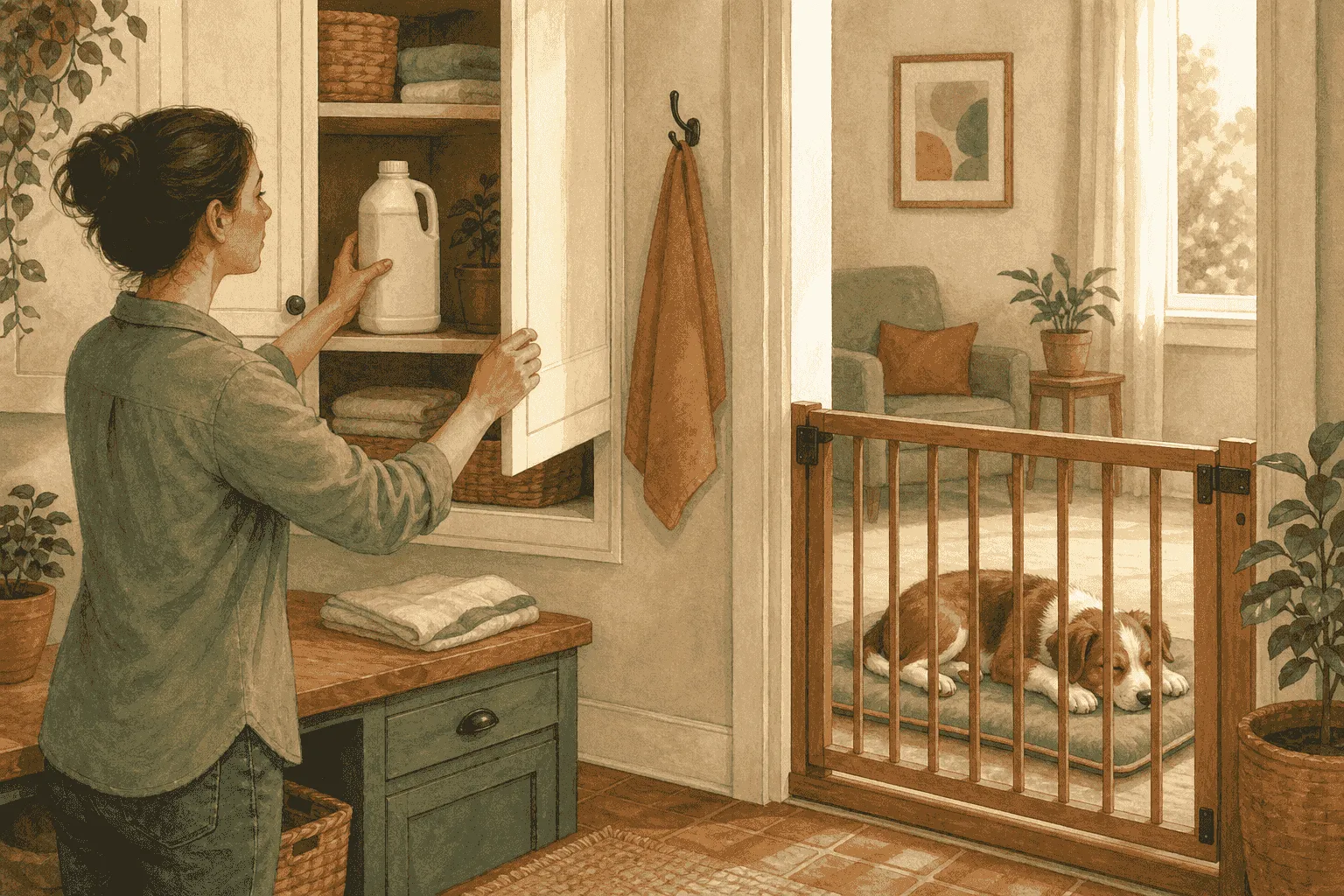
This approach makes cleaning supplies part of the home setup without turning them into a product recommendation. It also gives visitors and other caregivers a clear rule: the container stays identifiable, the puppy stays out of the area during cleaning, and the label decides the next step.
Keep the First-Week List Focused
Your broader first-week puppy supplies checklist covers rest, food, reward-based training, play, and walking equipment. Cleaning products serve a different job. They belong in the home-access plan, not in a shopping contest or a claim that one product handles every surface and every puppy.
That distinction matters as your puppy starts exploring. A product does not become suitable because the puppy has seen it before, and a cleaner is not automatically a crisis because it is present in the home. Use its own directions and protect access so you do not have to guess after the fact.
If a Cleaner May Have Reached Your Puppy
If your puppy may have licked, chewed, swallowed, or gotten a cleaner on fur, skin, or eyes, keep the container or take a clear photo of the full label if it is safe to do so. Then contact a veterinarian or animal poison-control service promptly.
Cornell University College of Veterinary Medicine treats exact product information as useful for professional assessment. Do not choose a response from the word “cleaner,” the color, the smell, or the appearance of your puppy. Do not independently induce vomiting or give food, milk, water, charcoal, a neutralizer, medicine, or another home response unless the professional directs it.
This page cannot determine what a particular exposure means. The useful next step is to preserve the product information, prevent further access, and make the call.
A Two-Minute Check for Today
- Put cleaning products in their original containers where your puppy cannot get to them.
- Read the directions for the products you already use, especially the parts about dilution, ventilation, rinsing, drying, and re-entry.
- Choose a puppy-free place for cleaning time and a clear route back into the room.
- Save your veterinarian and preferred animal poison-control contact before there is an urgent question.
Household food needs a separate access plan too; three food hazards to check around dogs can help you keep that decision distinct. For puppy cleaning supplies, the durable plan is simpler: follow the exact label, control access, and let a professional guide any possible exposure.
Sources
Petzette's claim cards for this article point to the following scientific, veterinary, or animal-welfare sources.
- Household Cleaning Products: Label-Led Prevention And Exposure-Information Boundary: Current veterinary toxicology and veterinary-school guidance, animal poison-control education, established cat-welfare guidance, a peer-reviewed feline disinfection guideline, and limited companion-animal case reports
- Gwaltney-Brant SM. *Toxicoses From Corrosive Agents in Animals.* Merck Veterinary Manual, Veterinary Professionals. Full review and last update March 2025; peer reviewed by Ahna Brutlag, DVM, DABT, DABVT. The source distinguishes acidic and alkaline corrosives from cationic detergents and shows why an everyday category such as “cleaner” cannot identify one risk or one response.