Health Signals07 September 2026
Senior Dog Care: Build a First-Year Observation Plan
Senior dog care is an individual plan. Learn what to set up at home, what changes to record, and when a veterinarian should guide the next step.
TextPetzette Editorial
Read6 Min
Evidence status
Source-backed editorial
- Evidence record
- 4 claim cards linked to 3 documented sources.
- Independent expert review
- Not commissioned. Petzette Editorial is responsible for the published wording.
- Source record checked
- 03 September 2026
- Scope
- General information, not an individual diagnosis or treatment plan.
Senior dog care is easier to manage when it starts with ordinary days rather than a fixed birthday or a frightening list of possible problems. If a dog is new to your household, the first-year decision is practical: which parts of the home should be easier to use, what changes are worth recording, and when should a veterinarian guide the next step?
The plan below is not a diagnosis or a promise that a home adjustment will solve a mobility change. It is a way to notice the dog in front of you, reduce one avoidable obstacle, and take a more useful record to the veterinary team.
Start With the Life Stage, Not a Birthday
There is no universal age at which every dog becomes senior. The American Animal Hospital Association’s (AAHA) canine life-stage framework describes a senior dog as being in the last 25% of its estimated lifespan through the end of life. That is an estimate, not a lifespan forecast or an online age calculator.
Breed, size, expected lifespan, health, lifestyle, and the dog’s records all provide context, but none of them settles the question alone. The veterinary team can use those details to discuss the relevant life stage and the care plan that makes sense for this dog. The senior life-stage guide explains the age question in more detail; this guide starts with what to do once you are planning daily life together.
For a new owner, make a short starting record instead of trying to assign an exact senior age. Note the dog’s known history, usual routes, resting places, and any veterinary instructions already in place. If the history is thin, that uncertainty is useful information to bring to the first appointment. Senior status does not mean that a dog is ill, and a calm first week does not prove that every care question has been answered.
Remove One Daily Obstacle First
AAHA’s 2023 Senior Care Guidelines treat environmental support as part of senior care alongside veterinary assessment, behavior, and caregiver support. The most useful first change may be small: make one route less slippery, move a resting place somewhere easier to reach, or remove an obstacle that the dog has to negotiate several times a day.
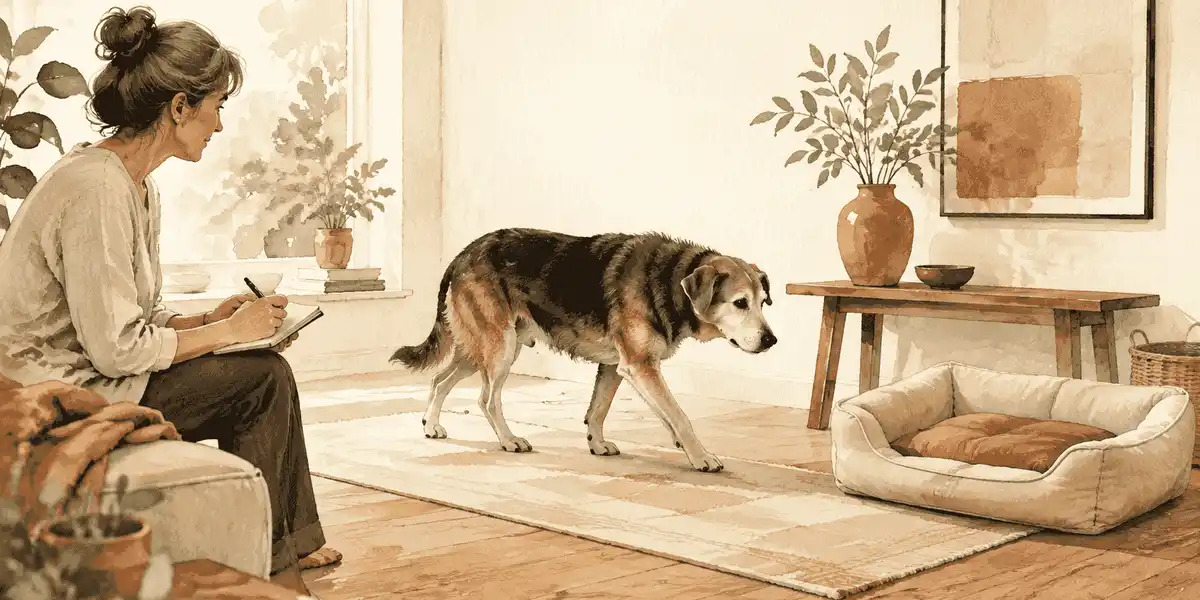
Walk through the home at the dog’s pace and look for the route between the places that matter. Consider the path to the bed, food and water area, door, and usual family room. Is there a smooth turn, a narrow gap, a step, or a surface that changes underfoot? A grippy surface, an easier route, or an accessible padded bed may help some senior pets use their space more comfortably. Choose the change for the individual dog rather than installing every possible aid.
Keep the adjustment stable and easy to understand. A ramp or altered route should not create a new wobble or force the dog into a difficult approach. Let the dog choose whether to use a resting place, and observe whether the route is actually easier. A rug does not treat arthritis, and a ramp does not tell you why a dog has slowed down. New or worsening movement changes still belong in a veterinary conversation.
Record the Ordinary Before You Record a Problem
A useful first-year observation is repeatable and boring. Choose one ordinary route and notice how the dog rises, turns, walks, uses a step or stairs, and settles again. You are looking for a pattern across normal days, not trying to score the dog or interpret one awkward moment.
Keep the note brief:
- Date the observation. Write down when the route or behavior looked different from the dog’s usual baseline.
- Describe what happened. Use visible words such as paused, stood slowly, slipped, avoided, limped, or rested. Do not add a disease label.
- Add the context. Note the surface, stairs, time of day, weather if it clearly changes the route, and whether the change happened once or kept returning.
- Record what happened next. Did the dog choose another route, settle, or return to the ordinary pattern? That still does not explain the cause, but it gives the veterinary team a clearer starting point.
AAHA’s senior-care guidance says that photos or short videos of movement and behavior at home can show context that may not appear in the clinic. If you make a clip, film an ordinary route from a safe position without calling the dog onto difficult stairs, repeating a movement for the camera, or blocking the exit. A short rise, turn, walk, or settling moment is enough. The clip supports a conversation; it cannot diagnose arthritis, neurological disease, or another cause.
Treat New Hesitation as a Question, Not a Verdict
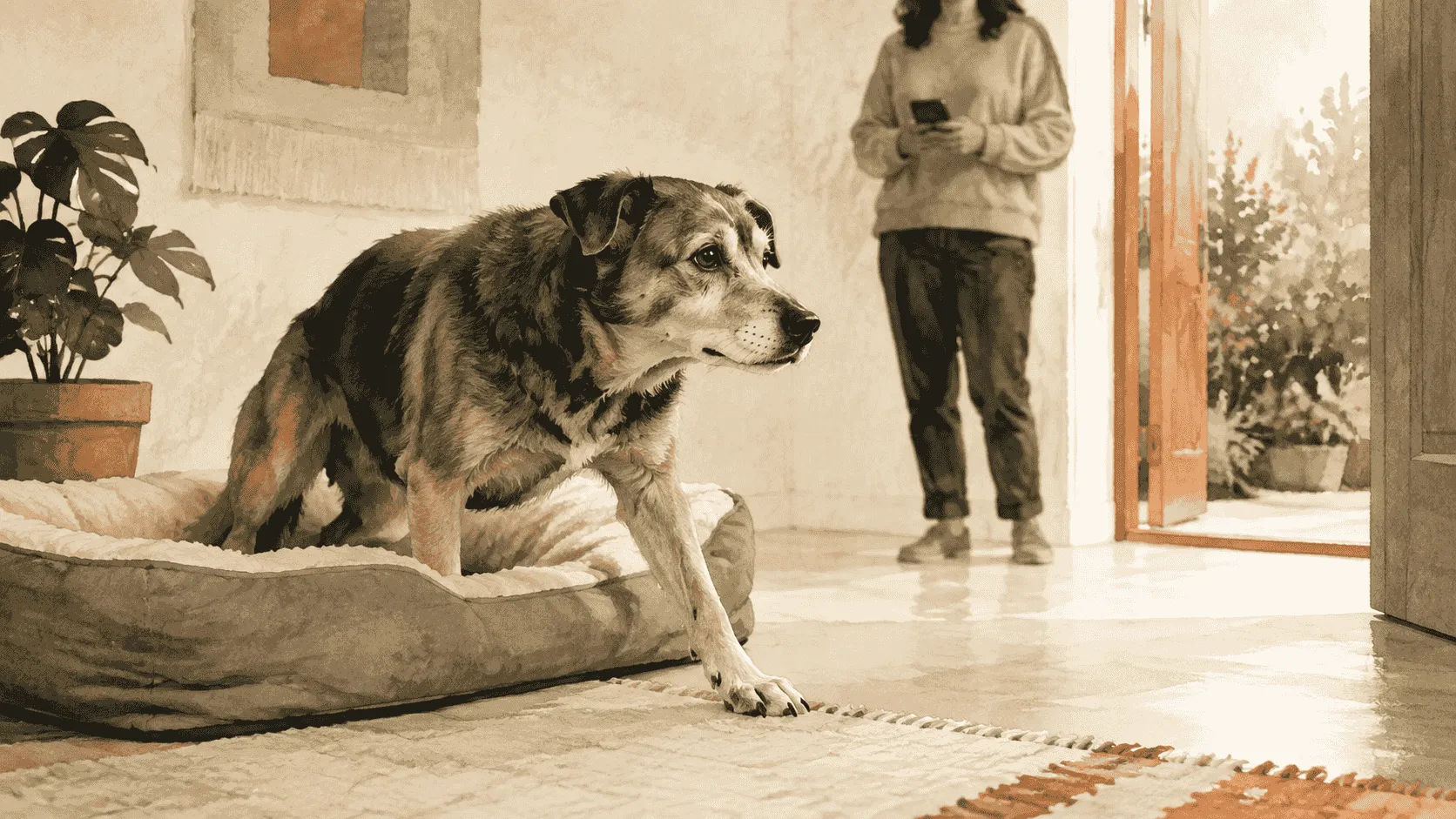
Older dogs can slow down, but “old age” is not a diagnosis. VCA Animal Hospitals’ veterinary education describes possible pain-related behavior changes that can include difficulty getting up, slow standing, limping, avoiding slippery floors, reluctance to jump, reluctance to go up or down stairs, altered posture, and restlessness at night.
None of those signs identifies a single cause by itself. A pause at the stairs may have more than one explanation, and one video cannot tell you which one is relevant. The useful threshold is change: if hesitation is new, getting worse, or appearing with other movement or behavior changes, contact a veterinarian and share the dated notes or ordinary clip. Ask what should be checked and which parts of the home plan are appropriate while you wait.
Do not make the dog repeat a difficult movement to prove that something is wrong. Do not medicate, add supplements, or use a home remedy based on a symptom match. If the dog seems acutely unwell, cannot move normally, or you are worried about a sudden severe change, seek prompt veterinary guidance instead of relying on an observation plan.
Build the First-Year Plan Around Check-ins
Once the baseline is written, keep the plan small enough to maintain. A useful check-in can cover four questions:
- What is the dog’s usual route? Keep the important path clear, stable, and reachable.
- What has changed? Record a repeated difference in rising, turning, walking, stairs, resting, or behavior without naming its cause.
- What was adjusted? Note the date of a new surface, bed position, or route so you can tell what changed before the dog’s response.
- What should the veterinarian see? Bring the history, notes, and any safely captured ordinary video to the next discussion, especially when a change is new or worsening.
This keeps senior dog care responsive without turning every quiet day into a test. It also leaves room for the dog’s other decisions. If food, appetite, body condition, or muscle is changing, use the separate senior dog food fit check rather than treating a home mobility plan as a nutrition answer.
Your next step is concrete: walk the dog’s most-used route today, remove one avoidable obstacle, and write down the ordinary movement you want to compare later. If the dog is newly hesitant, repeatedly struggling, or showing another concerning change, send that record to a veterinarian. The goal is not to prove that a dog is “just getting old”; it is to make daily life easier to observe and professional help easier to direct.
Sources
Petzette's claim cards for this article point to the following scientific, veterinary, or animal-welfare sources.
- AAHA Canine Senior Life-Stage Definition: Veterinary practice guideline
- Creevy KE, Grady J, Little SE, et al. 2019 AAHA Canine Life Stage Guidelines.
- AAHA Senior Care Guidelines 2023: Veterinary practice guideline
- VCA Pain Signals In Aging Dogs: Veterinary hospital owner education article