Health Signals03 September 2026
When Is a Dog Considered a Senior? Use the Life-Stage Framework
When is a dog considered a senior? AAHA's life-stage framework uses the last 25% of estimated lifespan, not one age for every dog.
TextPetzette Editorial
Read4 Min

Evidence status
Source-backed editorial
- Evidence record
- 6 claim cards linked to 5 documented sources.
- Independent expert review
- Not commissioned. Petzette Editorial is responsible for the published wording.
- Source record checked
- 03 September 2026
- Scope
- General information, not an individual diagnosis or treatment plan.
When is a dog considered a senior? There is no single birthday that answers that question for every dog. The American Animal Hospital Association (AAHA) uses a life-stage framework: a dog enters the senior stage during the last 25% of its estimated lifespan through the end of life. That is a useful starting point, not a promise about how long one dog will live.
The practical decision is whether to start planning with a senior-care lens, not whether an age chart has given your dog a definitive label. Use the framework to prepare better questions, check the home for ordinary obstacles, and bring meaningful changes to a veterinarian.
The Short Answer Is a Life-Stage Estimate
AAHA’s 2023 Senior Care Guidelines say that no specific chronological age defines senior status because dogs vary in how they age and in their estimated lifespans. The 2019 AAHA Canine Life Stage Guidelines describe the senior stage as the last 25% of estimated lifespan through end of life.
That wording matters. It does not mean that every dog has a known countdown or that you can calculate an exact senior birthday from a breed label. It means the veterinary team can discuss a dog’s life stage using the available records, breed and size context, estimated lifespan, health, and lifestyle.
For a newly adopted dog, records may be incomplete. That uncertainty is a reason to ask for the best available history and arrange a veterinary conversation, not a reason to invent a precise age. A dog can be in a senior life stage without being ill, and an age label cannot explain a new symptom or behavior change.
Why a Seven-Year Chart Is a Poor Shortcut
The familiar “one dog year equals seven human years” rule is easy to remember, but it is not a defensible biological rule. A 2020 Cell Systems study of 104 Labrador retrievers found a nonlinear relationship between dog and human DNA methylation changes. The study is useful for showing why aging comparisons depend on life stage and model choice; it was not a clinical age test for every breed.
Longevity data also needs a boundary. A Scientific Reports study analyzed 584,734 UK dogs and reported differences in longevity by population, breed, body size, face shape, and sex. Those are population patterns, not a forecast for an individual dog. If you are reading a lifespan list, the longest-living dog breeds guide explains how to keep the method and its limits visible.
So what should you do with a breed or size estimate? Treat it as background for a conversation. Do not use it to announce that a dog is “definitely senior” on a particular birthday, and do not use it to predict the years remaining.
Turn the Label Into Four Useful Questions
When you want to know whether senior-care planning is relevant, write down four questions for the veterinary team:
- What is known about this dog’s age and history? Bring adoption or breeder records, previous veterinary information, and any uncertainty about the estimate.
- Which life-stage plan fits this individual? Ask how the dog’s context affects preventive-care conversations instead of asking for a universal senior-age number.
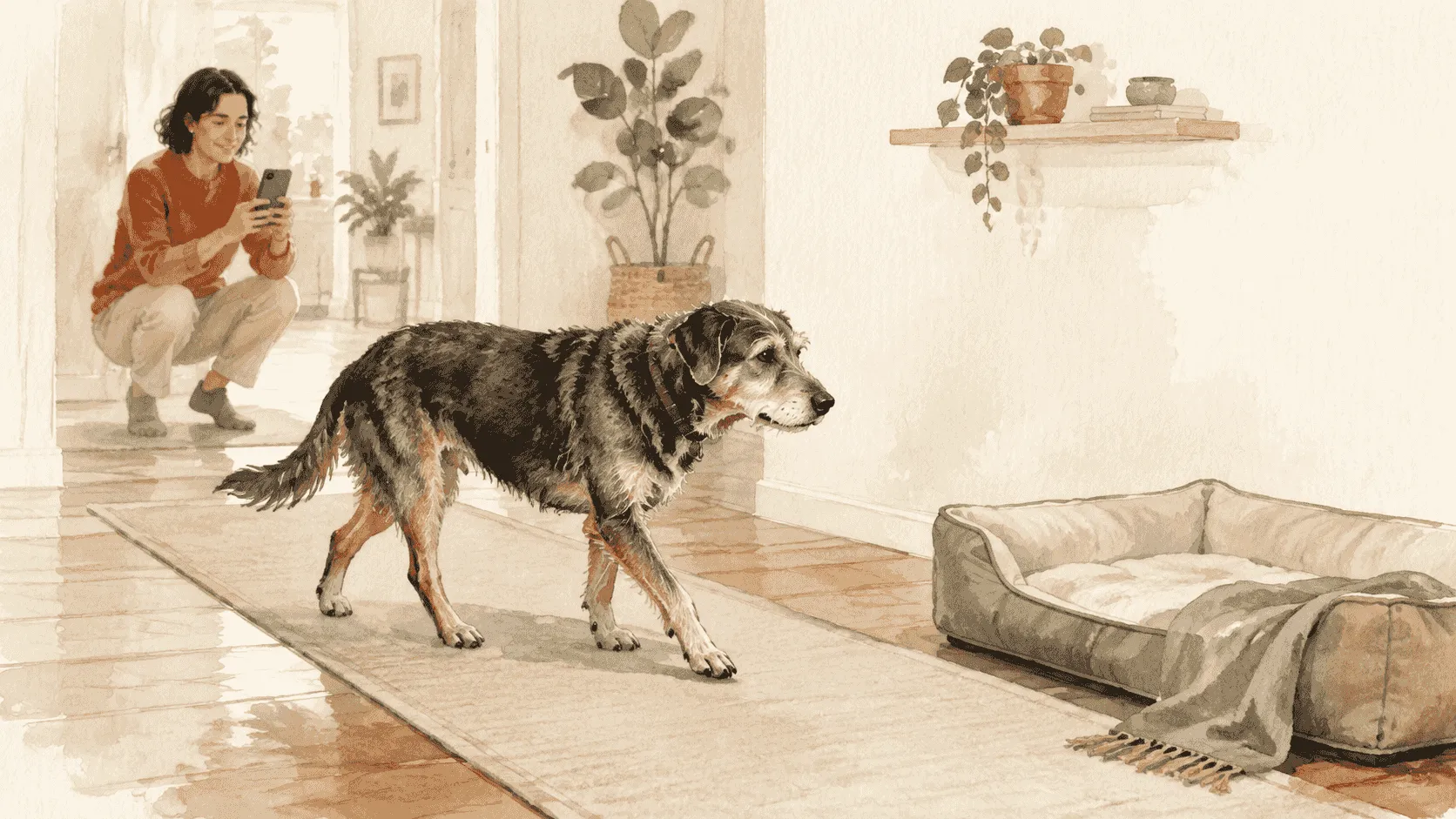
- What does the ordinary week look like? Note the dog’s usual movement, rest, routine, and behavior so a change can be described clearly. A short home video can give the veterinary team context that may not appear during a clinic visit.
- Where does the home make movement harder? Look for slick flooring, awkward routes, or a resting place that is difficult to reach. For some senior pets, better traction, an easier route, or accessible padded bedding can remove a daily obstacle. Any ramp or support needs to be stable and appropriate for that individual dog.
If a senior dog is joining your household, the first-year senior dog rescue fit plan can help you test routine, home access, and unknowns before pickup. The age question is only one part of making the week workable.
Watch for Change Without Trying to Diagnose It
Senior status is a planning frame, not an explanation for every difference. VCA’s veterinary education guidance lists possible pain-related changes in aging dogs such as difficulty getting up, reluctance to jump or use stairs, avoiding slippery floors, altered posture, and restlessness. A single observation does not identify the cause, and stairs do not automatically mean pain. If a movement or behavior change is new, worsening, or concerning, ask a veterinarian to assess it rather than trying to name the condition at home.
If you film a clip, capture one ordinary movement from a safe distance: getting up from the usual bed, turning on the usual route, or walking across the usual floor. Do not stage a difficult movement or repeat stairs to get a better video. The recording supports a professional conversation; it does not replace an examination. Do not delay needed care while collecting footage.
Make the Senior Decision Specific to This Dog
The best answer to “when is a dog considered a senior?” is a framework plus an individual check. AAHA’s last-quarter estimate tells you why one universal age chart is too simple. The dog’s records, expected lifespan context, routine, home routes, and observed changes tell you what to discuss next.
For a new dog, start a one-page note: what is known, what is uncertain, what the ordinary week looks like, and which movement or access questions you want answered. Then bring that note to the veterinary team. Senior status is not a diagnosis and does not decide the dog’s future; it is a prompt to make care, observation, and the next professional conversation more individual.
Sources
Petzette's claim cards for this article point to the following scientific, veterinary, or animal-welfare sources.
- AAHA Canine Senior Life-Stage Definition: Veterinary practice guideline
- Creevy KE, Grady J, Little SE, et al. 2019 AAHA Canine Life Stage Guidelines.
- Dog-To-Human Aging Is Nonlinear In A Labrador Methylome Study: Peer-reviewed comparative epigenetics study
Wang T, Ma J, Hogan AN, et al. Quantitative Translation of Dog-to-Human Aging by Conserved Remodeling of the DNA Methylome. Cell Systems. 2020;11(2):176-185.e6.
- Dog Breed Longevity Scientific Reports 2024: Peer-reviewed paper with welfare-organisation summary
- AAHA Senior Care Guidelines 2023: Veterinary practice guideline
- VCA Pain Signals In Aging Dogs: Veterinary hospital owner education article