Behavior28 August 2026
Why Do Cats Chirp? Read the Whole Scene
Why do cats chirp? Learn what a window-and-wildlife scene can add, why the reason stays uncertain, and when a changed pattern needs a veterinarian.
TextPetzette Editorial
Read5 Min
Evidence status
Source-backed editorial
- Evidence record
- 5 claim cards linked to 8 documented sources.
- Independent expert review
- Not commissioned. Petzette Editorial is responsible for the published wording.
- Source record checked
- 28 August 2026
- Scope
- General guidance. Individual animals and circumstances can differ.
Why do cats chirp? For a new cat owner, the useful answer is not “because your cat is copying a bird.” A chirp can fit a window-and-wildlife scene, a greeting, or another individual context, but the sound label is not a complete explanation. Start with what happened around the sound, read the whole cat, and choose a low-pressure next step.
What Cat Chirping Actually Describes
The word chirp describes a sound before it explains a reason. A 2020 review in the Journal of Veterinary Science describes a cat chirp as a short, high-pitched call; a sequence may be called a chirrup. Its ethogram lists reported contexts such as contact, locating another cat, and wanting something. Those are useful categories from the literature, not a universal household translation.
The review also separates chirping from chattering and emphasizes that cat vocalizations vary in pitch, duration, intensity, and pattern between individuals. Two sounds that owners group under the same word may not carry the same information for the cats producing them. Treat the label as a starting point for observation.
There is a useful limit in the primary evidence. In a 2013 Lund University pilot study, researchers recorded 257 vocalizations from three domestic cats while they watched birds through a window. They sorted the sounds into chirp, chatter, tweet, and tweedle, then found variation within and between those categories and cats. The study describes acoustic form in one narrow setting; it does not establish what every cat intends when it chirps.
Why Do Cats Chirp at Birds? Keep the Window in Context
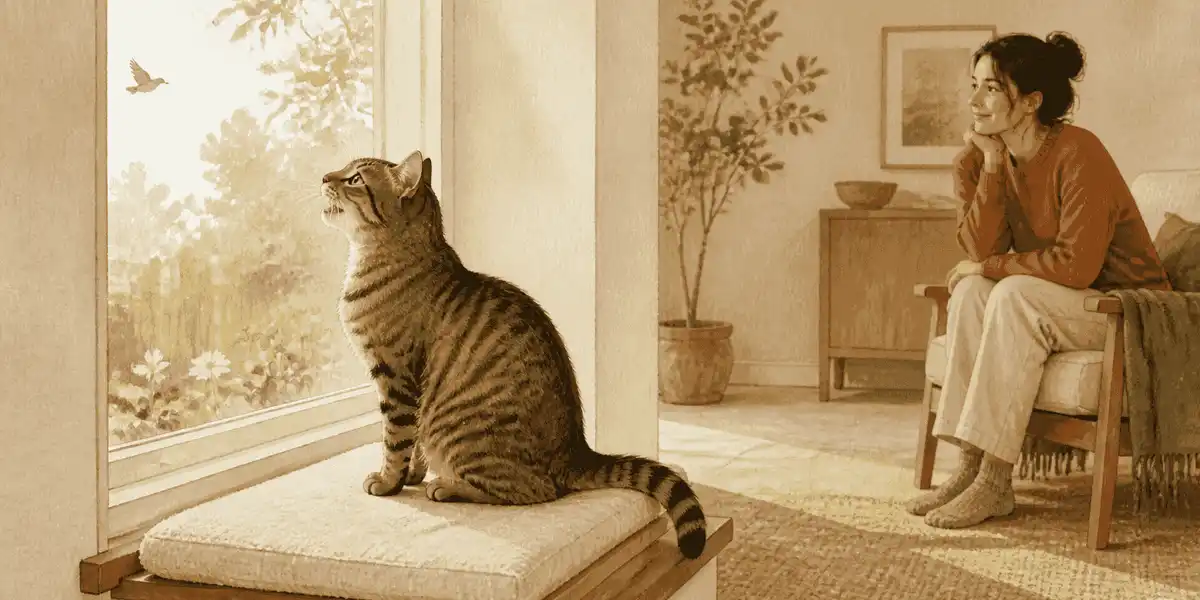
The window scene matters because it gives you more information than the sound alone. Cats Protection describes chirping or chattering around birds, rodents, and other prey outside as a pattern that may include a crouched body, forward ears, wide eyes, focused gaze, and side-to-side tail movement. That combination can tell you the cat is engaged with what it sees, but it still does not name the inner state.
Excitement, frustration, and attempts to mimic prey are among the explanations discussed in welfare guidance. They are theories, not conclusions you can test from the sofa. The small Lund study makes the same boundary from another direction: it connects the recorded labels with prey observation, but it does not test frustration, hunting intent, or mimicry.
So the answer to “why do cats chirp at birds?” is deliberately modest: the bird or squirrel may be part of the context, while the reason for the sound remains uncertain. Do not turn a moment at the window into a promise that your cat wants to hunt, is frustrated, or is trying to communicate one exact message.
Read the Whole Cat, Not the Sound
A small 2026 experiment found that cats’ responses to visual displays were clearer than their responses to brief isolated vocalizations. It does not prove that vision outranks every live interaction, but it supports a practical first-year rule: restore the scene before interpreting the noise.
Look at the ears, eyes, whiskers, mouth, posture, tail, movement, distance, and route. A facial signal is a combination rather than an emoji, and a chirp is one part of that combination. If the cat can approach, pause, turn away, or leave, those choices are information too. The whole-cat body-language guide gives you a wider snapshot for moments when one sound feels unusually important.
This is the same series-level caution used in why cats purr: a vocalization belongs beside the body, setting, and routine. It should not be used as a health test or as permission to continue an interaction the cat is trying to end.
What to Do When Chirping Starts
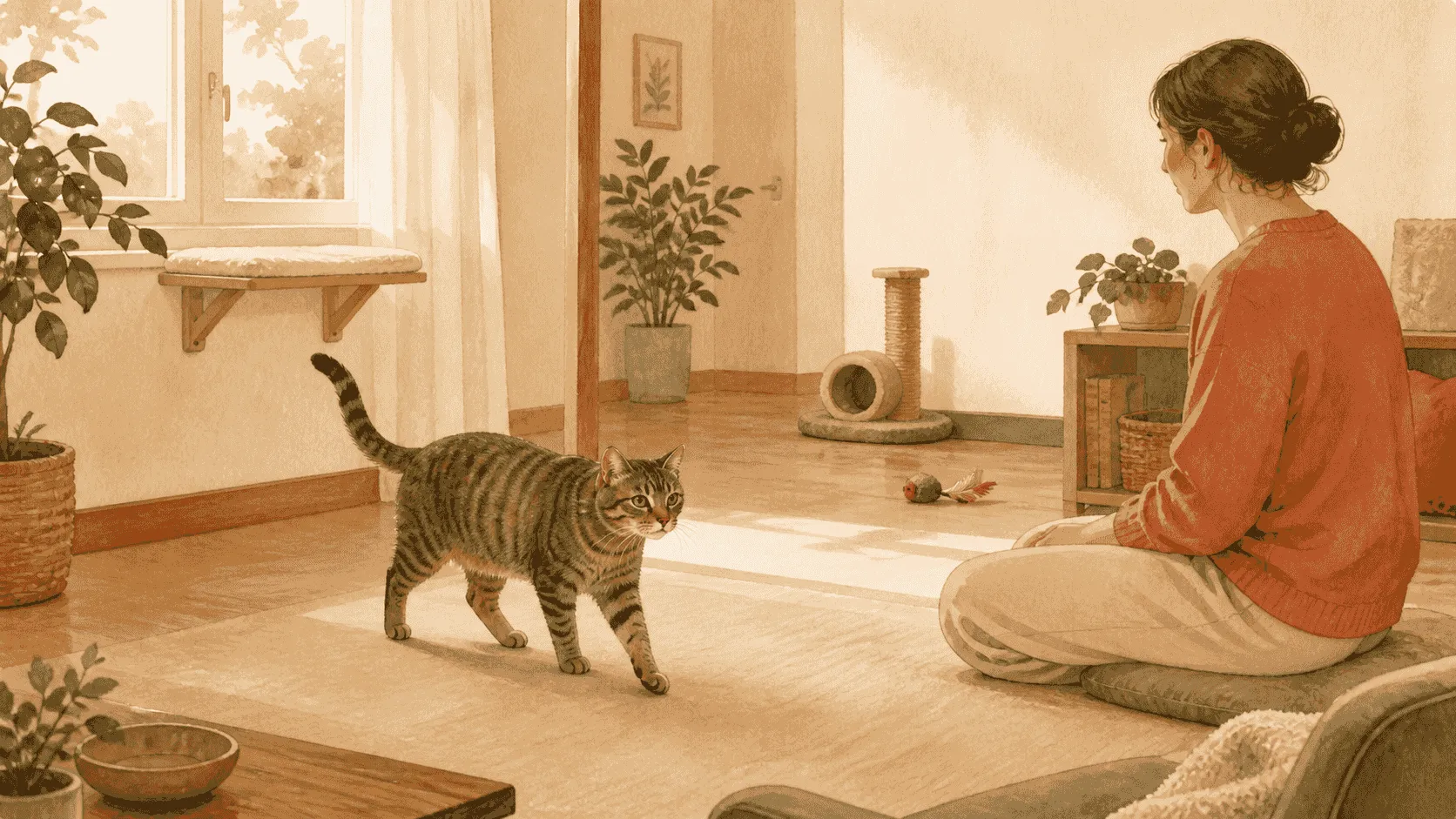
If the cat is familiar with the window routine and otherwise looks comfortable, you can simply observe without crowding the perch. Keep an open route so the cat can move away. Offer contact only as a small option, then pause; positive interaction is more useful when the cat can choose whether the next second includes you.
If the body becomes tense, the gaze stays fixed, or the cat cannot disengage from the scene, make the view optional rather than forcing a test. Quietly reduce access to part of the window or offer an easy, catchable play opportunity if the cat chooses it. A change in the room is a management option, not proof that you have found the cause. Do not grab the cat, repeatedly replay a sound, or insist on a distraction.
When a New Chirp Needs a Veterinarian
Compare the sound with this cat’s usual pattern. Cats Protection advises a veterinary check when chattering or chirping is new or markedly more frequent, and Cat Friendly Homes recommends veterinary advice for a marked change in a cat’s usual vocalization. Ask your veterinarian if the sound persists, changes sharply, or appears with appetite, energy, breathing, mouth, movement, or other behavior changes.
That call does not require a perfect explanation. Note the time, setting, what the cat watched, the accompanying body signals, how long the pattern lasted, and what happened afterward. A recording may help show context, but it cannot diagnose the cause. Do not let a familiar-sounding label reassure you through a new pattern.
Your Four-Step Chirp Check
- Observe: What happened just before the chirp, and what did the whole cat do?
- Compare: Is this a familiar sound and scene for this individual cat?
- Keep choice open: Leave an exit, pause contact, and use a quiet optional change if the scene is becoming too intense.
- Record or call: Write down a new or changing pattern and share it with your veterinarian.
Why do cats chirp? Sometimes the window helps explain when the sound appears. It does not finish the explanation. Let the setting, the cat’s choices, and any change from baseline guide what you do next.
Sources
Petzette's claim cards for this article point to the following scientific, veterinary, or animal-welfare sources.
- Feline Vocal Communication Review And Chirp Ethogram: Peer-reviewed veterinary behavior review of domestic-cat vocal communication
Tavernier C, Ahmed S, Houpt KA, Yeon SC. Feline vocal communication. Journal of Veterinary Science. 2020;21(1):e18.
- Schötz 2013 Cat Chirp Chatter Pilot: Published descriptive acoustic pilot study of domestic-cat vocalizations
Schötz S. A phonetic pilot study of chirp, chatter, tweet and tweedle in three domestic cats. Fonetik 2013. Linköping University; 2013:65–68.
- Cats Protection Cat Chattering And Chirping Guidance: Established animal-welfare organization guidance on cat chattering and chirping
Cats Protection. Cat chattering: why do cats chatter and chirp at birds? Published 2024-02-01; accessed 2026-08-28.
- Cats Respond To Visual And Auditory Cues From Other Cats: Peer-reviewed home-based cat social-cognition experiment
Spoelstra KE, Vonk J, van Berlo E, Kok J, Kret ME. Purr-ceiving feelings: domestic cats respond to intraspecific cues of emotion. *PeerJ*. 2026;14:e21292.
- Cat Facial Signals In Social Interactions 2023: Peer-reviewed observational study
- AAFP/ISFM Feline Environmental Needs Guidelines 2013: Peer-reviewed veterinary guidelines plus client-facing practice resource
- Cat Interaction Choice And Control Study 2021: Peer-reviewed controlled before/after human-training study
- FelineVMA Cat Meowing Guidance: Feline veterinary-association caregiver guidance on meowing and vocalization