Behavior14 August 2026
Why Do Cats Rub Against You? Read the Greeting Before You Respond
Why cats rub against you can vary by context. Use a gentle pause-and-observe check, scent-aware response, and veterinarian boundary.
TextPetzette Editorial
Read4 Min
Evidence status
Source-backed editorial
- Evidence record
- 6 claim cards linked to 7 documented sources.
- Independent expert review
- Not commissioned. Petzette Editorial is responsible for the published wording.
- Source record checked
- 23 July 2026
- Scope
- General guidance. Individual animals and circumstances can differ.
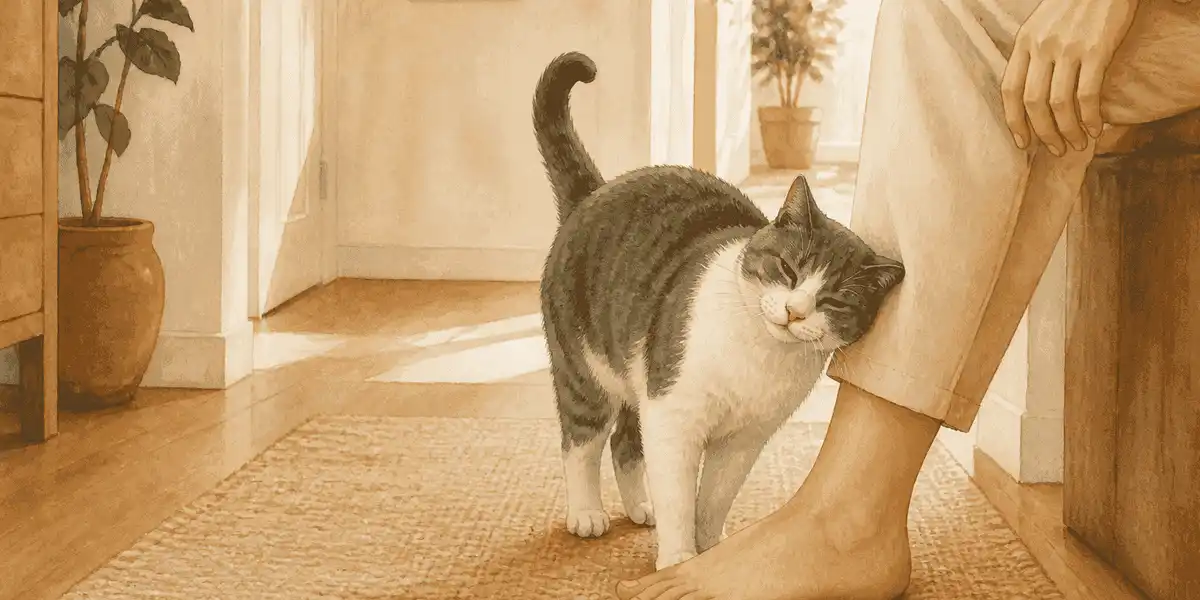
Why do cats rub against you? A cheek against your ankle or a full-body pass along the sofa can be a friendly hello while refreshing familiar scent. It can also happen around attention, a change in routine, or another part of the moment. The useful first decision is not what your cat “really means.” It is how to respond without turning one rub into a fixed message.
Cats Protection guidance describes face or body rubbing as a behavior that can greet familiar people and leave familiar scent. That is a helpful starting point, not a translation key. Watch what happens immediately before and after: Did your cat arrive from a quiet room, lead you toward a bowl, pause for contact, or move on to rub the furniture too? The sequence gives a more useful clue than the contact alone.
Why Do Cats Rub Against Your Legs? Start With the Whole Sequence
Rubbing on a person and rubbing on a table leg can belong to the same calm arrival sequence. It may be a greeting and scent update, and it may also occur when a cat wants attention. Neither possibility proves affection, hunger, comfort, or a single emotional state.
Try a short three-part check instead:
- Before: note the room, recent activity, and whether the cat approached by choice.
- During: look beyond the cheek or shoulder to the eyes, ears, whiskers, body, and pace.
- After: see whether the cat stays nearby, guides you somewhere, settles, or walks away.
This modest record is especially useful in the first weeks after adoption, when a cat may still be learning the home. It also keeps you from building a routine around a guess. A familiar rub can be welcome; it does not obligate either of you to a long petting session.
A Headbutt Is One Detail, Not a Mood Score
Cats use combinations of movements, not a one-feature dictionary. In a 2023 Behavioural Processes observational study of 53 cats in a cat-cafe setting, the combinations of facial movements differed between affiliative and non-affiliative cat-to-cat interactions. That study cannot decode a household cat’s exact feeling from one ear, cheek rub, or still image. It supports the simpler habit of widening the frame.
Add the partner and place to the picture. A loose cat who returns for another cheek rub may be inviting more of the same low-pressure contact. A cat whose body goes still, turns away, or moves toward a hiding place may need the interaction to stay small. For a broader way to do that, use our whole-cat body-language context check rather than relying on one gesture.
Reply With a Small, Optional Offer
When the whole scene looks comfortable, make your reply easy for the cat to accept or decline. Hold your hand still near a familiar cheek area rather than reaching over the body, then pause. If the cat leans in or returns, offer a brief stroke there and pause again. If the cat moves away, let that be the end of this turn.
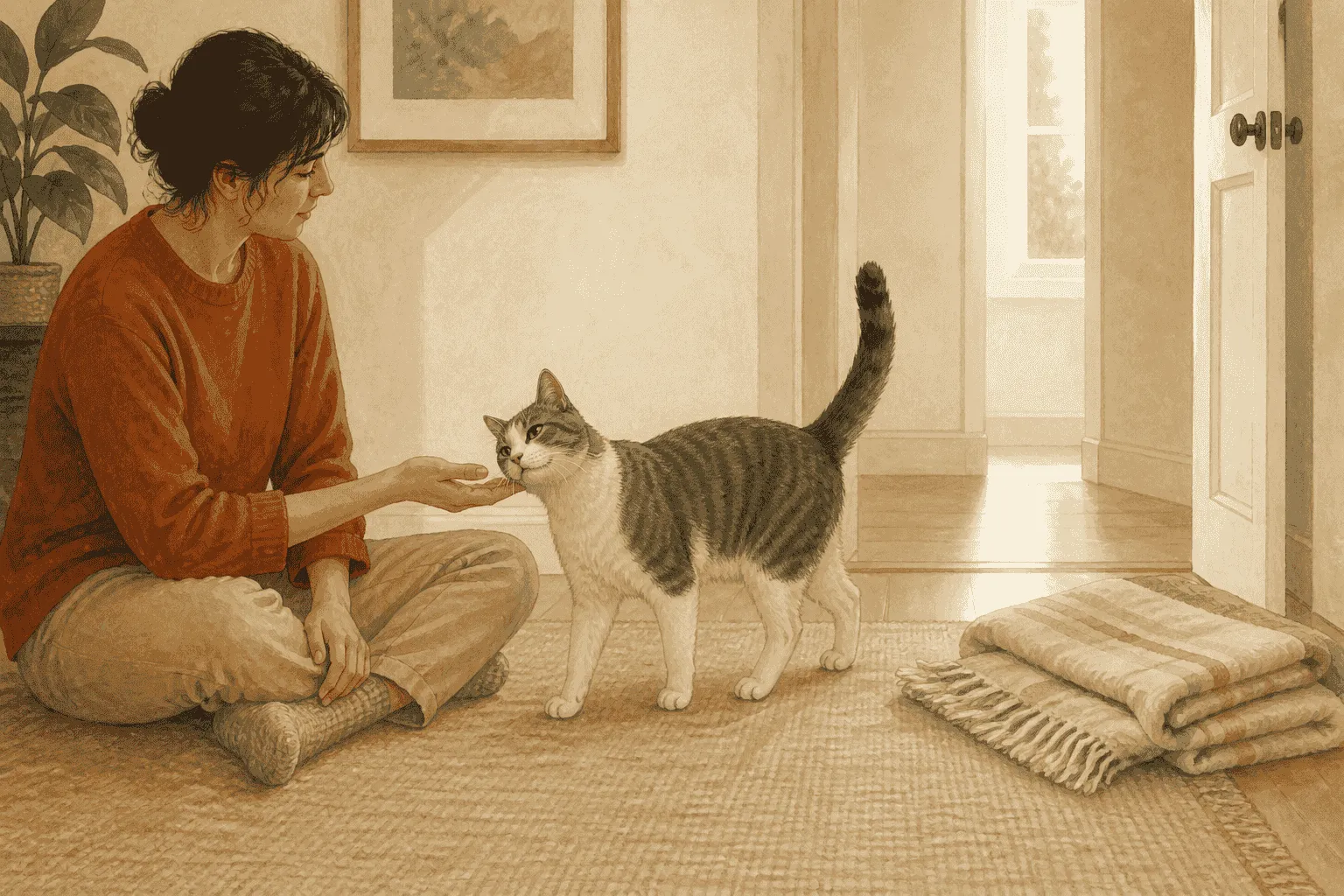
This is also a useful foundation for handling practice. Cats Protection recommends beginning with one second of touch in an already comfortable area, followed immediately by a reward and an open route away. Add time or a new area only while the easier step remains comfortable. A visible belly is not automatic permission to switch locations; read the whole cat and keep the offer low pressure. If licking appears during a petting moment, our cat-licking pause-and-read guide can help you keep the same calm approach.
Keep a Familiar Scent Clue During Change
Rubbing matters in the larger scent environment, too. AAFP/ISFM feline-environment guidance includes respect for a cat’s sense of smell among its core needs. When you change a bed, base room, or resting spot, handle the necessary cleaning, then leave one clean, familiar-smelling item available if it is safe to do so. That might be an unchanged blanket beside a new bed.
It is not a cure for stress and it does not mean leaving wet, dirty, or unsafe bedding in place. It is simply a way to avoid making every clue unfamiliar at once. Our first-year cat adoption plan has more on building a base room with choice and retreat space.
When Rubbing Needs a Veterinary Call
A cat’s rubbing cannot diagnose a problem. But a sudden, excessive, forceful, or uncomfortable change deserves attention, especially if it comes with unusual hissing or sensitivity to touch. If your cat hisses unusually or when one area is touched, stop testing that spot and contact your veterinarian instead of assuming it is a personality shift.
The reliable next step is small: notice the sequence, make contact optional, and compare today with your cat’s ordinary pattern. That gives you room to enjoy the hallway hello while keeping a change in behavior visible.
Sources
Petzette's claim cards for this article point to the following scientific, veterinary, or animal-welfare sources.
- Cats Protection Cat Rubbing And Bunting: Animal-welfare behaviour guidance
- Cat Facial Signals In Social Interactions 2023: Peer-reviewed observational study
- Cats Protection One-Second Handling Training: Animal-welfare handling guidance
- Cats Protection Belly Display And Petting: Animal-welfare body-language guidance
- AAFP/ISFM Feline Environmental Needs Guidelines 2013: Peer-reviewed veterinary guidelines plus client-facing practice resource
- AAFP ISFM Cat Friendly Veterinary Environment Guidelines 2022: Peer-reviewed feline veterinary-environment guideline
- Cats Protection Hissing Guidance: Current cat-welfare behavior guidance