Behavior28 August 2026
Why Do Dogs Sigh? Read the Whole Dog
Why do dogs sigh? Learn when a deep exhale fits relaxed rest, when to lower pressure, and when a breathing change needs your veterinarian.
TextPetzette Editorial
Read4 Min
Evidence status
Source-backed editorial
- Evidence record
- 3 claim cards linked to 4 documented sources.
- Independent expert review
- Not commissioned. Petzette Editorial is responsible for the published wording.
- Source record checked
- 28 August 2026
- Scope
- General guidance. Individual animals and circumstances can differ.
Why do dogs sigh? For a new dog owner, the useful answer is not a mood label. A deep exhale can appear during settling, after a demanding moment, or alongside a change that deserves a closer look. Start with the breath, the whole body, and the situation. Then choose one of three responses: leave a comfortable dog to rest, reduce pressure, or call your veterinarian.
Why Do Dogs Sigh? Start With the Breath, Not the Story
First, decide whether you saw a sigh-like breath. It is usually a deeper inhalation followed by a slower, more pronounced exhalation. A yawn, whimper, cough, snort, or effortful breath can be easy to confuse with it while you are learning your dog’s patterns.
A 1993 paper in Respiratory Physiology measured spontaneous sigh breaths in four unrestrained dogs. In that small experiment, the sighs had a larger breath volume and longer inhalation and exhalation phases than ordinary control breaths. During wakefulness and sleep, breathing moved back toward control levels within the next few breaths. That is a narrow description of physiology—not a translation of what your dog feels.
Note what happened without adding a cause: was your dog lying down, had the room just become busy, and did the sound come with visible breathing effort? This is more useful than deciding that the sigh means happiness, boredom, or worry.
When Dog Sighing Fits Relaxed Settling
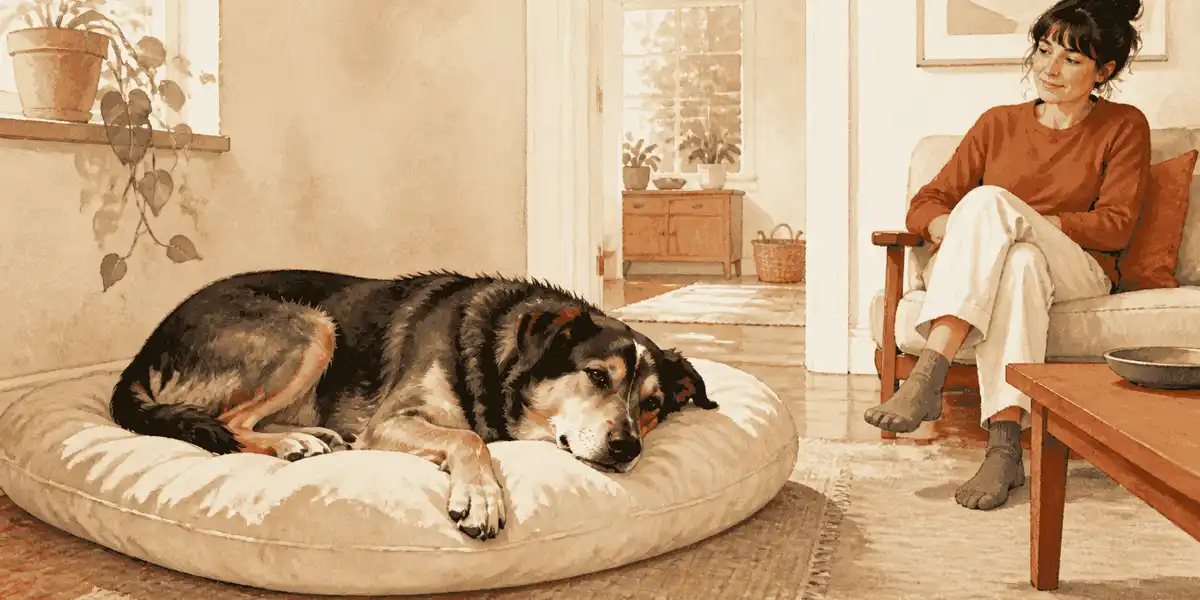
The most reassuring context is a dog who is choosing to settle. The body looks loose rather than braced. The ears are in a comfortable position, the eyes and mouth look soft, and the breathing returns to its usual easy rhythm. The dog may stretch, lower onto a bed, and sigh as the interaction or activity winds down.
An American Kennel Club article that quotes Vanessa Spano, DVM, DACVB, a board-certified veterinary behaviorist, describes this kind of context as one in which a sigh may accompany rest. It also makes the important larger point: the sound needs to be read with the environment and the dog’s other signals. It is not proof of contentment.
In this lane, the helpful action is simple. Let the dog keep the rest they chose, keep the route away from the bed clear, and let the next interaction begin by choice. Predictable access to quiet rest is part of a new dog’s routine, not a missed training opportunity. For more on judging rest against an individual dog’s routine, see how much sleep a dog needs in context.
When the Same Sound Means “Lower the Pressure”
A sigh-like exhale can also happen in a less comfortable moment: people leaning over the dog, an uninvited touch, a noisy room, or a blocked route away. The surrounding body can tell you whether more space would be sensible.
Look for a wider pattern such as turning away, becoming tense, lowering the body, keeping the ears back, or trying to leave. These signals are context-dependent too; one sign is not a verdict. If the whole picture looks uncertain, pause your hand, reduce the demand, and give the dog a clear way to move away. Do not make the dog stay so you can finish petting or prove that the sigh had a particular meaning.
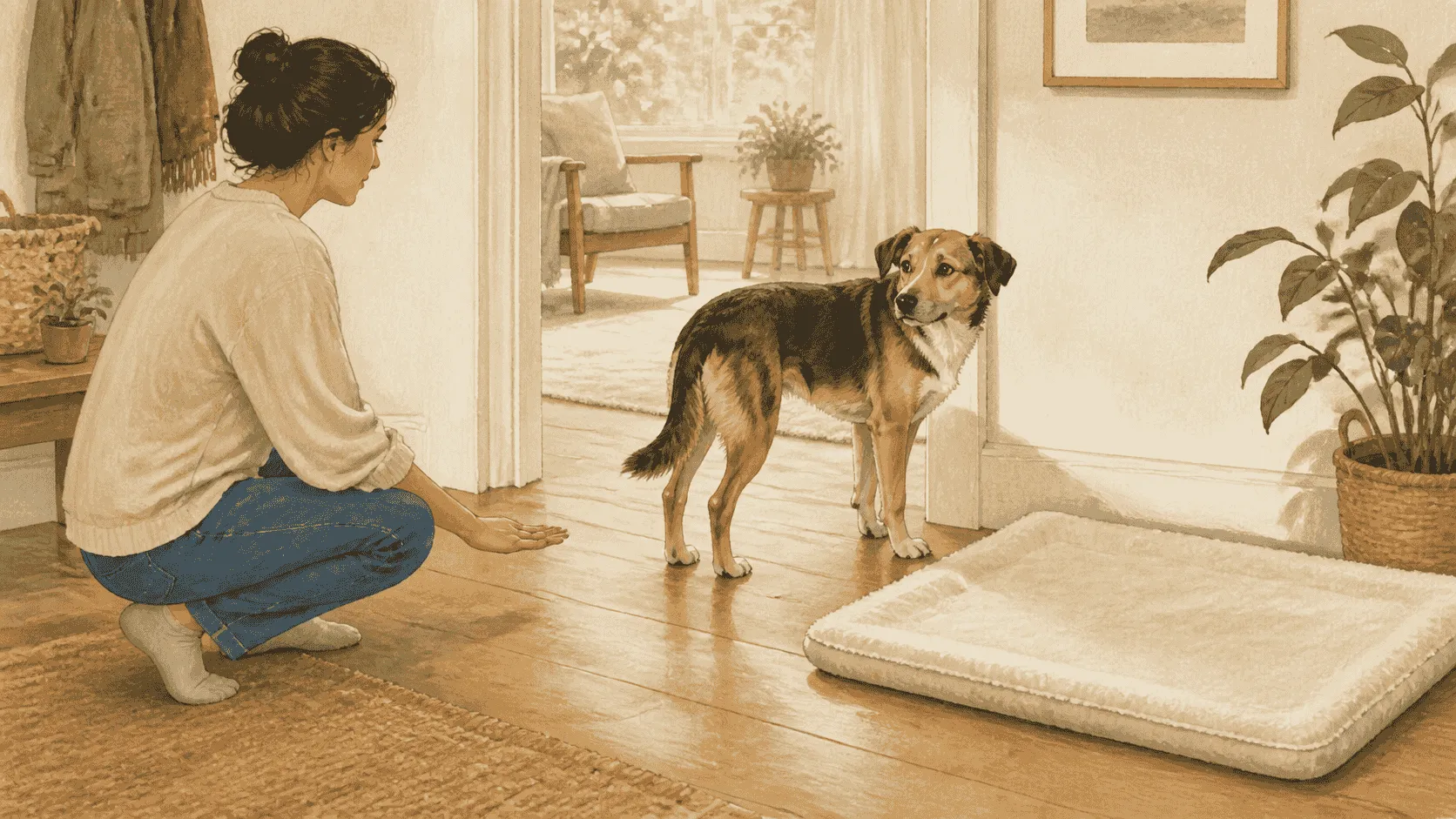
This is where a broader whole-body dog body-language pause map helps. Focus on what the dog can do next: rest, create distance, or re-engage voluntarily. If the dog returns loose, keep the interaction brief and easy. If avoidance continues, respect that information and change the setup.
What a Small Physiology Study Can—and Cannot—Tell You
The four-dog study is useful because it shows that a canine sigh can be a distinct, deeper breath pattern. It cannot set a normal number of sighs, identify an emotion, or decide that a sound is harmless in every situation. The experiment measured breathing mechanics, not contentment, frustration, anxiety, pain, or attention learning.
That limitation matters when a dog sighs after you stop an activity or when the sound seems to draw your attention. An American Kennel Club discussion includes frustration and learned attention patterns as possible contexts, but possibilities are not diagnoses. Do not repeat the interaction as a home test. Record the setting, activity, body posture, and whether the pattern is new instead.
Use a Three-Lane Sigh Check
When you hear the sound, make one calm pass through these questions:
- Settling: Is the dog loose, choosing rest, and breathing comfortably? Lower the noise and let the dog rest.
- Pressure or uncertainty: Does the sound sit beside tension, avoidance, crowding, or a blocked exit? Pause the interaction and create space.
- New or effortful: Is the pattern unusual for this dog, or does breathing look heavy, labored, wheezy, or interrupted? Stop trying to interpret the emotion and move to the veterinary boundary.
This check is deliberately about the next safe action, not about naming the dog’s feeling. If you are unsure whether you heard an ordinary sigh or a breathing change, treat that uncertainty as useful information to share with a veterinarian.
When a Sigh-Like Sound Needs a Veterinarian
Ask your veterinarian about a sudden or unusual pattern, especially when it comes with pain-related behavior changes or other changes in the dog’s physical state. Seek prompt veterinary guidance for heavy or labored breathing, gasping, or wheezing. There is no sound-count threshold that can diagnose the cause at home.
If it is safe and does not disturb the dog, a short note or video can help show the context: what happened immediately before the sound, how the whole body looked, and whether the breathing settled. Do not delay help to collect a perfect recording. A dog sigh can be ordinary during relaxed settling, but the sound alone is never a complete answer.
Sources
Petzette's claim cards for this article point to the following scientific, veterinary, or animal-welfare sources.
- Canine Sigh Breaths And Post-Sigh Breathing Patterns: Comparative canine respiratory physiology study
Issa FG, Porostocky S. Effect of sleep on changes in breathing pattern accompanying sigh breaths. Respir Physiol. 1993;93(2):175-187. PMID: 8210757.
- American Kennel Club Dog Sighing Is Context Dependent: Veterinary-behavior-informed dog behavior guidance
Johnstone G. Why Do Dogs Sigh? What the Sound Means—and Doesn't. American Kennel Club. Accessed 2026-08-28.
- Dogs Trust Body Language Context Guidance: Welfare organization dog body-language guidance
- Dogs Trust Predictable Routine And Rest: Animal-welfare routine guidance