Nutrition25 August 2026
Cat Calming Treats: What to Check Before You Give One
Cat calming treats can look like a quick answer. Learn what to check on the label, what behavior to record, and when your veterinarian should lead.
TextPetzette Editorial
Read4 Min

Evidence status
Source-backed editorial
- Evidence record
- 9 claim cards linked to 9 documented sources.
- Independent expert review
- Not commissioned. Petzette Editorial is responsible for the published wording.
- Source record checked
- 25 August 2026
- Scope
- General information, not an individual diagnosis or treatment plan.
Cat calming treats can look like a quick answer when a new cat hides, vocalizes, scratches, grooms differently, or struggles around a change. The first-year decision is whether to add anything at all, what to record before you do, and when your veterinarian should lead.
A calming label is a product description, not a home diagnosis. Start with the cat’s setting and whole pattern. If the concern appears mainly when you leave, the narrower cat separation-anxiety record can help you capture the absence-linked timeline. This guide focuses on the separate decision about a treat or supplement.
Start With the Cat, Not the Calming Label
Before adding a new food or supplement, write down what happened just before the change: a visitor, noise, move, handling, another animal, a blocked route, or a caregiver leaving. Note what the cat did, how long it lasted, what happened afterward, and whether eating, drinking, toileting, grooming, resting, or play also changed.
One sign or one episode cannot identify anxiety or its cause. A 2020 questionnaire study and a 2002 clinical-record study describe possible absence-linked patterns in cats, but current veterinary guidance also emphasizes that medical, environmental, and other behavior explanations can overlap. The broader cat-anxiety guide explains how to keep that record useful without turning it into a score or diagnosis.
What Cat Calming Treats Can—and Cannot—Tell You
VCA Animal Hospitals explains that some nutritional ingredients are discussed as possible support for stress or anxiety in cats, but the evidence may be preliminary, small, or inconsistent. Its supplement guidance also notes that non-drug health supplements are not reviewed before sale in the same way as approved drugs, and that products can carry interaction or adverse-reaction concerns.
Read the full ingredient panel and intended-use statement. Keep the package or a clear photograph. Do not use a “natural” phrase, one ingredient, or a calmer-looking moment as evidence that the product is suitable, that anxiety was the cause, or that the problem is solved. A veterinarian should consider the cat’s health, current food, medications, supplements, and the behavior context before an extra enters the plan.
Make the Home Easier Before Adding Another Variable
The AAFP/ISFM feline environmental-needs framework organizes a workable home around safe places, separated key resources, play and predatory opportunities, predictable positive interaction, and respect for scent. Keep food, water, toileting, scratching, play, and resting choices from collapsing into one crowded corner.
Offer a stable retreat the cat can enter and leave by choice. Current FelineVMA guidance describes an exit option as useful when a cat feels threatened, while also recognizing that individuals differ. Do not reach into a refuge, pull a cat out, or use the treat to lure the cat into contact it is trying to avoid. Environmental choice is support, not a cure; a new or worsening change still needs the right professional boundary.
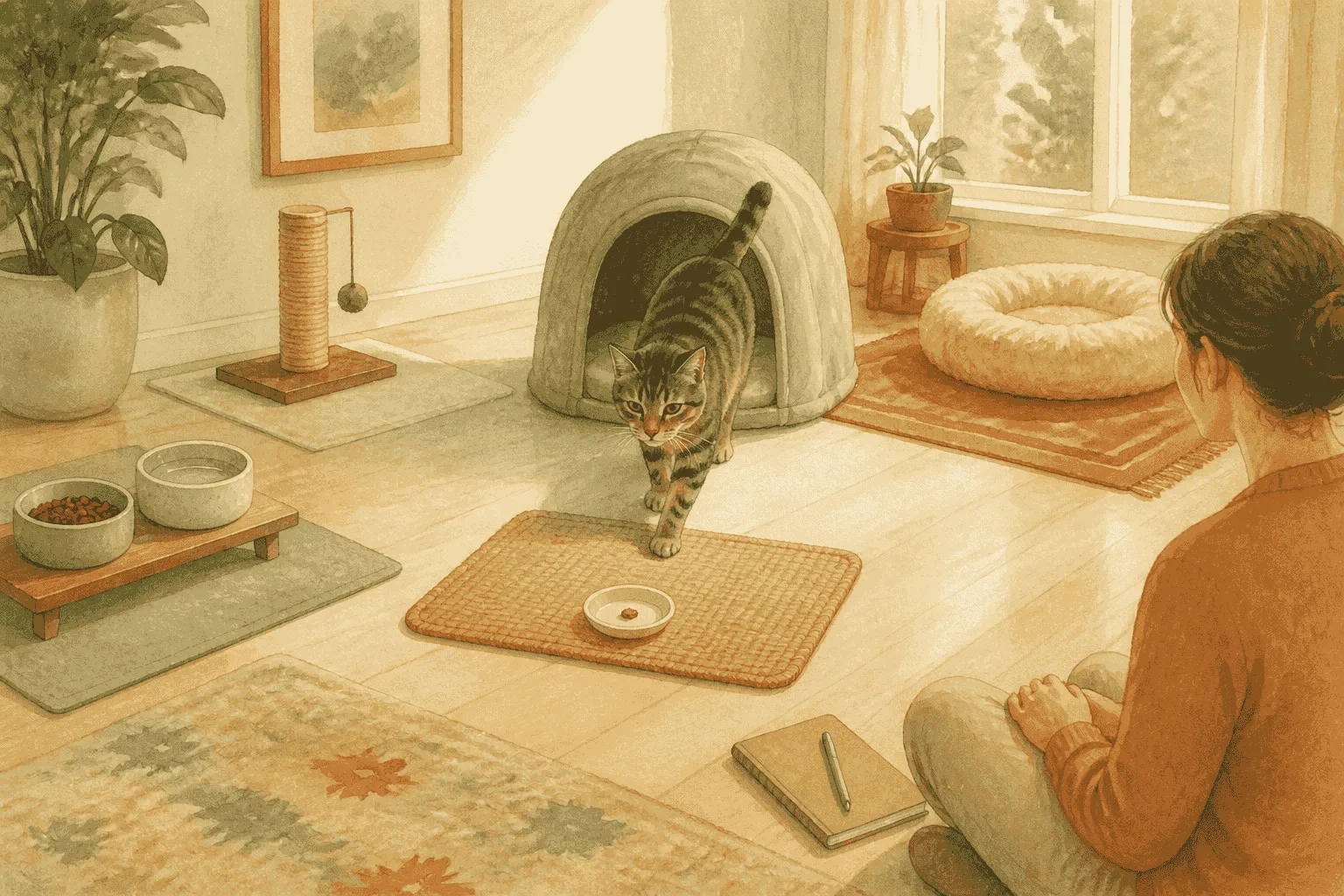
If a treat is being considered for cooperative care, keep the lesson smaller than the worry. FelineVMA guidance supports rewarding voluntary approximations: a glance toward a mat, one paw, or one brief relaxed posture may be enough for one session. Pause if the cat is ill, painful, hiding, growling, hissing, or fearful. A reward should not push the cat through a stop signal.
Count the Treat as an Extra
The 2021 American Animal Hospital Association nutrition and weight-management guidelines recommend that complete and balanced food provide at least 90 percent of total calories for generally healthy dogs and cats, with treats and other extras at 10 percent or less. That is a ceiling, not a promise that any product suits an individual cat.
Include calming treats with other treats, toppers, table food, and training rewards. Package directions are starting points that need to be reconsidered with growth, weight, body condition, activity, and health. A growing kitten, cat on a therapeutic diet, cat with an appetite or weight change, or cat receiving several extras may need an individual plan. The everyday cat-treat guide covers the broader food-and-reward decision; this page adds the behavior and supplement boundary.
Use a Five-Part Cat Calming-Treat Check
Before you offer the next treat, write five short lines:
- The situation: what happened before the behavior, and whether the cat had a way to leave.
- The whole pattern: posture, movement, distance, vocalizing, hiding, eating, toileting, grooming, and recovery.
- The product: intended use, complete ingredient panel, package instructions, and lot or package details if available.
- The current plan: food, medications, supplements, health concerns, and any recent change.
- The next handoff: whether to keep observing a familiar mild scene, simplify the environment, or ask your veterinarian before adding the product.
This note is more useful than trying several treats in succession. Changing multiple foods or supplements at once can make the pattern harder to interpret, and a product trial cannot tell you whether the original problem was medical, environmental, or behavioral.
When Your Veterinarian Should Lead
Ask your veterinarian before adding a calming supplement when the behavior change is new, repeated, severe, worsening, or paired with appetite, toileting, vomiting, pain, injury, or reduced wellbeing. Ask sooner if the cat may have had an adverse reaction or if current medication or supplements are part of the picture.
Bring the package or ingredient photograph, the five-line note, and a safely captured video if one already exists. Do not delay urgent care to make a recording, and do not stop prescribed medication or improvise a dose. A veterinarian can decide whether the next step belongs in health care, environmental support, behavior work, or some combination.
The practical answer is small: record the scene, preserve the cat’s choices, keep treats in the extras column, and let your veterinarian decide whether a calming product has a safe role. The label can start a conversation; it cannot finish one.
Sources
Petzette's claim cards for this article point to the following scientific, veterinary, or animal-welfare sources.
- VCA Guidance On Cat Calming Supplements: Label Limits And Veterinary Context: First-party veterinary-hospital guidance on nutritional supplements and feline behavior support
- VCA Animal Hospitals. “Thiamine, Colostrum, L-Theanine, L-Tryptophan.” Directly reviewed 2026-08-25.
- Cat Separation-Related Problems: Pattern, Limits, And Veterinary Boundary: Evidence synthesis of two peer-reviewed feline studies and current veterinary guidance. It supports only a cat-specific observation, environmental-support, and professional-assessment boundary for possible separation-related problems. It is not a diagnostic checklist, treatment plan, medication guide, dose guide, or promise that a cat can be made comfortable alone on a fixed schedule.
- Machado DS, Felsmann MZ, et al. Identification of separation-related problems in domestic cats: A questionnaire survey. *PLOS ONE*. 2020;15(4):e0230999. doi:10.1371/journal.pone.0230999; PMID:32294083. Direct PubMed and publisher DOI records reviewed on 2026-08-25.
- AAFP/ISFM Feline Environmental Needs Guidelines 2013: Peer-reviewed veterinary guidelines plus client-facing practice resource
- FelineVMA Environmental Needs: Safe Places And Choice: Current feline-veterinary caregiver guidance
- AAHA Nutrition And Weight Management Guidelines 2021: Peer-reviewed veterinary clinical guideline
Cline MG, Burns KM, Coe JB, et al. 2021 AAHA Nutrition and Weight Management Guidelines for Dogs and Cats. Journal of the American Animal Hospital Association. 2021;57:153-178.
- AAFCO Pet Food Labels And Nutritional Adequacy: US feed-control association consumer and regulatory guidance
- 2022 AAFP ISFM Cat Friendly Veterinary Interaction Guidelines: Peer-reviewed veterinary clinical guideline
- AAHA Cat Vet-Visit And Carrier Preparation: Veterinary association expert guidance
- FelineVMA Positive Reinforcement And Cooperative Care: Feline veterinary association caregiver guidance