Behavior08 September 2026
Cat Purring With Its Mouth Open: Flehmen or a Breathing Concern?
A cat purring with its mouth open may be flehmen in a scent context, but it is not a home all-clear for breathing difficulty.
TextPetzette Editorial
Read5 Min
Evidence status
Source-backed editorial
- Evidence record
- 4 claim cards linked to 3 documented sources.
- Independent expert review
- Not commissioned. Petzette Editorial is responsible for the published wording.
- Source record checked
- 08 September 2026
- Scope
- General guidance. Individual animals and circumstances can differ.
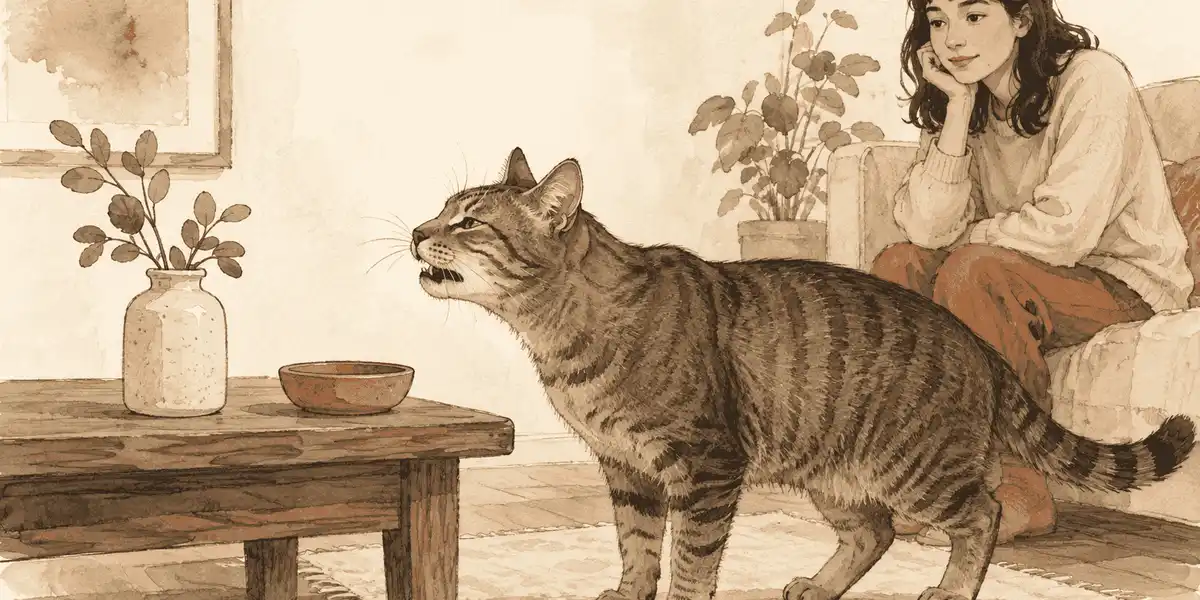
If your cat is purring with its mouth open, the safest next step is not to decide what the face means from a single moment or a video. In a scent-investigation context, a partly open-mouth upper-lip curl can be flehmen, a scent-related gape response. But flehmen is not an at-home all-clear. If the cat seems to be working to breathe or is breathing with its mouth open, seek urgent veterinary direction instead of trying to clear the episode as behavior.
What Flehmen Can Explain—and What It Cannot
Flehmen is a possible scent context, not a diagnosis. Merck Veterinary Manual describes the response as a gape expression or lip curl associated with interesting smells and the vomeronasal organ. A 1987 study by Hart and Leedy reported that flehmen in its tested cats was virtually always preceded by contact with scent material. Bradshaw’s 2018 review also describes the importance of feline olfactory and vomeronasal senses while emphasizing how difficult those signals are for people to interpret.
Those sources support a modest conclusion: after investigating an odor, a cat’s partly open mouth and raised upper lip can fit a scent-related response. They do not show that every similar-looking expression is flehmen, that the cat is healthy, or that a caregiver can identify the behavior reliably from a brief observation. They also do not establish that the cat is disgusted, judging someone, calm, sexually motivated, or recognizing a particular animal or person.
The distinction matters because “my cat is purring with its mouth open” can describe two different reader concerns: a curious face after a smell, or an apparent breathing change. The expression alone cannot settle which one you are seeing.
A Purr Does Not Clear an Open Mouth
Purring adds context, but it does not answer a health question. A 2009 Current Biology study found that some cats can use a purr with a cry-like component while soliciting food. Human listeners heard those tested solicitation purrs as more urgent than non-solicitation purrs. That is a specific finding about tested purr contexts, not a universal purr dictionary.
Use the same restraint here. A purr does not prove comfort, pain, hunger, or safety, and it cannot turn apparent open-mouth breathing into an ordinary behavior question. The guide to why cats purr explains why the sound belongs beside the situation and the rest of the cat rather than being translated on its own.

Make the Immediate Decision About Breathing
If your cat appears to be working to breathe, cannot breathe comfortably, or is breathing with its mouth open, treat that as an urgent veterinary question. Cornell Feline Health Center describes breathing difficulty as a clinical sign with many possible causes and advises veterinary care whenever there is a question about comfortable breathing. Merck identifies breathing difficulty and open-mouth breathing among serious emergency concerns, and Cats Protection also lists open-mouth breathing or marked effort as a reason for emergency advice or treatment.
Do not let a suspected scent trigger, purring, quietness between episodes, or a short duration reassure you that waiting is safe. The evidence does not provide a household visual test that separates flehmen from panting, dyspnea, airway disease, pain, fear, heat illness, poisoning, or another problem. A 2025 Veterinary Sciences study of 258 cats with severe emergency dyspnea found that the clinical presentation did not identify a particular cause before diagnostic workup. That referred emergency population cannot predict the cause or outcome for another cat, but it reinforces the boundary: visible breathing change is a clue, not a label.
If you call, use plain language rather than trying to choose the cause: “My cat appears to be breathing with its mouth open,” or “My cat seems to be working to breathe.” The cat panting guide covers the same urgent boundary in more detail. You do not need to prove that the episode was flehmen before asking what to do.
Do Not Turn Flehmen Into a Home Test
The source evidence does not authorize an intervention or a waiting routine. In particular:
- Do not offer urine, a stronger scent, pheromones, catnip, or another stimulus to see whether the expression happens again.
- Do not count breaths, compare videos, wait for a repeat episode, or complete a symptom checklist before contacting a veterinarian about apparent breathing difficulty.
- Do not inspect the mouth, pull the tongue, or try to sort the cause by looking more closely.
- Do not give food, water, medication, oxygen, steam, or a home remedy while trying to decide whether the expression is flehmen.
These are not missing steps in a better home diagnosis. The reviewed sources do not validate a caregiver’s ability to classify the episode that way, and delay is the main risk the boundary is meant to prevent.
Put the Boundary in Your New-Cat Plan
New owners can prepare one useful next step before a confusing episode happens: keep the veterinary clinic’s number available and know which emergency service your clinic uses after hours. If you need to call, describe the observable change and when you noticed it. Let the veterinary team decide whether the cat needs immediate assessment; do not use an online label, a scent trigger, or a normal-looking minute as clearance.
For a new kitten, the first-visit checklist can help you establish a routine veterinary relationship. It does not replace urgent care for breathing trouble. The practical rule is simple: flehmen may explain a scent-related lip curl, but it cannot clear a cat that appears unable to breathe comfortably.
The Takeaway
A cat purring with its mouth open may be showing flehmen after scent investigation. That possibility is useful context, not a conclusion about health. If the cat seems to be breathing with an open mouth or working to breathe, seek urgent veterinary direction rather than waiting to decide whether the expression has a behavioral name.
Sources
Petzette's claim cards for this article point to the following scientific, veterinary, or animal-welfare sources.
- Feline Breathing Difficulty: Urgent Referral and Diagnostic-Uncertainty Boundary: Evidence synthesis of a peer-reviewed feline emergency cohort, veterinary-school guidance, a peer-reviewed veterinary manual, and established welfare emergency guidance. It supports a narrow recognition, no-home-diagnosis, and urgent-professional-direction boundary for apparent breathing difficulty in cats. It is not a diagnostic guide, first-aid protocol, transport plan, treatment guide, or prognosis source.
- Abboud N, Deschamps J-Y, Joubert M, Roux FA. *Emergency Dyspnea in 258 Cats: Insights from the French RAPID CAT Study.* Veterinary Sciences. 2025;12(3):242. doi:10.3390/vetsci12030242; PMID:40266956; PMCID:PMC11946846.
- Cat Flehmen: Scent Context and No Breathing Clearance: Cross-source synthesis of peer-reviewed feline behavior research and review literature, a current specialist-authored veterinary manual, veterinary-school emergency guidance, and a peer-reviewed feline emergency cohort. It supports a narrow description of flehmen as scent-related context and a conservative no-home-clearance boundary for apparent open-mouth breathing or breathing difficulty. It is not a diagnostic guide, a household classification test, a first-aid protocol, a treatment guide, a prognosis source, or a behavior-management recommendation.
- Hart BL, Leedy MG. *Stimulus and hormonal determinants of flehmen behavior in cats.* Hormones and Behavior. 1987;21(1):44-52. doi:10.1016/0018-506X(87)90029-8; PMID:3557332.
- The Cry Embedded Within The Purr: Peer-reviewed paper