Gear Decisions08 October 2026
How to Wash Dog Toys: A Material-by-Material Safety Check
Learn how to wash dog toys by material: follow the label, clean hard and soft items appropriately, dry fully, and retire damaged toys.
TextPetzette Editorial
Read6 Min
Evidence status
Source-backed editorial
- Evidence record
- 2 claim cards linked to 5 documented sources.
- Independent expert review
- Not commissioned. Petzette Editorial is responsible for the published wording.
- Source record checked
- 08 October 2026
- Scope
- General guidance. Individual animals and circumstances can differ.
How to wash dog toys depends on what the toy is made of, what its label allows, and whether it is still in good enough condition to use. Start by sorting the toys and checking them while they are dry. Then choose a cleaning method the material can tolerate, rinse away residue, let the toy dry completely, and inspect it again before play.
Cleaning is one part of toy care. It does not repair a split seam, replace a missing piece, or make a toy safe for every dog. If you want the wider decision about size, play style, condition, and supervision, see our safer dog-toy and chewing guide. This page stays with the washing and return-to-play question.
Check the label and the toy first
The Centers for Disease Control and Prevention’s February 2026 guidance says to follow the cleaning instructions on a pet item’s packaging or tag. That is the best starting point because two toys that look similar can contain different fillings, squeakers, adhesives, dyes, or finishes.
Before adding water, make three quick groups:
- Hard rubber or plastic: Check whether the toy is dishwasher-safe. If it has a hollow cavity, look for residue trapped inside and make sure it can drain and dry.
- Plush or rope: Check the seams, stuffing, knots, and any attached parts. Confirm that the label permits a washing machine and dryer, or gives another method.
- Do not wash yet: Set aside anything split, cracked, loose, misshapen, or missing a piece. A toy in this group needs a safety decision, not a stronger cleaner.
Blue Cross guidance makes size, condition, play style, and supervision part of the toy check. That means the right moment to retire a toy may be before it becomes visibly filthy. A wash can remove dirt; it cannot change the size of a loose part or undo damage that a dog could pull apart.
How to wash hard dog toys
For a suitable hard rubber or plastic toy without more specific instructions, the CDC recommends soapy water. Use a sponge or brush to work into the surface and any hollow area, then rinse until cleaning residue is gone. Let the toy air-dry or wipe it with a clean towel, and do not return it to the dog while moisture or soap remains inside.
Use a dishwasher only when the toy is labeled dishwasher-safe. A high-temperature or sanitizing setting is a disinfection choice, not a reason to put an unknown toy through a hot cycle. Heat can change a material, loosen a component, or leave a toy looking clean while its structure has become less reliable.
Food-filled and hollow toys deserve a second look after cleaning. Turn them over, check the opening and seams, and make sure no old food or water is trapped where you cannot see it. If you cannot clean the inside properly or cannot get it fully dry, pause before using it again and follow the maker’s instructions or retire the item.
How to wash plush and rope toys
Soft toys can hold moisture in fabric, stuffing, knots, or seams. If the label allows machine washing, use the cycle and water temperature appropriate for the fabric, then air-dry or use a dryer as directed. The CDC notes that soft items such as plush and rope toys can be cleaned with a washing machine and dryer when the item is suitable for that method.
Do not treat “machine washable” as “ready when the outside feels dry.” Check the inside, seams, and rope knots. A toy should be completely dry before it goes back into the basket, especially if a dog will carry it, chew it, or sleep with it. If it stays damp, develops a persistent odor, or changes shape after washing, it may no longer be a good play option.
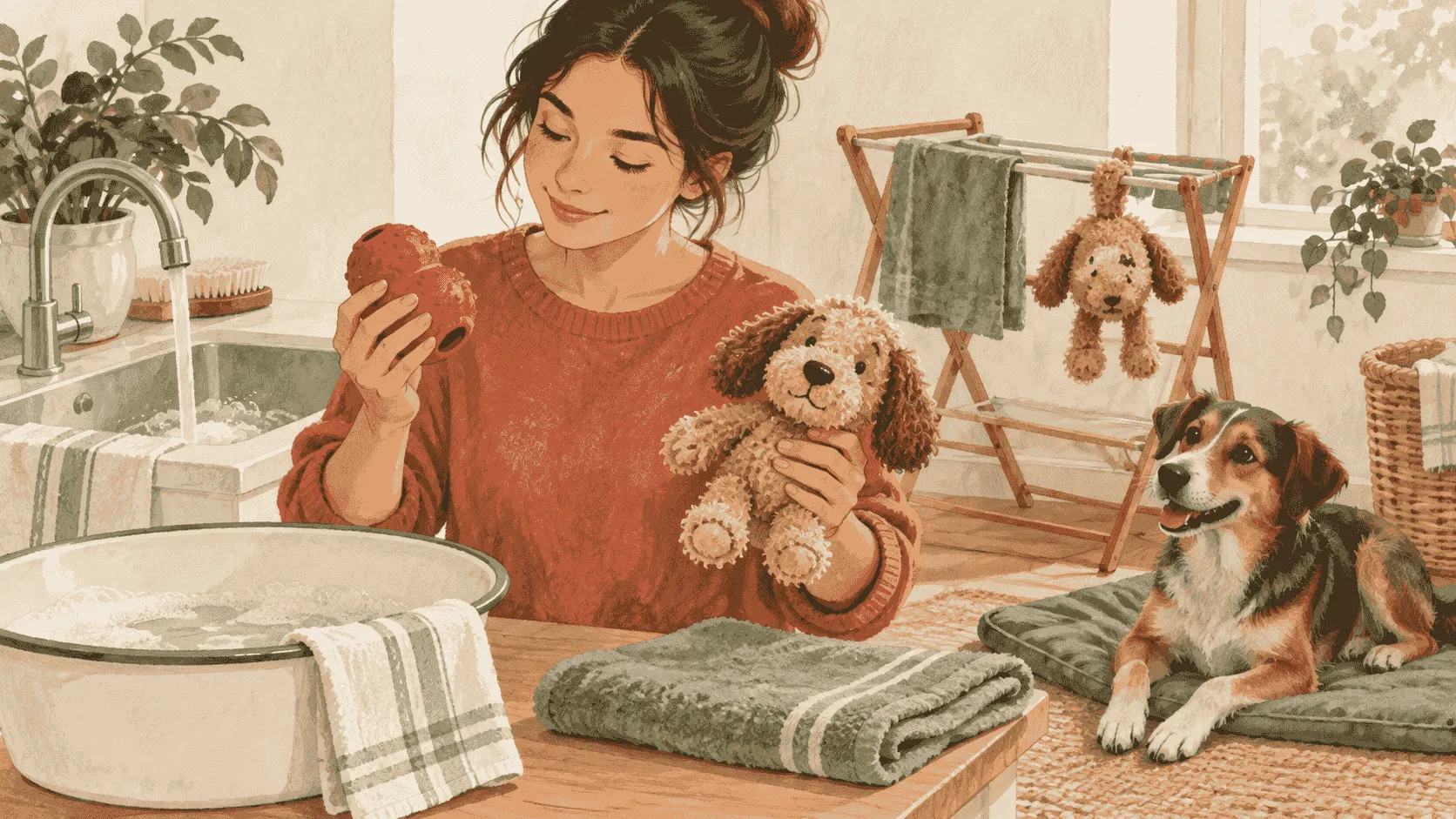
After drying, run the same inspection you would use before a game: look for pulled threads, loose eyes or labels, split seams, exposed filling, and pieces that could come away in the dog’s mouth. Remove a damaged toy rather than trying to extend its life with another wash. The dog toy safety guide explains why “tough” is not a universal condition.
Cleaning is not the same as disinfecting
The CDC separates cleaning, which physically removes dirt and germs with soap or detergent, from disinfecting, which uses chemicals to kill germs on a surface. Routine cleaning is usually enough for most pet items. Disinfection is an additional, situation-dependent step—for example, when a pet is sick or an item has been contaminated—rather than a default upgrade for every toy.
If you do use a disinfectant, follow that product’s label exactly. Keep the dog away from the wet product, do not mix bleach with another cleaner, rinse when the label or guidance requires it, and wait until the item is fully dry before access. Store the original container out of reach. A “natural” smell or a familiar kitchen ingredient is not proof that a cleaner disinfects, and a disinfectant is not automatically suitable for every material.
For a broader household plan, see puppy cleaning supplies: a label-led safety plan. The same principle applies here: the product label decides dilution, ventilation, rinsing, drying, and re-entry. If a cleaner may have reached your dog, keep the container or a clear label photo and contact a veterinarian or animal poison-control service promptly.
How often should dog toys be washed?
There is no useful schedule that fits every toy, dog, and home. The CDC gives monthly cleaning as an example for pet toys and says to clean more often when an item looks dirty or smells bad. Use that as a starting point, then adjust for the toy’s material, how often it is mouthed, whether food is involved, and whether the dog is sick or the household includes someone more vulnerable to germs.
More frequent washing is not a substitute for inspection. A toy can be clean and still be the wrong size, too damaged to use, or difficult to supervise. Conversely, a toy can be dusty without needing disinfectant. Match the response to the actual problem: clean visible residue, disinfect only when the situation and label support it, and retire structural damage.
A simple return-to-play check
Before a washed toy goes back to your dog, run this short sequence:
- Instruction: Did you follow the packaging or tag, or use a method supported for that material?
- Residue: Have soap, detergent, and any disinfectant been rinsed or handled as directed?
- Drying: Is the inside, filling, rope, and every seam fully dry?
- Condition: Are there no loose, split, cracked, missing, or newly misshapen parts?
- Fit: Is the toy still too large to swallow whole, and can you supervise the way this dog plays?
If a piece is missing or your dog may have swallowed part of a toy, do not wait for the toy to “come through.” Cornell University College of Veterinary Medicine lists vomiting, appetite loss, abdominal pain, diarrhea, dehydration, and lethargy among signs that can accompany a gastrointestinal foreign body. Contact your veterinarian promptly and describe the toy, the missing part, and when the exposure may have happened.
The practical answer to “how do I wash dog toys?” is therefore a material-and-condition check: follow the label, clean with a method the toy can tolerate, rinse and dry completely, then decide whether the toy still deserves a place in the play basket.
Sources
Petzette's claim cards for this article point to the following scientific, veterinary, or animal-welfare sources.
- CDC: Cleaning And Disinfecting Pet Supplies: Government public-health guidance
- Centers for Disease Control and Prevention. *About Cleaning and Disinfecting
- Blue Cross: How To Play With Your Dog: Animal-welfare and behavior guidance
- PDSA: Dog Chewing And Chew-Toy Safety: Veterinary-authored animal-welfare guidance
- Gastrointestinal Foreign Bodies In 72 Dogs: Peer-reviewed multicentre retrospective clinical study
Di Palma C, et al. *Animals*. 2022;12(11):1376. doi:10.3390/ani12111376.
- Cornell: Gastrointestinal Foreign-Body Obstruction In Dogs: Veterinary-school clinical education