Behavior13 October 2026
Male Cat Behavior After Neutering: What to Track
Male cat behavior after neutering can change in some hormone-linked ways. Learn what to record, what remains uncertain, and when to call your vet.
TextPetzette Editorial
Read6 Min

Evidence status
Source-backed editorial
- Evidence record
- 3 claim cards linked to 1 documented source.
- Independent expert review
- Not commissioned. Petzette Editorial is responsible for the published wording.
- Source record checked
- 13 October 2026
- Scope
- General guidance. Individual animals and circumstances can differ.
Male cat behavior after neutering can look different, but the safest answer is not a promise that surgery will rewrite a personality. Neutering may reduce some behaviors influenced by male hormones, such as sexually related marking, roaming, mounting, and some fighting. It is less likely to explain every change in anxiety, play, confidence, or attachment.
For a new cat owner, the useful decision is practical: separate the behaviors that may be hormone-linked from a broader change that deserves a veterinary conversation. Record what you actually see, keep post-operative instructions with the operating clinic, and avoid turning one quiet day or one dramatic interaction into a verdict.
What Neutering May Change
VCA Animal Hospitals’ behavior guidance, attributed to Ellen Lindell, VMD, DACVB, Debra Horwitz, DVM, DACVB, and Gary Landsberg, DVM, DACVB, DECAWBM, separates sexually dimorphic behavior from a cat’s underlying temperament. It describes castration as potentially reducing mounting and marking, with some reduction in roaming and certain aggressive encounters. UC Davis School of Veterinary Medicine gives a similar broad explanation for reduced fighting, roaming, and spraying in male cats.
That is a group-level guide to what may shift, not a forecast for this cat. If a male cat had been roaming, seeking females, marking, or fighting with intact males, a reduction in one of those patterns may be part of the expected conversation. The change can be gradual or incomplete, and the same cat may still show many familiar interests, routines, and social preferences.
Do not use “calmer” as a complete measurement. A cat who spends more time indoors may also have a different routine, less access to triggers, or a quieter household. A cat who seems less active may be recovering, uncomfortable, unwell, or simply having an ordinary low-energy day. The observation matters; the cause needs context.
What Neutering Does Not Settle
Neutering is not a reliable reset button for personality. VCA’s guidance says behaviors that are not driven by male hormones, such as anxiety or hyperactivity, are unlikely to disappear because of castration. A cat’s early experience, health, environment, learning history, and individual temperament remain part of the picture.
This means a change in affection is not a simple success score. A male cat who is more willing to sit nearby has not necessarily become a new personality, and a cat who remains reserved has not shown that the procedure “did not work.” Avoid comparing him with online stories about cats who became cuddly, playful, sleepy, or distant. Those stories cannot tell you what changed in this household or what the cat felt.
If the behavior change is sudden, intense, persistent, painful-looking, or paired with appetite, movement, elimination, or comfort changes, move the question out of the personality lane. Ask the veterinary team what they want you to notice and how urgently they want to hear from you. Do not start a medication, supplement, feeding restriction, or punishment plan from an internet explanation.
Treat Marking as Its Own Question
Urine marking deserves separate attention because neutering can reduce sexually related marking without guaranteeing that every mark stops. The 2014 AAFP/ISFM house-soiling guideline distinguishes sexual marking from reactional marking linked with environmental or social change. It also notes that some neutered male cats continue to mark.
So persistent marking does not prove that the operation failed, that the cat is being spiteful, or that the cause is hormonal. Look at the pattern instead:
- where the mark appears and whether it is on a vertical surface;
- when it started in relation to the procedure and any household change;
- whether the cat also produces ordinary urine in the litter box;
- whether another cat, person, doorway, outdoor animal, noise, or new object changes the scene; and
- whether there is straining, frequent unproductive box visits, blood, pain, or another urinary concern.
The last line changes the route. A sudden, painful, bloody, or difficult urination pattern needs prompt veterinary advice. For the wider health-and-setup decision, see the cat spraying health-and-setup check. Keep the room calm and avoid punishment while you arrange help; startling or scolding can add pressure without explaining the mark.
Make a Before-and-After Record
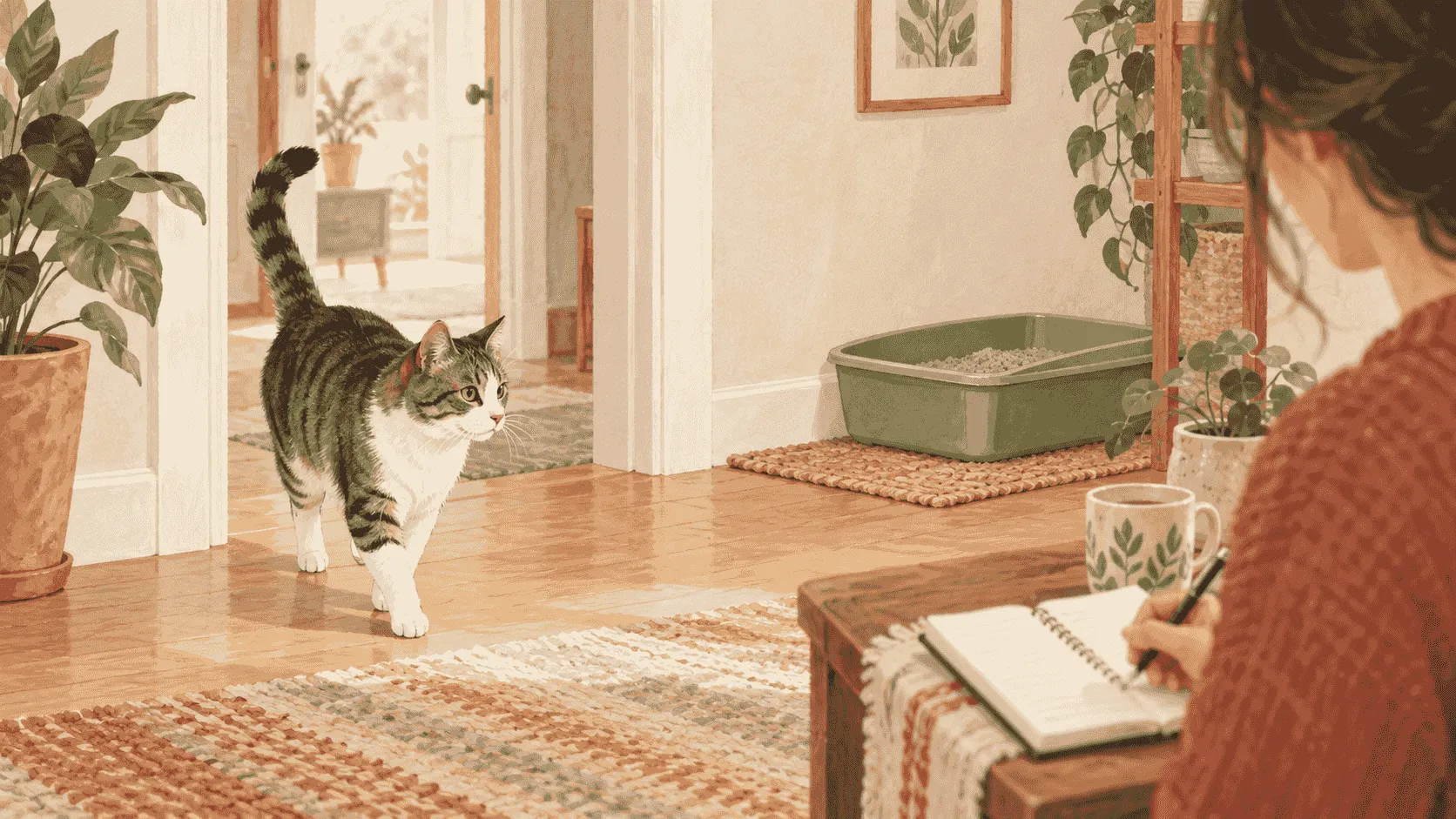
The AAHA/AAFP feline life-stage guidance says subtle changes in a young adult cat’s behavior and daily life may matter, and that a journal, photo, or video can help document a pattern. That record is useful because “he changed” is too broad for a veterinary history.
Write down a few neutral details:
- What changed? Use an observable description such as “left the room when the carrier appeared” or “marked the hallway twice,” rather than “became anxious.”
- When did it begin? Note the procedure date if known, the first observation, and whether the pattern repeats or fades.
- What happened around it? Include visitors, another cat, outdoor activity, handling, food, litter access, noise, or a change in the room.
- What happened afterward? Record whether he returned to a familiar activity, hid, ate, used the litter box, moved normally, or showed another change.
- What is his ordinary baseline? Compare with this cat’s normal routine, not with a breed description or someone else’s timeline.
If a short video is safe to capture without disturbing or cornering him, it may help show the sequence. It is not a personality score or a diagnosis. Do not provoke marking, repeat a handling test, restrain the cat to recreate a response, or delay a call while trying to collect a perfect record.
If Neutering Is Still Ahead
Use the pre-operative conversation to ask the clinic what behavior and recovery changes they want recorded, which post-operative instructions apply to this cat, and which signs should prompt a call. The evidence does not supply a universal age, recovery deadline, or home test that can replace that plan.
If the cat is intact and showing mating-related behavior, keep the practical problem separate from a personality label. Secure access to outdoor cats and prevent unintended mating while you discuss an individual reproductive plan. The cat-in-heat behavior guide covers the female-cat heat pattern and separation decision; this article is about what to observe around a male cat’s neutering and behavior question.
When to Call the Veterinarian
Contact the operating clinic or your veterinarian when a change is new, persistent, worsening, painful-looking, or difficult to manage safely. Call sooner when it comes with reduced appetite, unusual weakness, movement changes, urinary difficulty, marked hiding, or another concern the team told you to watch. Use the clinic’s own post-surgery route for questions about the incision, prescribed care, or recovery.
Bring the timeline, not a diagnosis. Say what the cat did, when it began, what was happening before and after, and whether the pattern has repeated. A veterinarian can decide whether the next step is reassurance, an examination, environmental support, or qualified behavior help. If you are still establishing routine care for a new kitten, the new kitten first-visit checklist can help you keep records and questions together.
Male cat behavior after neutering is best read as a pattern with limits. Some hormone-linked behaviors may decrease; personality is not rewritten; marking can persist for more than one reason; and a concerning change belongs with the veterinary team. Your next step is a short, factual record and a low-pressure home while you wait for individual guidance.
Sources
Petzette's claim cards for this article point to the following scientific, veterinary, or animal-welfare sources.
- Male Cat Neutering: Behavior, Marking, and Observation Limits: Feline veterinary behavior and life-stage guidance
- VCA Animal Hospitals. Cat Behavior and Training: Neutering and Behavior.