Nutrition25 October 2026
What Can Stray Cats Eat? A Safe First Feeding Plan
What can stray cats eat? Start with owner and health checks, keep food plain and temporary, and know when a veterinarian should guide the next step.
TextPetzette Editorial
Read5 Min

Evidence status
Source-backed editorial
- Evidence record
- 7 claim cards linked to 5 documented sources.
- Independent expert review
- Not commissioned. Petzette Editorial is responsible for the published wording.
- Source record checked
- 01 August 2026
- Scope
- General information, not an individual diagnosis or treatment plan.
What can stray cats eat? The safest first answer is not a long list of human foods. First work out whether this is a found cat who may have an owner, whether the cat needs urgent help, and whether it is safe for you to get close. If a healthy, approachable cat needs short-term food while you contact a veterinarian or local welfare organization, offer a simple, quiet option and keep the feeding plan temporary and observable.
This is a first-feeding decision for a roaming or newly found cat. It is not a homemade diet, a treatment plan, or permission to catch and handle a frightened animal. For the wider owner search and adoption sequence, use the safe first steps for adopting a stray cat.
Check the cat before choosing the food
A cat who appears on your porch is not automatically stray or available for adoption. Cats Protection’s found-cat guidance says a roaming cat may be owned, lost, abandoned, or living with little human contact. A missing collar, friendly greeting, or repeated visit cannot settle that question.
Start with distance. Note where and when you saw the cat, what the cat looked like, and whether there is an immediate concern. If the cat is sick, injured, trapped, in danger, or unsafe to approach, call a veterinary clinic or local animal-welfare organization and describe what you can observe. Do not turn food into a reason to corner, restrain, trap, or treat the cat yourself.
If the cat is healthy enough to approach without distress, arrange a microchip scan and begin a reasonable local owner search. Follow local reporting and holding requirements. Feeding a visitor can help you observe a situation, but it does not prove that the cat is unowned or make adoption the next step.
Start with complete cat food when you can
If you are responsible for a newly arrived cat, the best routine starting point is the food the cat was already eating, offered in a clean, quiet place away from the litter box and other animals. Cornell Feline Health Center guidance recommends preserving familiar food during a gradual transition because appetite loss can have many causes and is not something to explain away as relocation stress.
For a found cat, you may not know the familiar food yet. Ask the owner, rescue, veterinarian, or local welfare organization what the cat normally eats if someone can identify the cat. If you need to provide a temporary meal while arranging that help, choose unbranded, complete cat food when it is available and suitable for the cat in front of you. Put down a clean dish, keep the area calm, and step back far enough for the cat to choose whether to eat.
Keep the record simple:
- what food you offered and when;
- whether the cat actually ate, rather than only sniffed or approached;
- whether water was available and used;
- whether the cat vomited, had diarrhea, seemed painful, or changed in alertness; and
- whether the cat could leave the feeding area without being followed.
A quiet bowl can make intake easier to observe, but it cannot tell you why a cat is not eating. Do not keep changing foods in response to one missed meal or treat a different bowl as a cure.
If cat food is unavailable, keep any extra narrow
The broader human-food safety check for cats explains why a shared kitchen bite is not a second dinner. Human food should not replace a nutritionally complete everyday cat diet, and a suitable extra still belongs inside the cat’s total daily intake.
If a veterinarian or welfare professional has not identified a feeding restriction and an occasional extra is appropriate for this individual cat, Cats Protection guidance allows a small amount of plain, thoroughly cooked, boneless chicken or fish. Keep it genuinely plain: no seasoning, sauce, skin, fat trimmings, or bones. Offer only a small temporary extra rather than presenting chicken or fish as a complete diet.
Do not offer raw meat, raw fish, raw eggs, bones, chocolate, coffee, caffeine, onion, garlic, seasoned leftovers, or a dish with ingredients you cannot identify. This is not an exhaustive safe-food list. If the cat may already have eaten a harmful or unknown food, preserve the packaging or recipe details and contact a veterinarian or animal poison-control service promptly.
Do not force a cat to eat
Cornell’s guidance warns against forcing food into a cat’s mouth or improvising appetite treatment. Food refusal is a clinical sign with many possible causes; a quiet room and familiar food cannot distinguish stress from pain or illness.
If the cat refuses food, seems weak, has repeated vomiting or diarrhea, shows breathing difficulty, appears painful, or changes suddenly, call a veterinarian. Include the cat’s age estimate if known, how long you have observed the refusal, what was offered, and any other changes. Do not push food into the mouth, syringe-feed, give medicine, or use a guessed waiting period as permission to delay help.
If the animal may be a very young kitten, do not assume that a little human food is an adequate bridge. Use the new-kitten not-eating guide for the veterinary boundary, and let a veterinary team direct feeding support.
Make the feeding place a choice, not a trap
Feline environmental guidance recommends separated resources and a safe place that the cat can enter and leave by choice. Put food and water where the cat can retreat without being cornered, and keep other animals and children away while the cat decides whether to approach. Do not reach into a hiding place, block an exit, or carry the cat toward the bowl.
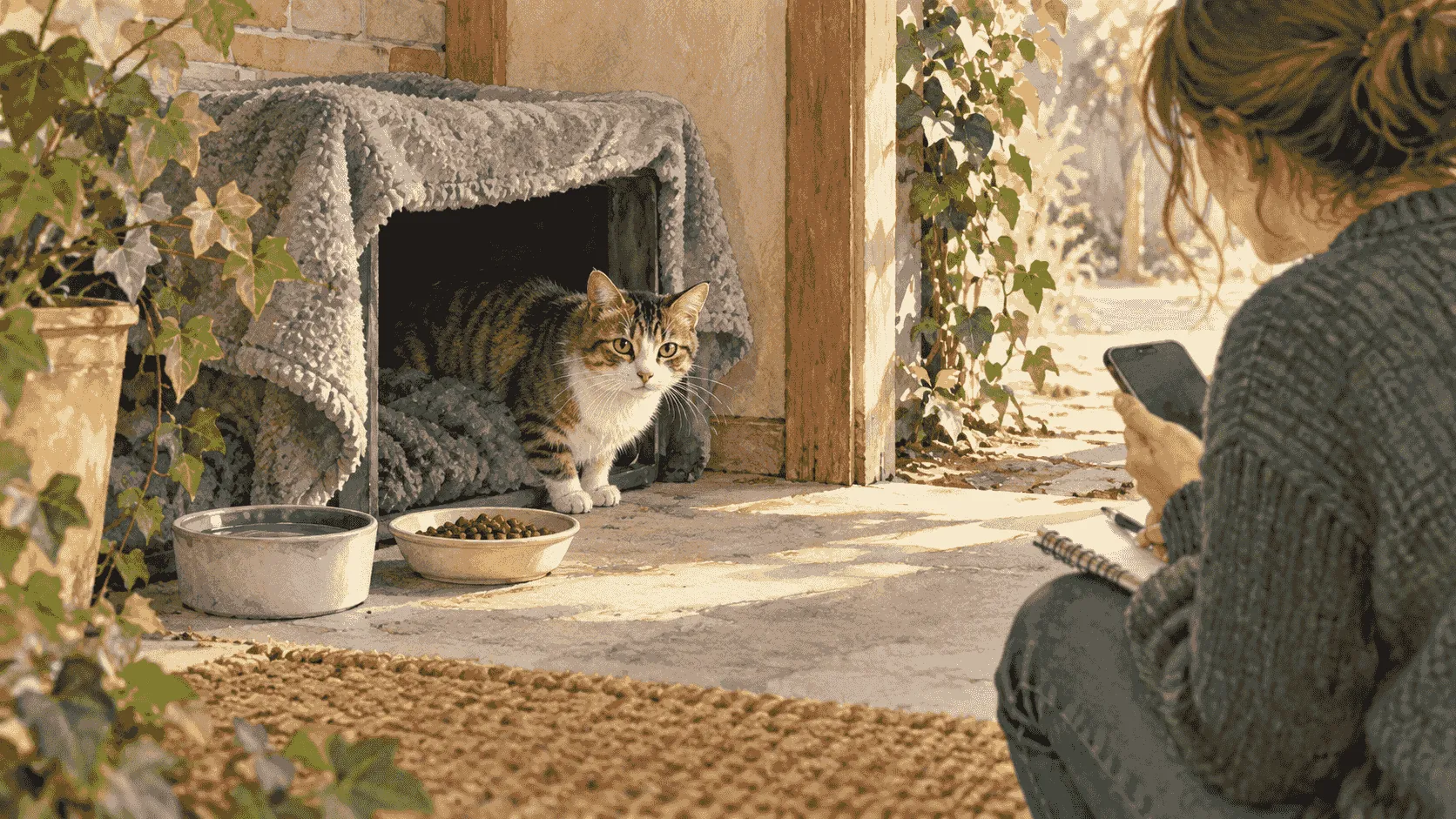
The goal is not to make a nervous cat perform trust. It is to reduce pressure while you collect useful information and contact the right local help. A cat who can eat, rest, and leave freely gives you a clearer observation than a cat who is surrounded by people or pets.
The first decision is a call, not a menu
Use this short plan:
- Unsafe, sick, injured, or trapped: keep your distance and call a veterinarian or animal-welfare organization.
- Approachable but ownership is unknown: offer only low-pressure, temporary support while arranging a microchip scan and local owner search.
- Healthy and in your care: use complete cat food as the foundation; keep any plain cooked extra small and occasional.
- Not eating or changing: stop experimenting and ask a veterinarian what to do next.
What can stray cats eat? A found cat needs more than a food answer. Keep the food plain, the setting quiet, the cat’s exit open, and the owner and veterinary questions visible. That is safer than turning one visit into a guessed diet or an unplanned adoption.
Sources
Petzette's claim cards for this article point to the following scientific, veterinary, or animal-welfare sources.
- Cats Protection Found A Cat Guidance: First-party cat-welfare guidance for lost, stray, and feral cats
- Cornell New-Cat Appetite And Feeding Guidance: Veterinary-school feline health and new-cat care guidance
- AAHA Nutrition And Weight Management Guidelines 2021: Peer-reviewed veterinary clinical guideline
Cline MG, Burns KM, Coe JB, et al. 2021 AAHA Nutrition and Weight Management Guidelines for Dogs and Cats. Journal of the American Animal Hospital Association. 2021;57:153-178.
- Cats Protection Cats And Human Foods Guidance: Current cat-welfare feeding and household-food safety guidance
- WSAVA Principles Of Wellness 2025: Global veterinary-association wellness guidance