Nutrition27 August 2026
What Bones Can Dogs Eat? A Safer Chew Decision
What bones can dogs eat? Use an evidence-led chew check, avoid unsafe home rules, and know when possible ingestion needs your veterinarian.
TextPetzette Editorial
Read4 Min

Evidence status
Source-backed editorial
- Evidence record
- 3 claim cards linked to 6 documented sources.
- Independent expert review
- Not commissioned. Petzette Editorial is responsible for the published wording.
- Source record checked
- 03 August 2026
- Scope
- General information, not an individual diagnosis or treatment plan.
What bones can dogs eat? For a new dog owner, the most useful answer is not a universal list. The evidence reviewed here does not establish a bone type that can be treated as suitable for an individual dog. Use the question as a decision point: before offering a bone, choose an outlet you can supervise; after possible swallowing, know which signs deserve prompt veterinary direction. This guide focuses on bone-specific uncertainty, while our dog-toy guide covers broader chewing, play, and enrichment choices.
Why There Is No Universal Bone List
A 2022 study by Barash and colleagues in the Journal of Veterinary Internal Medicine described 129 dogs referred for endoscopically managed bone foreign bodies in the esophagus or stomach. That is a referral case series, not a measure of how often a particular bone causes trouble in the wider dog population. It does not show that every bone will lodge or that every ingestion needs an endoscopic procedure or surgery.
It does show why a short “safe bone” list cannot carry the whole decision. Merck Veterinary Manual identifies bones as common esophageal foreign bodies and describes signs such as drooling, gagging, difficulty swallowing, regurgitation, and repeated swallowing. The evidence supports taking a possible ingestion seriously without pretending it predicts exactly what has happened inside a particular dog.
A Bone Is Not Just Another Chew
Chewing can serve several functions. A 2025 review in Frontiers in Veterinary Science, led by researchers at the University of Sydney, describes it as a common behavior with more than one context and emphasizes individual safety and welfare assessment. RSPCA guidance likewise recommends suitable objects for chewing and play as part of a dog’s environment, while recognizing that an object appropriate for one dog may not suit another.
That makes the important variables practical rather than magical: the dog’s size and chewing style, the object’s condition, the activity you intend, and whether meaningful supervision is possible. A label such as “tough” cannot make that assessment for you. Nor does a dog’s previous uneventful experience establish that the next bone will be suitable.
Use a Three-Part Chew Check
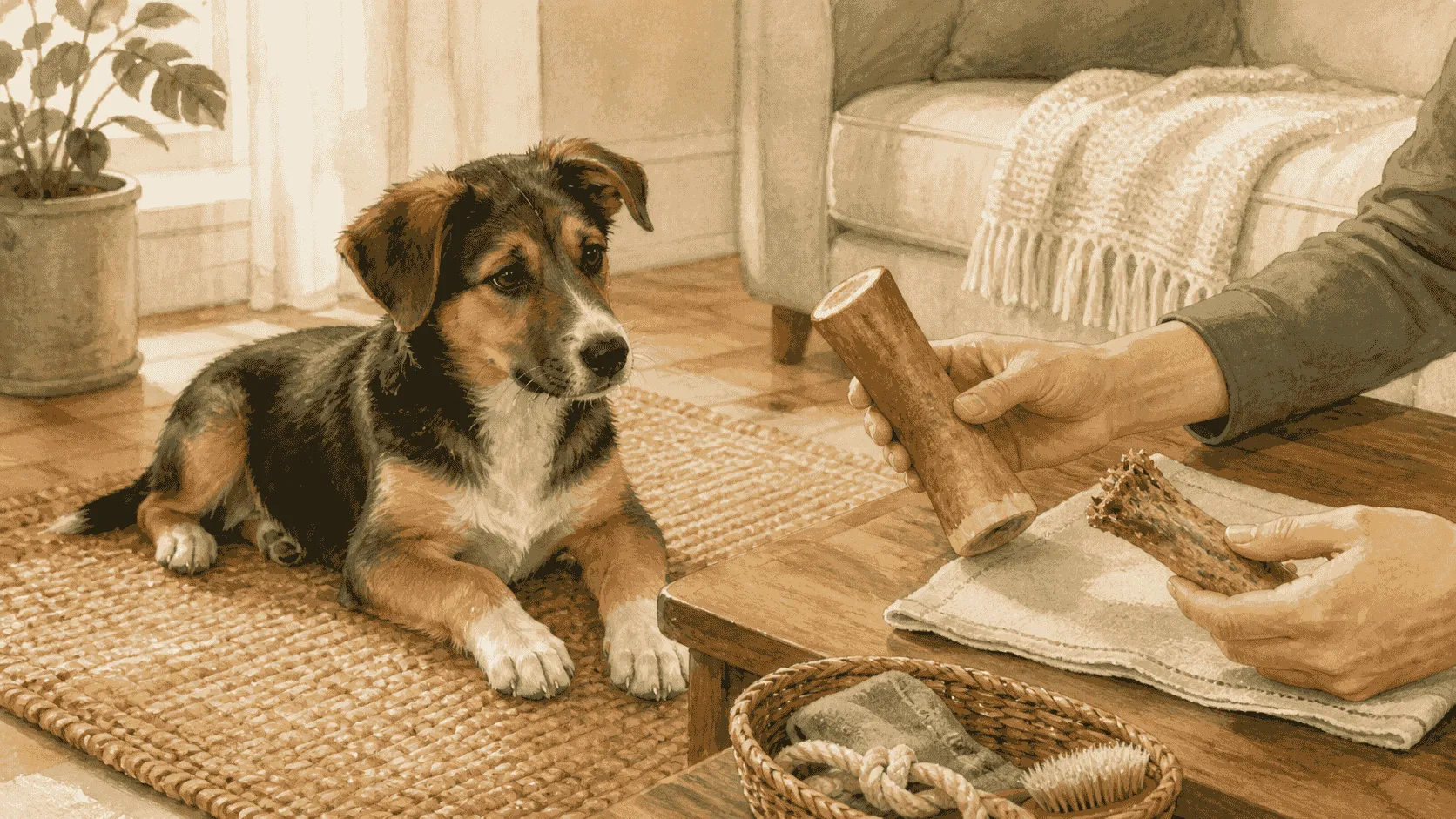
- Pause when the object is uncertain. If you cannot account for the bone’s suitability for this dog, do not treat uncertainty as permission to test it. Set it aside and choose an outlet whose size, condition, and intended use you can assess.
- Match the alternative to the dog in front of you. Use a dog-appropriate object for the activity you are offering, and watch how the dog actually uses it. An object that is carried gently may need a different plan from one that is rapidly dismantled. For a broader inspection routine, see our safer checks for dog toys and chewing outlets.
- Supervise and recheck. Stay present whenever ingestion is possible. Remove an object if it becomes split, loose, misshapen, or missing a piece, and keep replacement options and household hazards managed. Supervision is a useful part of the plan, not a guarantee that an accident cannot happen.
The aim is not to find a material that promises zero risk. It is to make a modest choice you can observe, adjust, and stop when the dog’s behavior or the object changes.
If Your Dog May Have Swallowed a Bone
Contact a veterinarian promptly if your dog may have swallowed a bone. Choking is an emergency. Gagging, drooling, repeated attempts to swallow, regurgitation, or difficulty swallowing also deserve prompt professional direction. These signs do not let an owner diagnose an obstruction, but they do change the next action from home observation to a veterinary call.
Avoid home fixes: do not try to pull an object out, make the dog vomit, or feed bread as a way to solve the uncertainty. Tell the veterinarian what may have been swallowed, when it happened, and what you have observed. If vomiting or other digestive signs appear, our guide to recording what to notice after a possible foreign-body event can help organize the history; it is not a substitute for contacting the clinic.
Make the Next Decision Small
Before offering a bone, ask two questions: can I make a reasoned choice for this particular dog, and can I supervise the way it is being used? If either answer is unclear, leave that bone out and offer a dog-appropriate alternative instead.
After possible ingestion, do not wait for certainty or a missing piece to confirm a problem. Call your veterinarian, report the exposure plainly, and follow the professional direction you receive. That keeps the useful boundary clear: chewing can have a place in a dog’s routine, but no internet list can turn an uncertain bone into a universal rule.
Sources
Petzette's claim cards for this article point to the following scientific, veterinary, or animal-welfare sources.
- Dog Bone Foreign Bodies: Referral-Series Evidence and Public-Safety Limits: Peer-reviewed retrospective canine referral-case series, supplemented by veterinary reference and government consumer-safety guidance
- Barash, A., et al. Endoscopic removal of bone foreign bodies in the upper gastrointestinal tract of dogs. Journal of Veterinary Internal Medicine. 2022. doi:10.1111/jvim.16383.
- Dog Chewing Function And Welfare Review 2025: Peer-reviewed narrative review
- RSPCA Dog Home And Chewing Outlets: Animal-welfare organization guidance
- Gastrointestinal Foreign Bodies In 72 Dogs: Peer-reviewed multicentre retrospective clinical study
Di Palma C, et al. *Animals*. 2022;12(11):1376. doi:10.3390/ani12111376.
- Blue Cross: How To Play With Your Dog: Animal-welfare and behavior guidance
- Cornell: Gastrointestinal Foreign-Body Obstruction In Dogs: Veterinary-school clinical education