Behavior04 October 2026
Why Do Dogs Like Bones? A Safer Chew Plan
Why do dogs like bones? Learn how chewing can serve more than one purpose, how to choose a safer outlet, and when possible swallowing needs a vet call.
TextPetzette Editorial
Read5 Min
Evidence status
Source-backed editorial
- Evidence record
- 4 claim cards linked to 8 documented sources.
- Independent expert review
- Not commissioned. Petzette Editorial is responsible for the published wording.
- Source record checked
- 03 August 2026
- Scope
- General guidance. Individual animals and circumstances can differ.
Why do dogs like bones? The most honest answer is that chewing can have more than one function, and a bone does not reveal which one is operating for this dog. A 2025 narrative review in Frontiers in Veterinary Science, led by researchers at the University of Sydney, describes canine chewing across food acquisition, ingestion, self-care, social interaction, and welfare. That is useful context, not a motive decoder.
For a new dog owner, the practical question is not whether a bone has a magical appeal. It is whether the object gives this dog a safe, observable activity—or whether a different outlet makes the same moment easier to manage. This guide focuses on that choice. Our bone-safety guide explains the separate question of what to do with an uncertain bone, while this page explains why interest is not permission.
Chewing Can Be Normal Without Being One Simple Story
Dogs use their mouths to explore and interact with objects, and chewing can fit several ordinary contexts. The review does not support turning a chewed object into a verdict about spite, boredom, teething, stress, or dental disease. The same visible action can sit inside different routines, and an owner usually cannot identify the underlying function from one episode.
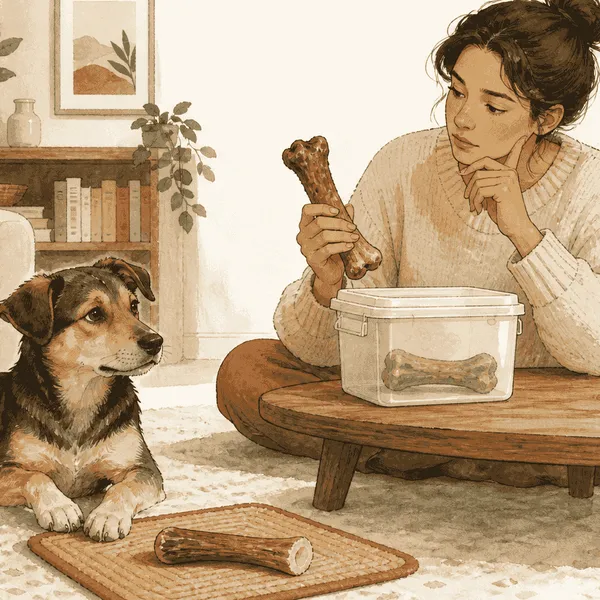
That matters with bones because the object may be valued, edible, interesting to carry, or simply available at the moment. Those are plausible descriptions of the scene, not a diagnosis of what your dog feels or intends. If your dog approaches a bone, sniffs it, carries it, chews briefly, walks away, or returns later, record the pattern without forcing one explanation.
RSPCA guidance treats chewing as an activity to plan for: offer safe, dog-appropriate outlets and investigate sudden or dangerous changes rather than punishing the evidence. That still does not make every bone suitable. The review’s individual-safety boundary, together with Blue Cross guidance on toy size, condition, and supervision, keeps the dog’s size, chewing style, and the object’s condition in the decision.
Read the Dog and the Object Together
Before deciding what the bone means, make a short two-part check:
- The dog: Can the dog pause, change activity, and walk away? Does the dog try to dismantle or swallow pieces quickly? Is the interest familiar, or suddenly more intense or difficult to interrupt?
- The object: Is it intact, the right size for this dog, and still in the condition you intended? Is anything split, loose, sharp, or missing? Can you supervise the way the dog uses it?
This is an observation plan, not a home test. A dog that chooses a bone does not prove that the bone is safe, and a dog that has used one before without trouble has not created a universal safety rule. The 2025 review specifically cautions that chew-object safety and welfare value need individual assessment, including attention to dental-fracture and injury concerns.
If the dog becomes tense, blocks access, freezes, stares, hides the object, or swallows rapidly when someone approaches, increase distance rather than testing the response. Do not pull the bone away to prove that the dog will give it up, send a child or another dog to investigate, or punish a growl. A resource-guarding pattern is a separate behavior and safety question; our guide to dogs burying bones covers stashing and guarding in more detail.
Give the Mouth a Safer Job
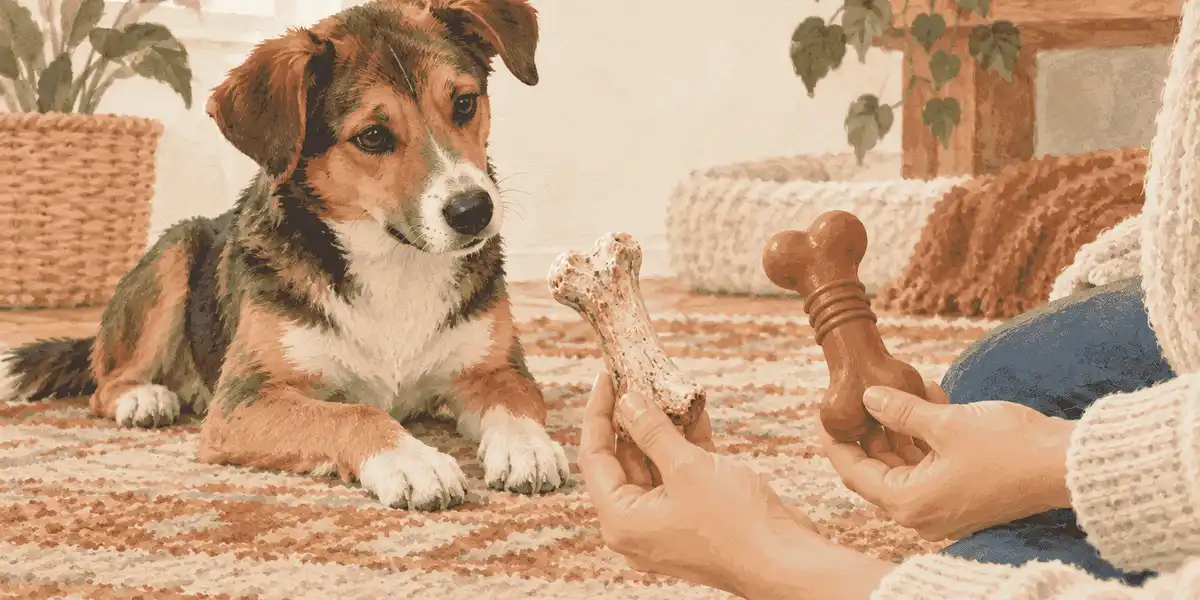
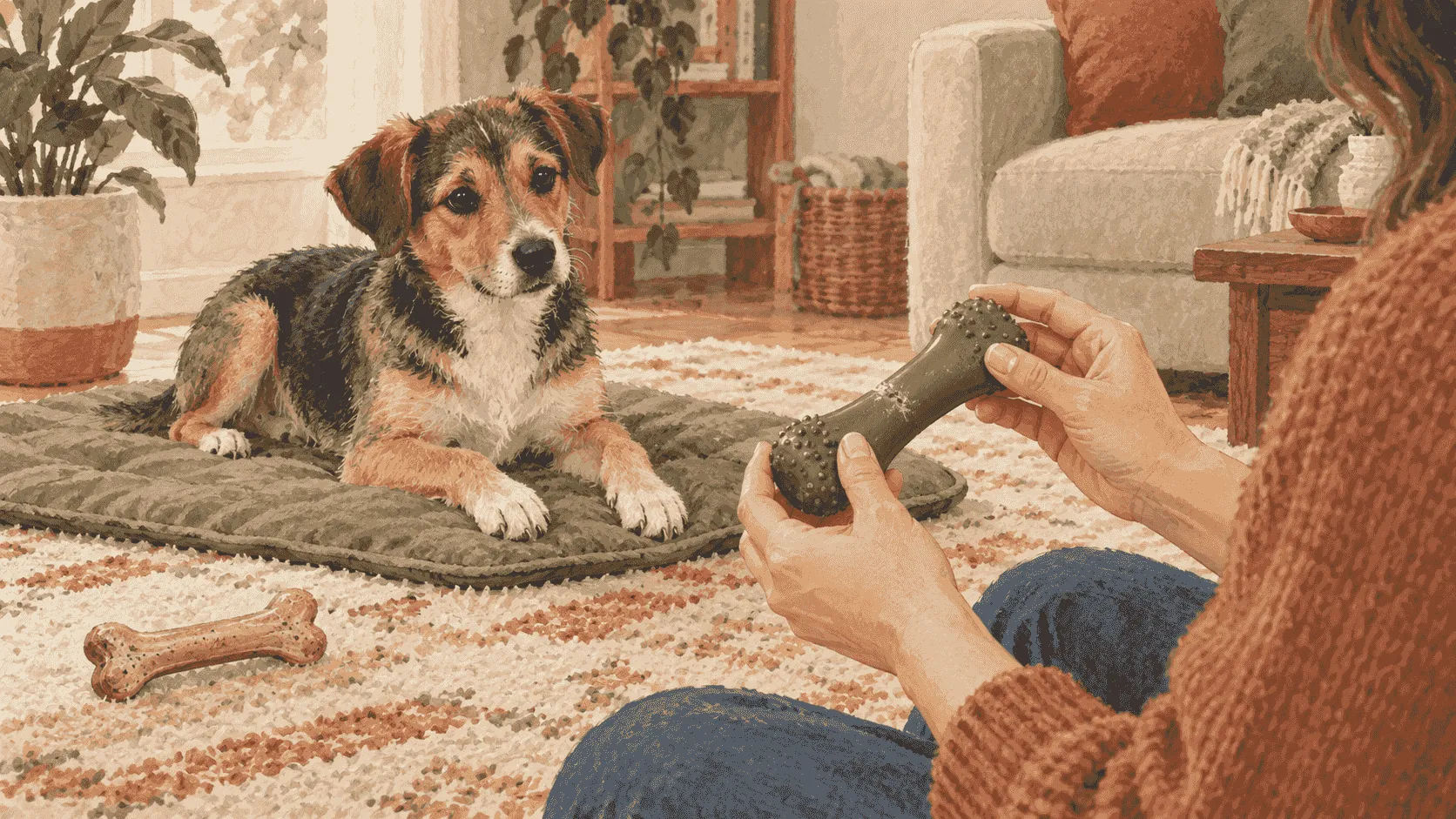
If a bone is uncertain, replace the activity rather than arguing with the dog about the object. Choose a dog-appropriate chew or play object whose size and condition you can assess, and make the exchange calm. Blue Cross guidance recommends toys that are too large to swallow, in good condition, and suited to the individual dog’s play style. It also recommends supervision when pieces could be ingested and removing damaged toys.
The aim is not to find one object that works for every dog. The wider dog-toy guide uses the same size, condition, and supervision checks for chewing and play. Your safer outlet might be a brief supervised chew, a simple search, a sniffing opportunity, or a calm rest choice, depending on the dog and the setting. Blue Cross describes enrichment as a way to express natural behaviors such as scent work, searching, and food foraging; it does not present enrichment as a cure for distress, aggression, or a health problem.
Keep the first alternative easy enough to understand. Offer it without pressure, watch how the dog uses it, and stop when damage appears or the dog cannot disengage. A substitute should preserve a safe job for the mouth, nose, or brain; it does not need to imitate a bone perfectly.
If Your Dog May Have Swallowed a Bone
Do not assume a swallowed bone is safe because the dog looks comfortable at first. A retrospective Journal of Veterinary Internal Medicine referral study described 129 dogs with endoscopically managed bone foreign bodies in the esophagus or stomach. That is a referral series, not a prediction that every swallowed bone is lodged or needs the same procedure. It is still a reason to treat possible ingestion as a veterinary question rather than a home experiment.
Contact a veterinarian promptly if your dog may have swallowed a bone. Choking is an emergency. Gagging, drooling, repeated attempts to swallow, regurgitation, difficulty swallowing, vomiting, appetite loss, abdominal pain, diarrhea, dehydration, or lethargy after possible ingestion need prompt professional assessment. These signs do not let an owner diagnose an obstruction, but they change the next action.
Do not pull at a suspected object, make the dog vomit, feed bread or bulky food to push it through, or wait for a missing piece to prove there is a problem. Tell the veterinarian what the dog may have swallowed, when it happened, whether a piece is missing, and what you observed.
Make the New-Dog Chew Decision Small
The next time your dog shows interest in a bone, use three questions: can I assess this object for this dog, can I supervise its use, and can the dog disengage without a contest? If any answer is unclear, leave the bone out and offer a safer activity instead.
Chewing can be a normal part of a dog’s life without making every bone a good choice. Read the whole episode, keep alternatives observable and product-neutral, and treat sudden, dangerous, persistent, or escalating chewing as a reason to speak with your veterinarian or a qualified reward-based behavior professional. The useful answer to “why do dogs like bones?” is not one fixed motive; it is a safer next decision built around the dog in front of you.
Sources
Petzette's claim cards for this article point to the following scientific, veterinary, or animal-welfare sources.
- Dog Chewing Function And Welfare Review 2025: Peer-reviewed narrative review
- RSPCA Dog Home And Chewing Outlets: Animal-welfare organization guidance
- Dog Bone Foreign Bodies: Referral-Series Evidence and Public-Safety Limits: Peer-reviewed retrospective canine referral-case series, supplemented by veterinary reference and government consumer-safety guidance
- Barash, A., et al. Endoscopic removal of bone foreign bodies in the upper gastrointestinal tract of dogs. Journal of Veterinary Internal Medicine. 2022. doi:10.1111/jvim.16383.
- Gastrointestinal Foreign Bodies In 72 Dogs: Peer-reviewed multicentre retrospective clinical study
Di Palma C, et al. *Animals*. 2022;12(11):1376. doi:10.3390/ani12111376.
- Blue Cross: How To Play With Your Dog: Animal-welfare and behavior guidance
- Cornell: Gastrointestinal Foreign-Body Obstruction In Dogs: Veterinary-school clinical education
- Dog Nosework Positive Judgment Bias 2019: Peer-reviewed animal behaviour paper with Purdue Canine Welfare Science summary
- Blue Cross Dog Enrichment: Animal welfare charity guidance / dog enrichment advice