Health Signals22 August 2026
Why Do Dogs Like Sticks? A Safer Play Plan
Why do dogs like sticks? Learn why sensory play can appeal, why found wood is risky, and how to swap in a safer fetch plan.
TextPetzette Editorial
Read4 Min

Evidence status
Source-backed editorial
- Evidence record
- 4 claim cards linked to 10 documented sources.
- Independent expert review
- Not commissioned. Petzette Editorial is responsible for the published wording.
- Source record checked
- 12 July 2026
- Scope
- General information, not an individual diagnosis or treatment plan.
Why do dogs like sticks? A branch can offer scent, texture, something to carry, and something to chew. Blue Cross notes that these sensory and chewing qualities can be appealing, but they do not reveal one fixed reason for an individual dog’s interest. The useful first-year decision is simpler: do not turn found wood into a fetch or chew toy. Replace the object, not the chance to chase, carry, or investigate.
That distinction matters because a stick can change shape during the game. A dog may carry it without trouble one day and meet a splinter, point, loose branch, or swallowed piece the next. You do not need to make sticks scary to make the walk safer; you need a small plan for what your dog can do instead.
Why Sticks Can Be Appealing Without Being a Good Fetch Toy
Dogs often explore the world with their mouths and noses. A 2025 veterinary review describes chewing as common behavior with several possible functions, so a stick in the mouth does not establish boredom, spite, pain, or a training failure. It may simply be an interesting thing in that place at that moment.
That is why a calm swap works better than a scolding storyline. If your dog notices or picks up a branch, guide them toward an appropriate object or another activity rather than trying to prove why the branch mattered. A short scent search, a sniff-focused stretch of the walk, or a suitable fetch game can keep the interesting part of the outing without making found wood the equipment.
The goal is not to ban curiosity. It is to give curiosity a safer route. The wider dog-toy safety guide can help you match a play object to your dog’s size, style, and current condition.
Found Wood Changes Shape, So the Game Changes
The British Veterinary Association advises against throwing sticks because they can cause mouth cuts, deep throat injuries, retained splinters, and delayed problems after contact. Blue Cross also highlights the unpredictable size, weight, bounce, thorns, branches, and splinters in found wood. A smooth-looking stick is not a product standard, and a soft-looking branch is not a safety test.
A 2008 Veterinary Surgery retrospective series described acute mouth and esophageal stick injuries in 41 dogs. That finding does not tell you the chance that one game will lead to an injury. It does show why the risk is real enough to change the default game before a dog runs onto a pointed or breakable object.
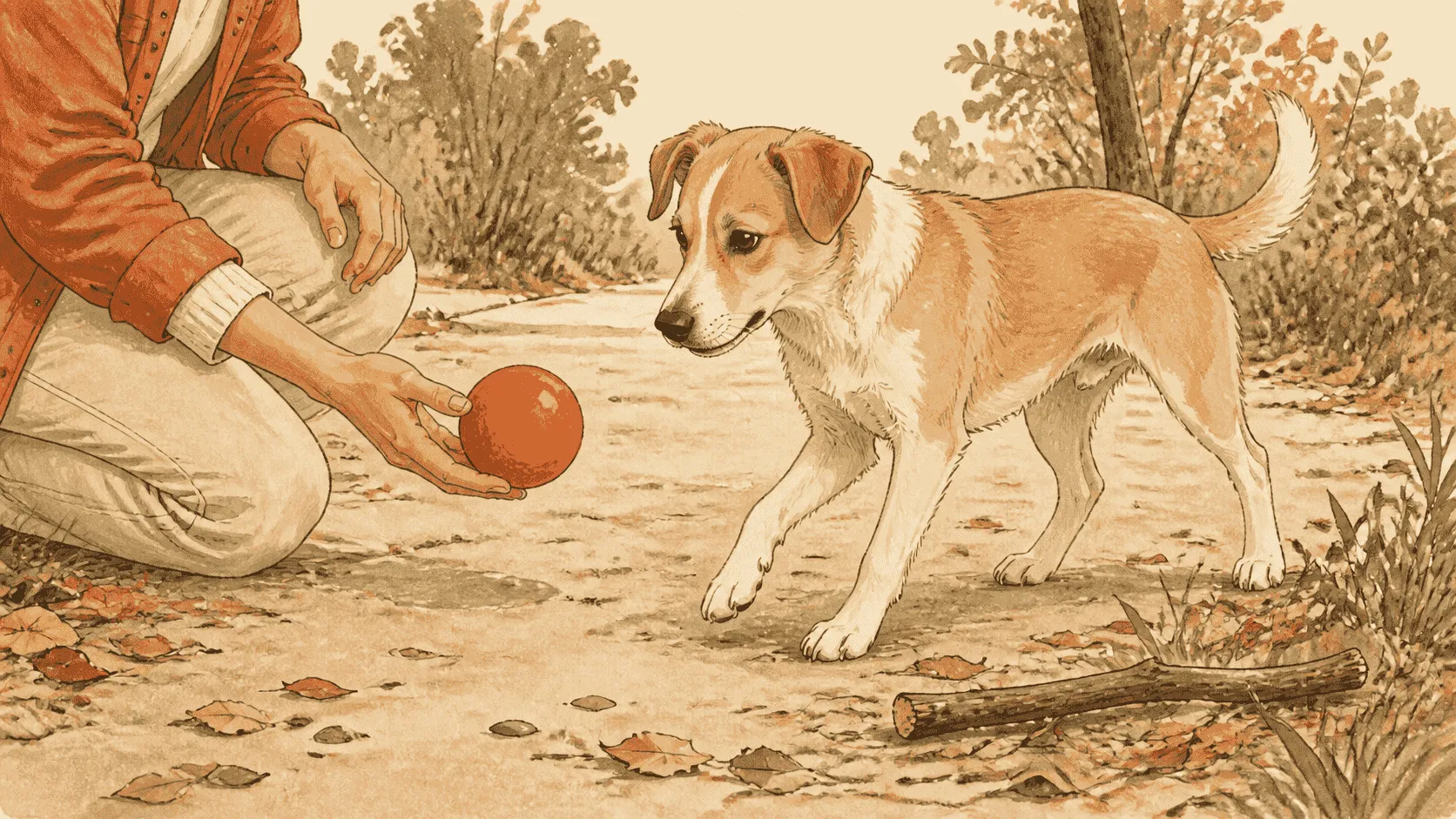
Leave a found stick on the ground rather than throwing it, tugging it, or using it as a chew. If your dog is already carrying one, make the exchange easy: offer a suitable alternative, create a little space, and avoid a chase that turns the branch into a prize.
Swap the Object, Not the Chase
Bring one dog-appropriate fetch object before the walk. It does not need a brand name or a promise to be indestructible. It needs to be large enough that your dog cannot swallow it whole, in sound condition, and suited to how this dog carries, retrieves, or chews.
Run a quick check before play:
- Is the object too large to swallow whole?
- Are there loose, split, cracked, or missing pieces?
- Does this dog try to shred or swallow it?
- Can you supervise the way your dog uses it today?
Retire the toy when damage appears. A manufactured object can still become unsafe, so “safer than a stick” is not the same as permanently safe. For a different kind of outdoor job, let the walk include calm sniffing and choice; matching the lead to the walk has ideas for making that part manageable.
If a Stick May Have Injured Your Dog, Leave the Mouth Alone
Suspected penetration, choking, gagging, bleeding, pain, a change in swallowing, or possible swallowed wood needs prompt veterinary direction. Do not probe deeply into your dog’s mouth, pull at embedded material, or assume that a cough identifies a splinter. A retained fragment or injury may not be obvious from the outside.
Keep the dog from taking another bite if you can do so calmly, then call your veterinarian or an emergency clinic and describe what you saw: whether the stick was thrown, chewed, or carried; when it happened; any change in breathing, swallowing, eating, or behavior; and whether a piece may be missing. The veterinarian can decide what the individual dog needs next.
Make the New-Dog Walk Plan Easy to Repeat
Put the fetch object by the lead, not in the car after the walk has already started. At the same time, teach a gentle exchange during calm moments with a low-value item so the first real branch does not become a contest. Reward the release, offer the safer object, and keep the next game short enough to stay enjoyable.
If sticks are a recurring attraction, change the route or pause near branch piles before your dog reaches them. Add other safe outlets for the nose, brain, mouth, and routine rather than expecting one toy to solve every behavior. A sudden or dangerous chewing pattern still deserves a closer look with your veterinarian or a qualified behavior professional.
The next useful step is small: pack a suitable fetch object, inspect it before the throw, and leave found wood where it is. Your dog can still chase, carry, sniff, and play—without asking a branch to do a toy’s job.
Sources
Petzette's claim cards for this article point to the following scientific, veterinary, or animal-welfare sources.
- Acute Oropharyngeal And Esophageal Stick Injury In 41 Dogs: Peer-reviewed retrospective clinical study
Doran IP, Wright CA, Hotston Moore A. *Veterinary Surgery*. 2008;37(8):781-785. doi:10.1111/j.1532-950X.2008.00448.x.
- Blue Cross: Are Sticks Safe For Dogs?: Veterinary-reviewed animal-welfare guidance
- British Veterinary Association: Stick Injury Prevention: Veterinary-association clinical prevention commentary
- Dog Chewing Function And Welfare Review 2025: Peer-reviewed narrative review
- RSPCA Dog Home And Chewing Outlets: Animal-welfare organization guidance
- Gastrointestinal Foreign Bodies In 72 Dogs: Peer-reviewed multicentre retrospective clinical study
Di Palma C, et al. *Animals*. 2022;12(11):1376. doi:10.3390/ani12111376.
- Blue Cross: How To Play With Your Dog: Animal-welfare and behavior guidance
- Cornell: Gastrointestinal Foreign-Body Obstruction In Dogs: Veterinary-school clinical education
- Dog Nosework Positive Judgment Bias 2019: Peer-reviewed animal behaviour paper with Purdue Canine Welfare Science summary
- Blue Cross Dog Enrichment: Animal welfare charity guidance / dog enrichment advice