Nutrition23 October 2026
What Fish Can Dogs Eat? A Plain, Boneless Safety Check
What fish can dogs eat? Use a plain, cooked, boneless check, keep it as a small extra, avoid raw salmonid exposure, and know when to call a veterinarian.
TextPetzette Editorial
Read5 Min

Evidence status
Source-backed editorial
- Evidence record
- 5 claim cards linked to 7 documented sources.
- Independent expert review
- Not commissioned. Petzette Editorial is responsible for the published wording.
- Source record checked
- 23 October 2026
- Scope
- General information, not an individual diagnosis or treatment plan.
Can dogs eat fish? Sometimes, but the useful answer is narrower than a list of fish names. For a generally healthy dog, a small piece of plain, cooked, boneless fish can be considered as an optional extra when the preparation and the dog’s diet fit. That is a starting point, not a universal clearance for every fish, recipe, or dog.
The decision has four parts: identify the fish and preparation, keep it in the small extras part of the diet, separate cooked food from raw-salmonid exposure, and ask a veterinarian when the individual dog changes the picture. A possible exposure is a different question from whether you are planning a treat.
Start With the Fish-Form Check
Before offering a fish extra, pause over the whole form rather than the ingredient name alone:
- Is it plain and cooked? The North Carolina State University College of Veterinary Medicine Veterinary Hospital lists cooked salmon and tuna in its cooked-meat treat examples for cats and dogs. The same guidance separates those examples from salty, spicy, fatty, or fried foods that may cause problems. A sauce, seasoning blend, fried coating, or mixed dish creates a different decision.
- Can you account for bones? Treat the fish as a boneless extra, not as a chew. If you cannot make a reasonable bone check, leave that piece out. A fish name does not turn a bone into a suitable chew outlet.
- Is the item still an extra? Fish from a plate, training reward, topper, and other shared-food bites all belong in the day’s extras picture. A treat does not become complete food because it is a recognizable animal ingredient.
- Does it fit this dog? Food sensitivity, digestive disease, another medical condition, a weight-management plan, a therapeutic diet, or a growth-related question can change the answer.
This is deliberately a form check, not a promise that the word “fish” identifies a safe product. The everyday dog-treat guide covers the broader question of how rewards fit a dog’s routine.
Which Fish Can Dogs Eat?
Use a named cooked example as a narrow starting point. NC State’s table includes cooked salmon and tuna, but it does not create a complete fish whitelist or a universal portion chart. It also does not say that raw, undercooked, fried, seasoned, salty, fatty, sauced, or mixed fish preparations are equivalent to the examples.
That distinction matters when a search result says “fish.” A plain cooked piece and a restaurant dish may share a species name while differing in added ingredients, fat, preparation, and bones. A fish-based supplement, fish oil, complete food, or home-prepared recipe is a separate decision rather than an automatic extension of this one.
For generally healthy dogs, the 2021 American Animal Hospital Association nutrition and weight-management guidelines keep complete and balanced food at 90 percent or more of total calories, with treats and other extras at 10 percent or less. The 10 percent figure is a ceiling in a general framework, not a target or a universal serving amount. It can also be the wrong unchanged framework for a therapeutic diet or an individual dog with different needs.
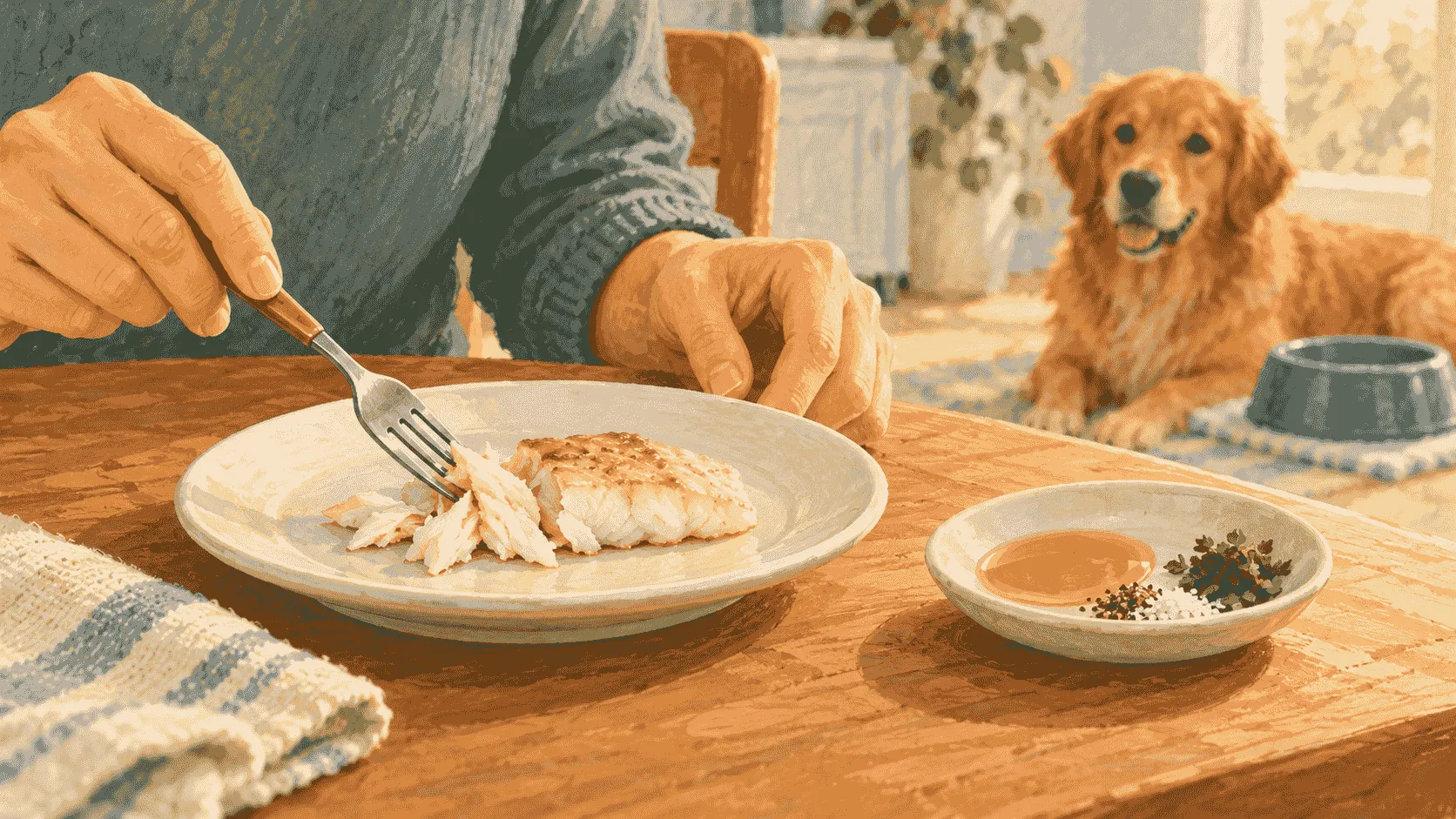
For a new dog, keep the experiment readable: introduce one form at a time, do not hide it in a mixed recipe, and record what you offered. If the dog has a health or diet question, ask the veterinarian before using a general treat example.
Raw Salmonid Fish Needs a Different Boundary
Raw or undercooked salmonid fish is not the same decision as a plain cooked fish extra. VCA Animal Hospitals describes salmon poisoning in dogs after exposure to infected raw or undercooked salmon, trout, or steelhead, with the disease most commonly reported in Washington, Oregon, northern California, and southern Vancouver Island. The article also identifies access to raw fish parts and fishing or waterway waste as prevention concerns.
Keep raw or undercooked salmonid fish and fish parts inaccessible to dogs, especially in that regional context. If a dog may have eaten one, contact a veterinarian promptly and report the fish, preparation, place, and time. Do not wait for a symptom list to settle the question, induce vomiting, or give medication unless a veterinary or poison-control professional directs you. VCA’s guidance gives this exposure a professional-help boundary; it does not show that every raw fish is infected or that every exposure causes the disease.
Fish Bones Are a Foreign-Body Question
A fish bone is not a bonus chew. The Pet Knowledge Vault’s bone evidence describes a referral series of 129 dogs with endoscopically managed bone foreign bodies and notes that possible ingestion needs case-specific veterinary assessment. The series does not show that every swallowed bone becomes lodged, but it is enough to reject a casual “safe bone” rule.
If your dog may have swallowed a fish bone, contact a veterinarian promptly. Choking is an emergency; gagging, drooling, repeated attempts to swallow, regurgitation, or difficulty swallowing also change the next action from a routine treat decision to professional direction. Do not pull at a suspected object, feed bread as a home fix, or induce vomiting. The bone decision guide keeps that foreign-body boundary separate from ordinary treat planning.
Make the Next Step Small
Use this short check before offering a fish extra:
- identify the exact fish and preparation;
- keep it plain and cooked, with a reasonable bone check;
- count it with the dog’s other extras rather than treating it as a meal;
- leave the item out when the preparation is unclear; and
- ask a veterinarian when the dog has a medical, dietary, weight, or growth-related reason for a tailored plan.
If access has already happened, stop using the routine treat screen. Keep the package or ingredient details, note the possible time and place, and call a veterinarian or animal poison-control service when the exposure may involve raw salmonid fish, a bone, or a mixed dish with an unknown ingredient.
The practical answer is not “fish is safe” or “fish is forbidden.” It is more useful: a plain, cooked, boneless fish extra may fit some generally healthy dogs, while preparation, regional raw-fish exposure, bones, and individual health needs determine what happens next.
Sources
Petzette's claim cards for this article point to the following scientific, veterinary, or animal-welfare sources.
- NC State Cooked Fish Pet Treat Guidance: Veterinary-hospital nutrition guidance for cats and dogs
- AAHA Nutrition And Weight Management Guidelines 2021: Peer-reviewed veterinary clinical guideline
Cline MG, Burns KM, Coe JB, et al. 2021 AAHA Nutrition and Weight Management Guidelines for Dogs and Cats. Journal of the American Animal Hospital Association. 2021;57:153-178.
- UC Davis Treat Guidelines For Dogs: Veterinary-school nutrition-service guidance
- VCA Raw Salmonid Exposure Boundary: Professional veterinary and animal-poison guidance for dogs
- Schmid, Renee, DVM, DABT, DABVT; Brutlag, Ahna, DVM, MS, DABT, DABVT; and Barnette, Catherine, DVM. “Salmon Poisoning.” VCA Animal Hospitals. Last updated 2026-08-14.
- Dog Bone Foreign Bodies: Referral-Series Evidence and Public-Safety Limits: Peer-reviewed retrospective canine referral-case series, supplemented by veterinary reference and government consumer-safety guidance
- Barash, A., et al. Endoscopic removal of bone foreign bodies in the upper gastrointestinal tract of dogs. Journal of Veterinary Internal Medicine. 2022. doi:10.1111/jvim.16383.
- AAFCO Pet Food Labels And Nutritional Adequacy: US feed-control association consumer and regulatory guidance
- AVMA Pet First Aid: Poison Response Boundary: Veterinary-association first-aid brochure