Behavior04 October 2026
Why Do Dogs Put Their Paw on You? Read the Whole Moment
Why do dogs put their paw on you? Learn what a paw can and cannot tell you, how to pause for choice, and when a changed pattern needs help.
TextPetzette Editorial
Read5 Min
Evidence status
Source-backed editorial
- Evidence record
- 5 claim cards linked to 5 documented sources.
- Independent expert review
- Not commissioned. Petzette Editorial is responsible for the published wording.
- Source record checked
- 04 October 2026
- Scope
- General guidance. Individual animals and circumstances can differ.
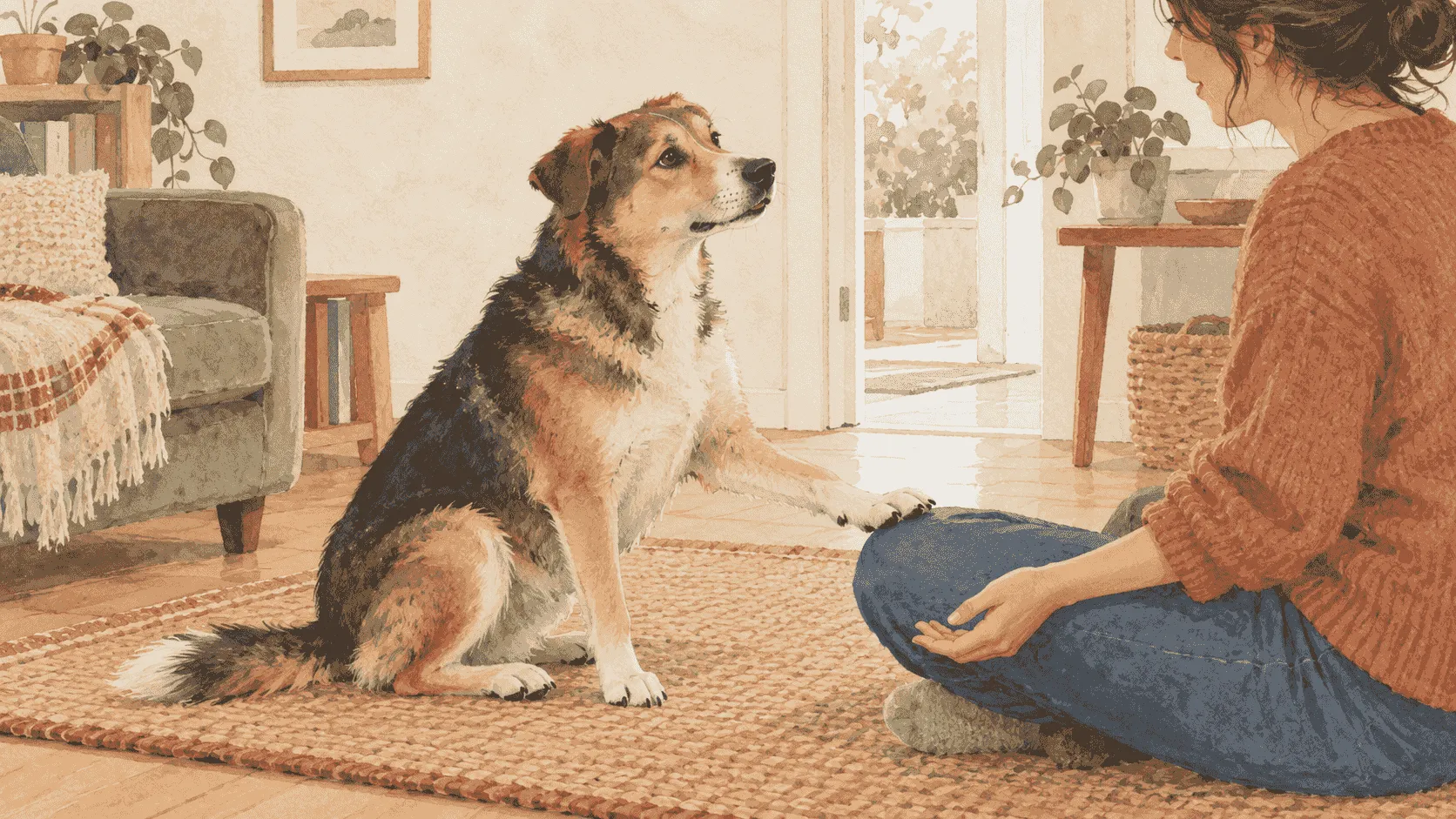
Why do dogs put their paw on you? The honest answer is that a paw on a person is an observation, not a complete translation. It can happen during a learned response, a close interaction, or a moment when the dog is unsure. The paw alone cannot tell you whether a dog is happy, anxious, affectionate, demanding attention, or asking for touch.
The useful first-year decision is smaller: should you continue the interaction, pause, or give the dog more room? Read the whole dog, the situation, and what changes when you stop adding pressure.
A Paw Is Not a Personality Test
Individual dogs can use one front paw more often in particular actions. A 2019 Laterality meta-analysis found individual left- or right-sided preferences in many dogs, while not finding a population-level rightward preference. That is a motor-laterality finding, not a household score for personality or mood.
The laterality evidence is also sensitive to the task. A 2022 Animals study compared a food-toy task with locomotion tasks and owner-rated emotionality in pet dogs. It found no significant association between its paw-preference measures and that emotionality measure, and the tasks did not all agree with one another. A 2023 Animal Cognition study likewise shows why learning history, owner context, and the way a task is recorded matter.
So do not turn a paw placed on you—or a paw used in a food-toy, stepping, reaching, or learned give-paw task—into a left-versus-right emotion decoder. It does not tell you that a dog is anxious, confident, aggressive, smart, healthy, or the right match for a person. Do not stage or repeat a paw test to label the dog.
Start With the Moment Before the Paw
Dogs Trust guidance recommends reading the individual dog, the whole body, and the context. That is more useful than building a dictionary around one front foot. Before you touch, ask:
- What happened just before? Was there a greeting, a request, a pause in play, food nearby, a change in handling, or a person moving closer?
- What is the whole body doing? Look at the face, ears, mouth, tail, weight, movement, and muscle tension together. Is the dog loose and able to shift position, or still, low, stiff, and trying to create distance?
- Where is the dog choosing to be? A clear route away matters. Approaching, staying close, turning aside, freezing, and leaving are different observations.
- What happens when you pause? Remove your hand, soften your attention, or add a little space. Watch whether the dog settles, remains nearby by choice, re-approaches, or leaves.
One yawn, lip lick, ear position, tail movement, or lifted paw is not an established at-home emotion test. A 2022 controlled study of 28 dogs found that no individual facial action consistently classified the study’s positive-anticipation and frustration conditions. A 2024 systematic review of 39 dog-welfare studies likewise reported limited validation and context-dependent meaning. That does not make observation useless; it makes a whole-scene pause safer than a score.
For the wider sequence, use the dog body-language pause map. It is a broader decision aid for lowering pressure without pretending that a single cue names the feeling.
Use an Offer-Pause Check for Touch
If the dog is loose, close by choice, and free to move, make the next interaction easy to stop. Offer a brief touch at the shoulder or side of the neck, then remove your hand. The controlled petting-versus-vocal-praise study by Feuerbacher and Wynne found that the tested dogs spent more time near petting than vocal praise in its choice procedures. The measure was time spent nearby in that setting—not a love test, a universal reward rule, or permission to keep touching.
That distinction matters when a paw is resting on your leg or hand. A dog can choose proximity without choosing every kind of contact. The same dog may remain beside you but move away when you touch a sensitive body area, wake them, lean over them, or continue after the moment has changed.
Try this sequence:
- Keep your hand still or move it away instead of reaching farther because the paw is present.
- Leave a clear route out and give the dog a moment to change position.
- Continue only if the dog stays loose or voluntarily returns after the pause.
- Stop if the dog turns away, stiffens, freezes, withdraws, or repeatedly tries to leave.
This is not a pass-or-fail consent test. It is a low-pressure way to collect better information. A dog who places a paw on you has not given a permanent pass for hugging, lifting, paw handling, or prolonged petting. The belly-rub guide uses the same offer, pause, and choice principle for a different touch question.
Keep a Pattern, Not a Paw Score
If the behavior is confusing, write down what you actually saw rather than naming a motive. Note the setting, what happened immediately before, whether the dog approached or was already resting, which body cues appeared together, what you did next, and whether the dog stayed, re-approached, or left.
You can record which paw appeared, but keep that detail descriptive. A repeated left-paw or right-paw pattern is not a personality result, welfare score, or medical clearance. The research note on paw preference specifically warns against using a home task to choose a dog, assess health, predict behavior, or decide that a dog is safe or unsafe.
Do not recreate a tense moment to see whether the paw appears again. Do not hold a paw still, corner the dog, repeat a handling test, or add touch to force a clearer answer. A short record made without provoking the dog is more useful than a better-looking test.
When a Pawing Change Needs Help
Ask your veterinarian about a new, persistent, or concerning change in paw use or behavior. Move that conversation sooner if the dog seems painful, has a changed walk, cannot settle, or shows a wider change in movement or daily behavior. The paw gesture does not diagnose pain, lameness, neurologic disease, fear, anxiety, aggression, or any other cause.
If the pattern includes strong fear, escalating handling difficulty, repeated attempts to escape, or bite risk, create space and seek qualified behavior-professional support as well. Do not punish a dog for putting a paw on you, and do not keep touching to prove that the gesture was friendly. The safer response is to lower pressure and let an appropriate professional interpret a changed pattern.
The short answer to “why do dogs put their paw on you?” is therefore conditional: the paw may be part of a learned action or a social moment, but it cannot speak for the whole dog. Read the setup, offer a pause, watch the response, and treat new or worrying changes as a reason for individual help—not as a clue to decode at home.
Sources
Petzette's claim cards for this article point to the following scientific, veterinary, or animal-welfare sources.
- Dog Paw Preference Is Not A Personality Or Emotion Test: Cross-source peer-reviewed canine laterality evidence note
- Ocklenburg S, Isparta S, Peterburs J, Papadatou-Pastou M. *Paw preferences
- Dog Body-Language Observation Limits And Raised-Hackles Context: Cross-source peer-reviewed canine-welfare evidence and established animal-welfare guidance. This note supports a narrow public boundary: visible cues can guide calmer observation and space, but neither one cue nor an owner-made tally is a validated at-home emotion, stress, welfare, aggression, pain, or bite-prediction test.
- Bremhorst A, Mills DS, Würbel H, Riemer S. *Evaluating the accuracy of facial expressions as emotion indicators across contexts in dogs.* Animal Cognition. 2022;25:121-136. doi:10.1007/s10071-021-01532-1; PMID:34338869; PMCID:PMC8904359. The directly rendered PMC full text reports a 28-dog laboratory study of positive anticipation and frustration across food and toy contexts. Although several facial actions differed between the study conditions, no individual action consistently classified the associated state. The authors state that diagnostic-accuracy measures are needed for candidate emotion indicators.
- Dogs Trust Body Language Context Guidance: Welfare organization dog body-language guidance
- Dog Petting Versus Vocal Praise Choice Procedures: Peer-reviewed canine behaviour experiment
Feuerbacher EN, Wynne CDL. Shut up and pet me! Domestic dogs (Canis lupus familiaris) prefer petting to vocal praise in concurrent and single-alternative choice procedures. Behavioural Processes. 2015;110:47-59.
- RSPCA Dog Body Language: Animal-welfare behavior guidance