Behavior31 August 2026
Why Do Dogs Lick Their Lips? A Context-First Check
Why do dogs lick their lips? Learn how to read the whole situation, notice a changed pattern, and decide when a veterinarian should help.
TextPetzette Editorial
Read4 Min

Evidence status
Source-backed editorial
- Evidence record
- 3 claim cards linked to 3 documented sources.
- Independent expert review
- Not commissioned. Petzette Editorial is responsible for the published wording.
- Source record checked
- 30 August 2026
- Scope
- General guidance. Individual animals and circumstances can differ.
Why do dogs lick their lips? A quick tongue flick can appear around a food bowl, a greeting, handling, or a busy room. It is tempting to choose one explanation, but a lip lick on its own cannot name an emotion or a health problem. The useful decision is smaller: should you continue, lower the pressure, or record a changed pattern for a professional conversation?
A Lip Lick Is a Clue, Not an Emotion Test
RSPCA guidance includes lip licking among possible signs of worry when it appears with a matching whole-body picture. A dog may also lower its head or body, move its ears back, turn away, tuck its tail, or lift a front paw. A stiff body, forward weight, fixed stare, tense mouth, or exposed teeth can show that the dog needs more distance. The same guidance says to read those details in the situation and against the individual dog’s usual behavior.
Dogs Trust makes the same point in plainer terms: the same lip lick can occur in different contexts, so the individual dog, whole body, and moment matter. A dog that licks its lips near dinner may be giving you a different observation from a dog that licks its lips while a hand reaches over its head. Context changes the next action even when the visible cue looks similar.
There is also a research reason to stay modest. Bremhorst and colleagues’ 2022 Animal Cognition study examined 28 dogs in controlled positive-anticipation and frustration conditions; no individual facial action consistently classified the associated state. A 2024 systematic review in the Journal of Veterinary Behavior, covering 39 observational studies, likewise described limited validation and context-dependent meaning. The papers set a boundary around turning one lip lick—or a home tally—into a score for stress, fear, happiness, pain, or safety.
What Happened Before the Lip Lick?
Start with the event immediately before the tongue appeared. You are not trying to recreate the moment; you are identifying what changed.
- Food or a familiar routine: note whether the dog is loose, able to move away, and behaving as usual. Keep the observation beside the whole scene rather than treating the lip lick as a final answer.
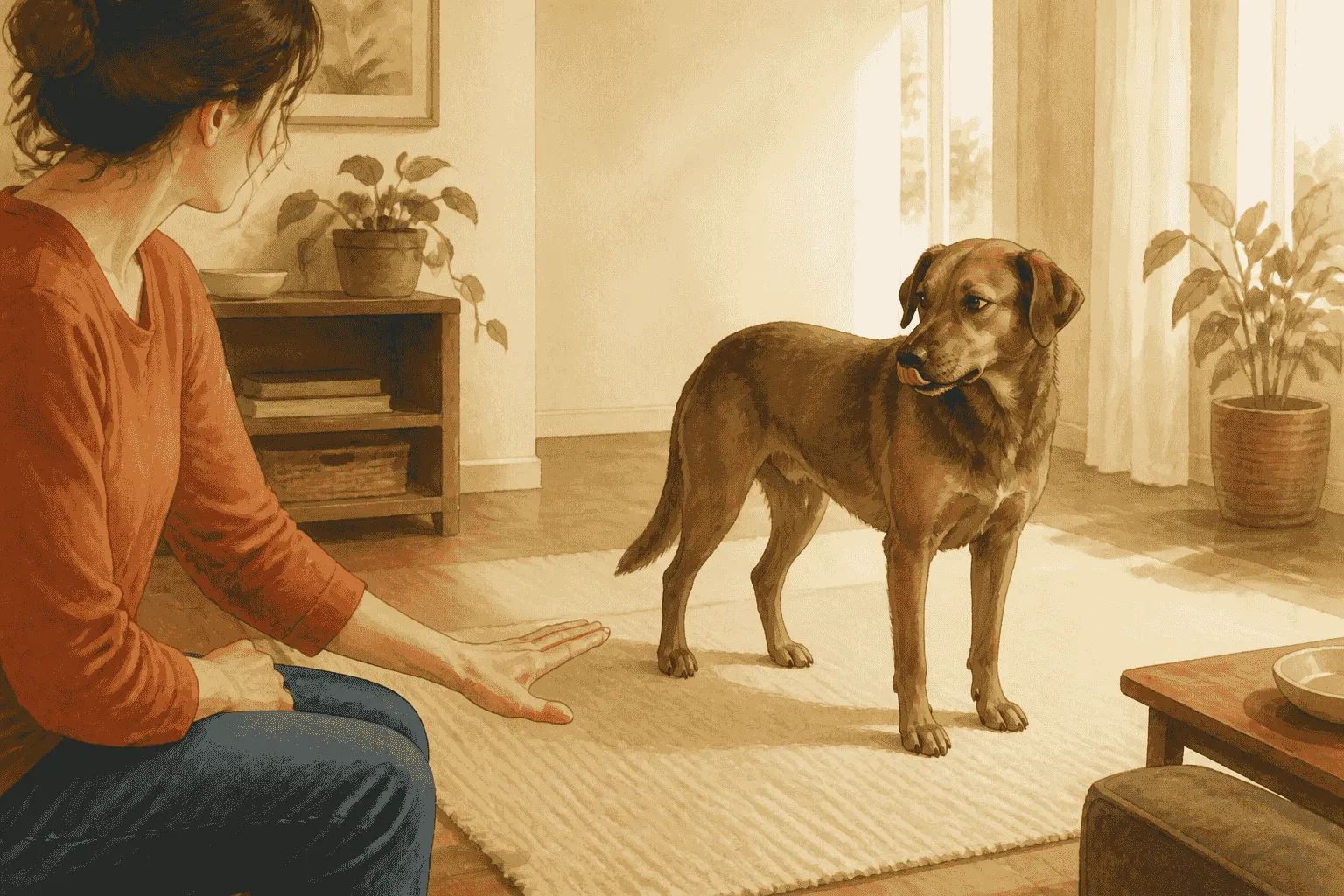
- A person moving closer or reaching: pause the approach. Turn slightly aside, lower your hand, and leave the dog a clear route away. Do not add touching, staring, lifting, or repeated filming to “test” the response.
- Handling, a visitor, another dog, or a noisy room: reduce the pressure first. More distance and fewer demands give you a safer chance to see whether the dog settles or chooses to leave.
- A new or repeating situation: write down the setting, time, people or animals present, what happened just before it, and what the dog did next. A short record is more useful than a confident label.
The practical split is simple: watch a brief, familiar cue quietly; record a new, persistent, or escalating pattern.
Read the Whole Dog at the Same Time
Look for combinations rather than collecting points. Is the body soft or stiff? Is the dog approaching, staying put, turning away, freezing, or creating distance? Are the ears, tail, weight, mouth, and eyes changing together? What happens when you make the scene easier?
The answer does not need to be “my dog is anxious.” It can be an observable next step: the dog turned away when a visitor leaned in, then returned after the visitor sat sideways. That description respects uncertainty while helping you choose what to do.
For the broader rule, read why dogs look to you when they are unsure. That guide explains how a dog may use an owner as a secure base while exploring, without turning a glance or another body cue into a universal translation.
Use a Three-Question Lip-Lick Check
Use these questions in order:
- What changed? Record the trigger, setting, time, and target of the dog’s attention.
- What did the whole body do? Note posture, ears, tail, movement, gaze, mouth, and whether the dog could choose distance.
- What happened after pressure dropped? Give space without creating a new test. If the dog softens or leaves, respect that choice; if the pattern repeats, keep the record and reduce similar pressure next time.
This check helps you respond; it does not diagnose. A photograph, clip, or checklist can preserve context for a veterinarian or qualified behavior professional, but cannot replace an assessment.
When a Veterinarian or Behavior Professional Should Lead
Contact your veterinarian when lip licking is new, marked, persistent, difficult to interrupt, or part of a broader behavior or health change. A visible cue can have more than one explanation, and veterinary input matters when medical influences could be involved. If the dog is showing serious fear, aggression, repeated distress, or bite risk, ask for qualified behavior support alongside veterinary guidance.
Do not wait for a perfect record when the change is sudden or concerning. Move the dog away from pressure, keep the surroundings safe, and make the call. The useful professional question is “What changed, and what support does this individual dog need?”
Your Next Move
When you see a dog lick its lips, pause before interpreting. Read the whole body, identify what happened just before it, and lower pressure if the picture is tense or unclear. A familiar, brief cue can remain an observation; a new or worrying pattern belongs in a clear note and, when needed, a veterinarian or behavior conversation.
The safest answer to “why do dogs lick their lips?” is bounded: the cue may carry different information in different moments. Make the next moment easier to read rather than forcing certainty from one small movement.
Sources
Petzette's claim cards for this article point to the following scientific, veterinary, or animal-welfare sources.
- RSPCA Dog Body Language: Animal-welfare behavior guidance
- Dog Body-Language Observation Limits And Raised-Hackles Context: Cross-source peer-reviewed canine-welfare evidence and established animal-welfare guidance. This note supports a narrow public boundary: visible cues can guide calmer observation and space, but neither one cue nor an owner-made tally is a validated at-home emotion, stress, welfare, aggression, pain, or bite-prediction test.
- Bremhorst A, Mills DS, Würbel H, Riemer S. *Evaluating the accuracy of facial expressions as emotion indicators across contexts in dogs.* Animal Cognition. 2022;25:121-136. doi:10.1007/s10071-021-01532-1; PMID:34338869; PMCID:PMC8904359. The directly rendered PMC full text reports a 28-dog laboratory study of positive anticipation and frustration across food and toy contexts. Although several facial actions differed between the study conditions, no individual action consistently classified the associated state. The authors state that diagnostic-accuracy measures are needed for candidate emotion indicators.
- Dogs Trust Body Language Context Guidance: Welfare organization dog body-language guidance