Behavior01 September 2026
Why Do Dogs Bury Bones? Read the Whole Pattern
Why do dogs bury bones? Learn what a quiet stash may mean, how to handle guarding or digging, and when a possible swallow needs a vet call.
TextPetzette Editorial
Read4 Min
Evidence status
Source-backed editorial
- Evidence record
- 5 claim cards linked to 6 documented sources.
- Independent expert review
- Not commissioned. Petzette Editorial is responsible for the published wording.
- Source record checked
- 01 September 2026
- Scope
- General guidance. Individual animals and circumstances can differ.
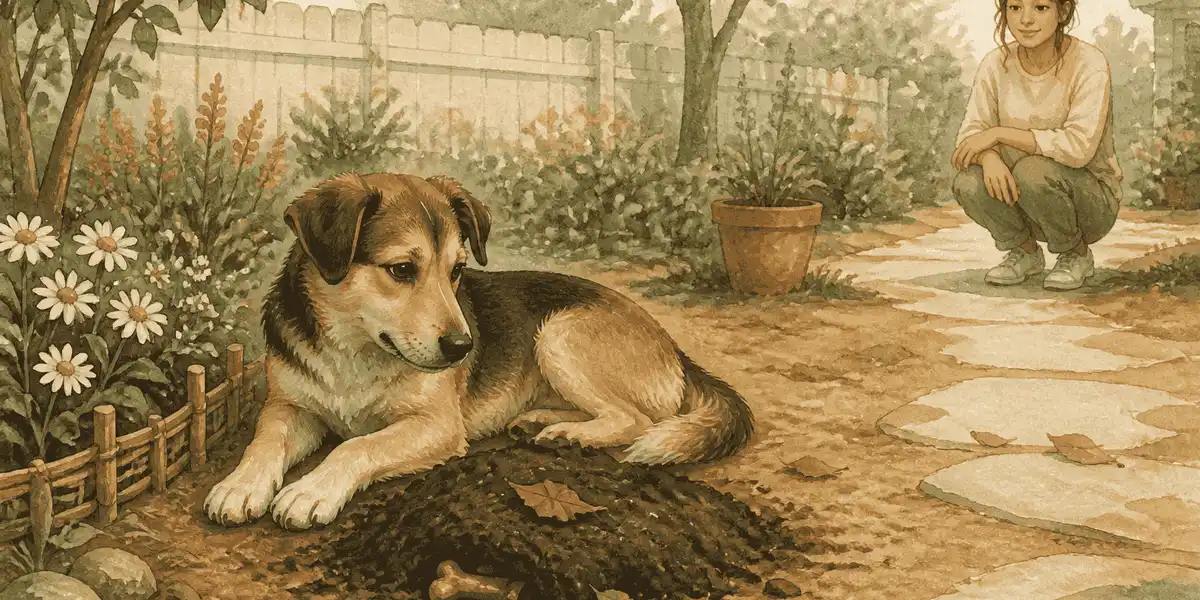
Why do dogs bury bones? A dog may be putting a valued object away for later—or may never return to it. The University of California, Davis School of Veterinary Medicine describes dogs sometimes burying food, bones, or toys and retrieving them later or not at all. For a new dog owner, the useful first-year decision is what to do next: leave a quiet stash alone, manage access, or call for help when the pattern includes guarding or a possible swallowed bone.
That explanation is useful context, not a complete translation. A buried bone can fit a familiar stashing pattern, a moment that changes when another dog comes close, or an outdoor digging problem. Read the item, setting, and whole response before assigning a motive. The same context-first guide to reading dog behavior applies: one action is not the whole dictionary.
What Dog Burying Can Tell You—and What It Cannot
UC Davis guidance says dogs may retrieve a buried item later or may not return. It notes that dogs may protect resources around other dogs and retrieve treats when safe. “Saving it” describes the action, not the dog’s personality, hunger, or emotional state.
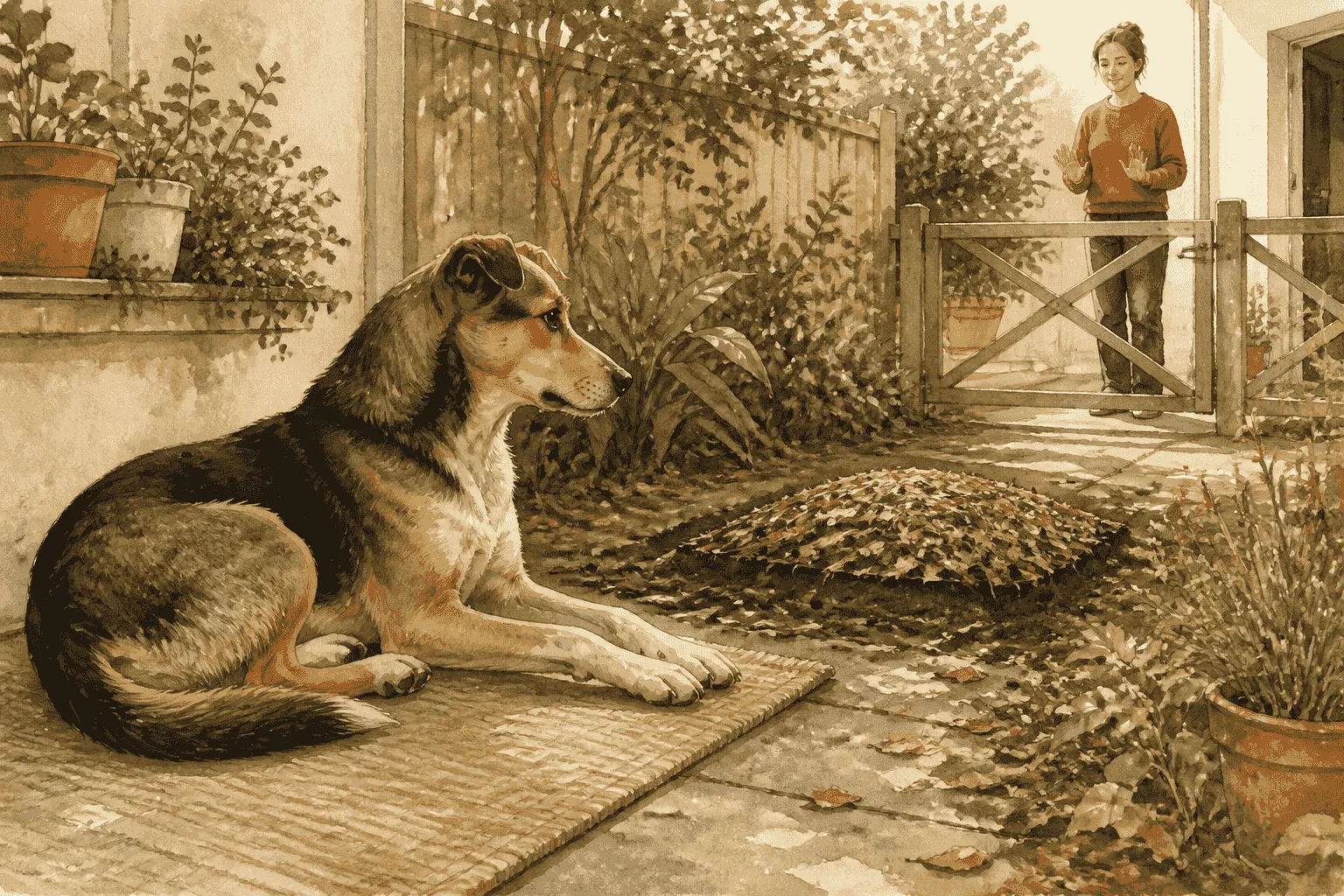
Start with a short observation rather than a home theory. Was the object food, a bone, or a toy? Did the dog settle after covering it, check the spot repeatedly, or abandon it? Was another dog, child, visitor, or busy route nearby? Did the dog stay loose and move away, or become tense when someone approached?
Read the Space Around the Buried Bone
Use four quick checks:
- The object: Is the bone intact, worn, split, or missing a piece? Treat uncertainty as a safety question, not proof the dog chose well.
- The setting: Is the stash indoors, outdoors, near a fence, or reachable by another dog?
- The response: Does the dog leave freely, or freeze, block, stare, or swallow rapidly when someone comes near?
- The change: Is this familiar, or sudden, frantic, escalating, or linked with distress or a physical change?
Observe from a distance. Do not uncover the spot to test the dog, send another dog to investigate, or make the stash a contest. A short before-and-after note is more useful than a story about what the dog “really means.”
When Burying Turns Into Resource Guarding
The buried item matters less than the response around it. Dogs Trust describes guarding as a request for distance from something the dog values, not spite or a power move. Freezing, body tension, blocking, staring, hiding the item, or rapid swallowing can warn that the space around the resource needs to get larger.
If you see that pattern, stop approaching and use a door, gate, or other barrier to keep people and dogs away. Do not pull the bone from the ground, reach under furniture, punish a growl, or practice taking it to prove a point. The immediate job is to prevent another confrontation. New guarding deserves a veterinarian conversation because pain or illness may contribute; established or risky guarding calls for qualified behavior support.
Make the Bone-Safety Decision Separately
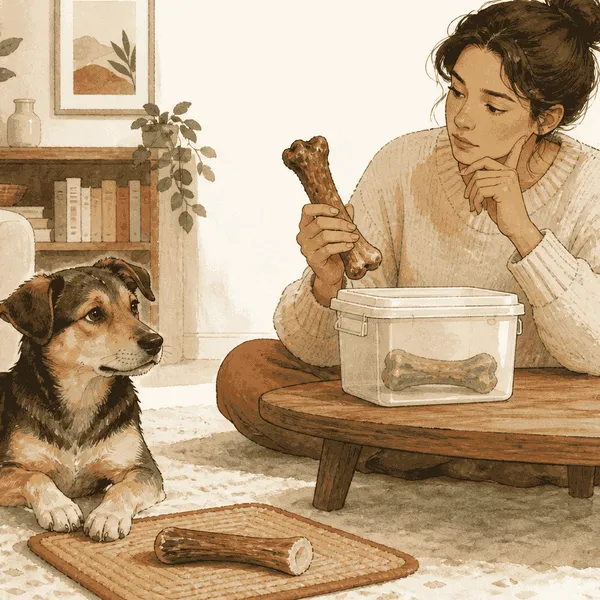
Do not let a buried bone decide whether it is suitable to chew or eat. A dog-chosen object can still split, disappear, or be swallowed. Our bone-safety guide for dogs covers that separate decision: assess the dog, the object’s condition, and available supervision rather than relying on a universal safe-bone list.
If the bone is uncertain, keep your distance and manage access instead of starting a tug-of-war. If you choose a different chew, inspect its condition and watch how the dog uses it. Avoid turning a buried object into an unplanned ingestion event.
If the Backyard Becomes Part of the Pattern
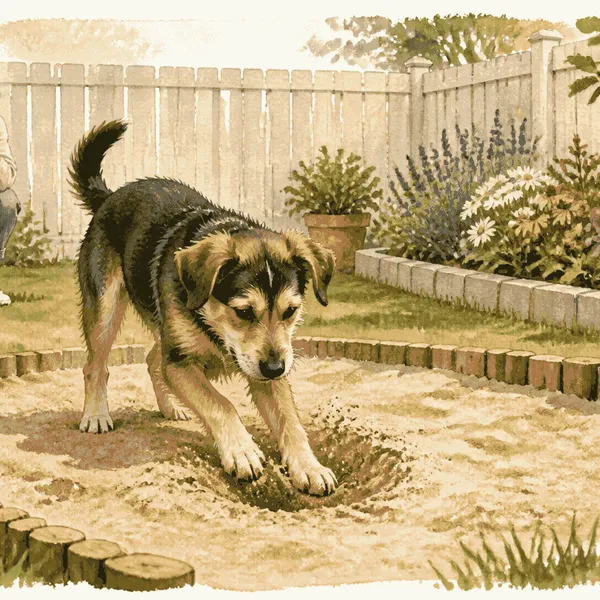
Some dogs cover valued objects outdoors and also dig. If digging is the main problem, give an interested dog one separate sand or soil area where digging earns a yes, while protecting flower beds and fences. The safer dog-digging outlet guide explains that boundary pairing in more detail.
Do not make a fence line the approved place to dig, or assume a garden hole is harmless because it contains a familiar object. Sudden or frantic digging, repeated escape attempts, or digging tied to distress changes the plan. Keep the dog safe, note the context, and ask your veterinarian or a qualified behavior professional for help when you cannot safely interrupt it.
When a Buried Bone Needs a Veterinarian
Call a veterinarian promptly if you think your dog swallowed any part of a bone. Choking is an emergency. Gagging, drooling, repeated swallowing, regurgitation, or difficulty swallowing also deserve prompt direction. A 2022 Journal of Veterinary Internal Medicine referral study described 129 dogs with endoscopically managed bone foreign bodies, but that sample does not predict that every swallowed bone is lodged or needs the same procedure.
Do not pull at a suspected object, induce vomiting, or give bread or another home fix. Report what may have been swallowed, when it happened, and what you observed. A veterinarian can decide what this dog and exposure require; an article cannot diagnose an obstruction from the garden.
Your Next Step: Record, Protect, Recheck
For the next ordinary episode, write three lines: what was buried, what was nearby, and how the dog responded when no one approached. Keep other dogs and children away, avoid testing the response, and recheck the plan before offering any bone again.
A quiet stash that the dog can leave without tension may remain manageable to observe. A new or escalating pattern, guarding warning, possible ingestion, or physical change deserves a professional call. The useful answer to “why do dogs bury bones?” is not one inherited label; it is a safer reading of the whole scene and a defensible next decision.
Sources
Petzette's claim cards for this article point to the following scientific, veterinary, or animal-welfare sources.
- Dogs Trust Resource Guarding Safety: Animal-welfare behavior guidance
- UC Davis Dog Burying Objects And Digging: Veterinary school behavior guidance
- University of California, Davis School of Veterinary Medicine. *Digging in Dogs*. Animal Health Topics. Direct source page reviewed 2026-09-01.
- Canine Resource Guarding Expert Definition Study: Peer-reviewed mixed survey and qualitative expert-consensus study
- Canine Resource Guarding Factors In Multi-Dog Contexts: Peer-reviewed cross-sectional owner survey
- Dog Bone Foreign Bodies: Referral-Series Evidence and Public-Safety Limits: Peer-reviewed retrospective canine referral-case series, supplemented by veterinary reference and government consumer-safety guidance
- Barash, A., et al. Endoscopic removal of bone foreign bodies in the upper gastrointestinal tract of dogs. Journal of Veterinary Internal Medicine. 2022. doi:10.1111/jvim.16383.
- Blue Cross Dog-Friendly Garden Dig Pit: Welfare and behavior guidance